1 Billion Becquerels Per Hour Emission of Radioactive Materials from Fukushima I Nuke Plant at the End of June
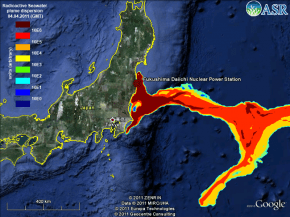 “That’s an amazing reduction from the maximum emission of 2,000 terabecquerels per hour on March 15, it is actually one-2 millionth of the maximum, says TEPCO in the Reference No. 2 of the progress report on the ‘roadmap’ to God knows where.
Is this number, 1 billion becquerels per hour emission, good? TEPCO’s Matsumoto, in the press conference on July 19, avoided the judgment, and said he didn’t know, but it was one-2 millionth of what it had been on March 15.
On closer reading of the document, though, I noticed one strange thing about this emission number. TEPCO is talking about the radiation emission measured in cesium (cesium-134 and -137), not in iodine equivalence.
To come up with the iodine-131 equivalence, you have to multiply cesium-134 by 3, and cesium-137 by 40 (according to INES handbook). TEPCO doesn’t even give the breakdown of cesium 134 and -137 in its calculation of 1 billion becquerels/hour number. Other nuclides have even higher multiplier: americium-241 is 8,000, plutonium-239 is 10,000.
If half of 1 billion becquerels is cesium-134 and the other half is cesium-137, then in iodine-131 equivalence like in the previous calculations, the emission would be:
(0.5*3)+(0.5*40)=1.5+20=21.5 billion becquerels/hour
Instead of 1 billion becquerels/hour, it would be 21.4 billion becquerels/hour in iodine equivalence, or 516 billion becquerels in one day. In less than 2 days, we would be talking about over 1 terabecquerels.” Read more.
 Israel National News
- Live updates stopping in honor of Shabbat in N. America, will resume on Saturday night from Israel
- Shabbat Shalom!
- Ontario Premier pushes for injunction to stop Al-Quds Day rally in Toronto
- Debris from Iranian missile interception falls in Lod, no injuries reported
- MDA: No known injuries from impacts, one man injured on the way to shelter
- All missiles fired from Iran in recent barrage were intercepted
- Trump: Iran war will end when I 'feel it in my bones'
- Residents of central Israel permitted to leave protected spaces
- Reports of a person suffering serious injuries during barrage on southern Israel
- Residents of southern Israel permitted to leave protected spaces
FrontPage Magazine
- Jeffrey Epstein Tried to Escape to Muslim World Before Arrest
- 2 Islamic Terrorist Attacks in 1 Day
- House ‘Sharia-Free Caucus’ Turns 50
- Iranian Muslim Immigrant DA Blames Muslim Terror Attack on Guns
- We the People Never Voted for Mass Islamic Immigration
- Did Islamic Polygamy Lead to Record $14M PPP Fraud?
- Jihad at Old Dominion University
- Ohio HS Teacher Delivers Bonkers Anti-Trump Rant in Class
- Iran’s President vs. The Revolutionary Guards
- Video: Jamie Glazov Delivers A Wake-Up Call on the Ideological War Waged Against American Values
Gatestone Institute
- 'Trump Derangement Syndrome': The Danger of Hatred Clouding Perception
- Spain's Pedro Sánchez and His Extremist Problem
- Before Pouring Billions into Gaza, Trump's 'Board of Peace' Needs To Ask A Few Hard Questions
- If Saudi Arabia Wants U.S. Alliance, It Must End Support for Sudanese Armed Forces — Aligned with Muslim Brotherhood and Iran — Not Fund It
- UN and EU Condemn the Strike, Not the Regime: Double Standards, Selective Outrage
- Why Fusion Energy Needs to Be American Born – Now More Than Ever
- To Defend the Abraham Accords, Trump Must First Defend the UAE
- A Dangerous Prelude to Trump's 'Board of Peace' in Gaza?
- Make or Break Time for Iran's Remaining Allies
- Tehran Chooses the Samson Option
Middle East – The Jerusalem Post
- Hamas urges Iran not to strike neighboring countries, backs retaliation against Israel
- Lebanese ‘Patriotic Officers’ warn army not to confront Hezbollah, fueling fears over army unity
- Shi’ite cells in Gulf states are cooperating with Iran, leaking data, coordinates to IRGC
- US strikes Kharg Island in Iran, Tehran's 'crown jewel,' Trump says in Truth statement
- Missile strikes helipad in US embassy compound in Iraq
- Iranian aircraft leaves India with sailors, bodies as Indian ships granted passage through Hormuz
- National Security Council issues warning for Israelis in UAE amid Iranian threat
- Lured by profits, some shipowners brave mines and missiles to sneak oil past Iran
- Israel declines Lebanon's offer for direct talks, sources say
- UN seeks $308 million for Lebanon as war displaces 800,000 people
Earthquakes & Volcanic Activity
- Volcanoes Today, 14 Mar 2026: Santiaguito volcano, Fuego, Semeru, Shiveluch, Ibu, Reventador, Mayon, Sangay
- World Earthquake Report for Saturday, 14 March 2026
- Reventador Volcano Volcanic Ash Advisory: OCNL TO FRQT VA EMS. to 16000 ft (4900 m)
- Fuego Volcano: sporadic emissions of volcanic ash
- Semeru Volcano Volcanic Ash Advisory: ERUPTION LAST REPORTED AT 14/0713Z EST VA DTG: 14/0720Z
- Santiaguito Volcano Volcanic Ash Advisory: DISCRET VA EM AT 0605Z. to 14000 ft (4300 m)
- Ibu Volcano Volcanic Ash Advisory: ERUPTION LAST REPORTED AT 14/0537Z EST VA DTG: 14/0630Z
- Aoba Volcano Volcanic Ash Advisory: UNKNOWN OBS VA DTG: NOT PROVIDED
- Mayon Volcano Volcanic Ash Advisory: ERUPTION AT 20260314/0318Z VA CLD UNKNOWN REPORTED OBS VA DTG: 14/0340Z
- Shiveluch Volcano Volcanic Ash Advisory: VA CONTINUOUSLY OBS IN SATELLITE IMAGERY to 29000 ft (8800 m)
Islamic Terrorist Network In America

Click For Larger Version


Click To Learn What Makes This An Idol

 MidnightWatcher - Prophecy in Motion
Recent Comments