Archive
Shot Across The Bow: Enormous Asteroid To Zip Between Earth And Moon Wednesday
We’ve been seeing a lot of close ones lately. It’s only a matter of time before one of these big ones hits …
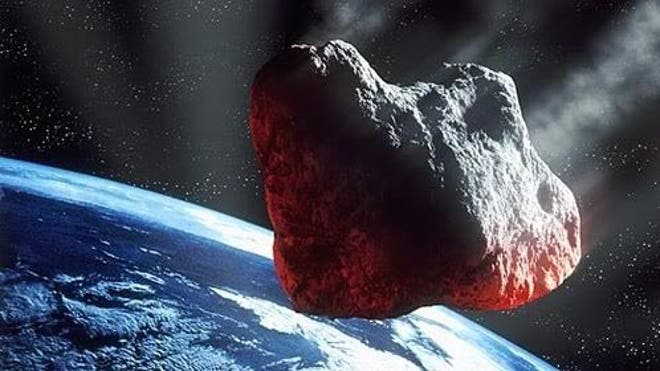 FOX News – “Talk about a close shave!
An asteroid 100 feet wide is set to squeak past the Earth early Wednesday evening, soaring fewer than 218,000 miles from our planet — slightly closer than the orbit of the moon itself.
Called asteroid 2014 DX110, the extraterrestrial visitor will stay a safe distance away from our planet, experts say. But as it barrels by at 33,000 miles per hour, the comet will present quite a spectacle. You’ll be able to watch the flyby in a live webcast directly through the website of the Slooh space telescope, as well as the VirtualTelescope.com site.
‘We continue to discover these potentially hazardous asteroids — sometimes only days before they make their close approaches to Earth,’ Slooh’s technical and research director, Paul Cox said in a statement a few weeks ago, before a very similar asteroid was discovered zipping past our planet.
‘Slooh’s asteroid research campaign is gathering momentum with Slooh members using the Slooh robotic telescopes to monitor this huge population of potentially hazardous space rocks. We need to find them before they find us!’
DX110 will make its closest pass at 5:07 p.m. EST.
The flyby of DX110 comes just over a year after two major near-Earth object (NEO) events on Feb. 15, 2013. That day, as scientists were tracking the extremely close pass of the 98-foot asteroid 2012 DA14, another, unrelated space rock unexpectedly exploded above Chelyabinsk, Russia, causing substantial damage to buildings that injured more than 1,000 people with falling glass.” Read more.
Sun Unleashes Monster Solar Flare, Biggest Of 2014

A massive X4.9 solar flare erupts from a long-lived sunspot on the sun at 00:49 GMT on Tuesday, Feb. 25 (7:49 p.m. Monday, Feb. 24 EST) in this view from one of many light wavelength observations by NASA’s Solar Dynamics Observatory.
By Miriam Kramer, Space.com – “The sun fired off a major solar flare late Monday (Feb. 24), making it the most powerful sun eruption of the year so far and one of the strongest in recent years.
The massive X4.9-class solar flare erupted from an active sunspot, called AR1990, at 7:49 p.m. EST (0049 Feb. 25 GMT). NASA’s Solar Dynamics Observatory captured high-definition video of the monster solar flare. The spaceecraft recording amazing views the solar flare erupting with a giant burst of plasma, called a coronal mass ejection, or CME.
Earth isn’t in danger from the latest eruption of space weather activity, according to officials with Spaceweather.com, which tracks space weather and stargazing events. Sunspot AR1990 (previously named AR1967) is located on the southeastern limb of the sun, pointed away from Earth. This is the third time this sunspot has rotated onto the Earth-facing side of the sun.
‘Long-lived sunspot AR1967 returned to the Earthside of the sun on Feb. 25th and promptly erupted, producing an X4.9-class solar flare,’ astronomer Tony Phillips wrote in a Spaceweather.com alert. ‘This is the strongest flare of the year so far and one of the strongest of the current solar cycle.’
Earth isn’t totally out of the woods yet, however. This region of the sun is set to rotate more fully into view of Earth over the next week, according to officials with the NOAA-led Space Weather Prediction Center.” Read more.
Amazing ‘Hand Of God’ Appears After Supernova Explosion
Psalms 19:1, “The heavens declare the glory of God; And the firmament shows His handiwork.”
Interesting pareidolia. It may only be the remnants of an exploding star, but it does almost looks like a hand that is reaching out to grasp, oh, say, a crown of thorns. It even looks like there is a “wound” in the wrist area of the hand. According to CARM, when the Romans crucified their victims, the nails “were driven through the wrists between the radial and ulna bones and not through the palms since the nail would have ripped through the palm because the palm could not withstand all the weight of the body” …

A cloud that formed after a star exploded has been nicknamed the Hand of God by NASA astronomers. The object is a pulsar wind nebula. (Photo: NASA/JPL-Caltech/McGill)
The Toronto Sun – “NASA scientists have nicknamed a cloud that developed from an exploding star the Hand of God because of its shape.
The cloud is a pulsar wind nebula and is fuelled by the leftover, dense core of a star that blew up in a supernova explosion. The particles are interacting with magnetic fields around the material, causing it to glow with X-rays.
‘The result is a cloud that…looked like an open hand,’ NASA said on its website.
‘One of the big mysteries of this object is whether the pulsar particles are interacting with the material in a specific way to make it look like a hand, or if the material is in fact shaped like a hand.’
There is a second red cloud near the ‘fingertips’ of the Hand of God cloud. Astronomers think the pulsar’s wind is heating this cloud, causing it to glow.” Source – The Toronto Sun.
Sun Unleashes Powerful X-Class Solar Flare Towards Earth, And More May Come
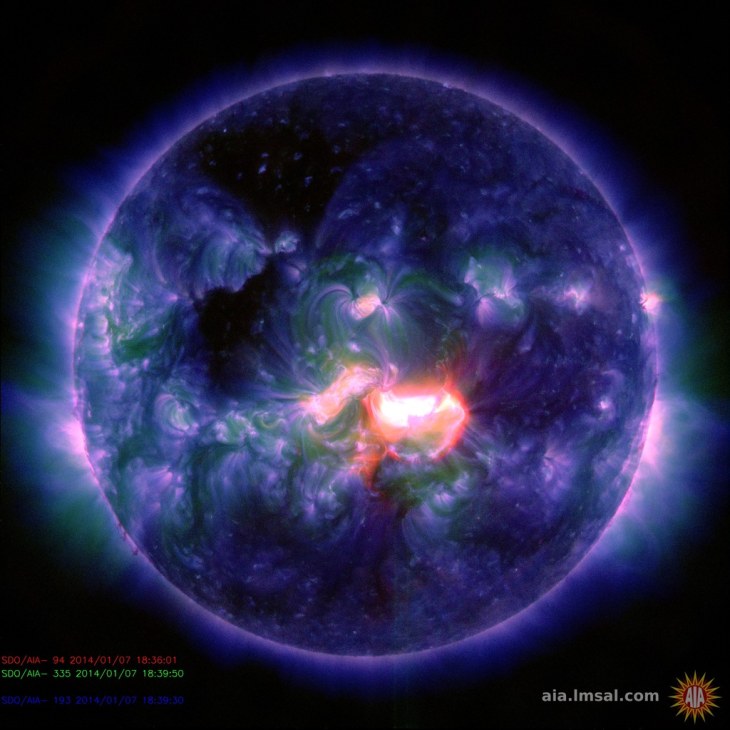 By Alan Boyle, NBC News – “The sun erupted with a powerful solar flare on Tuesday, disrupting radio traffic and sending a blast of electrically charged particles our way. And there may be more blasts to come.
The X1.2-class flare was recorded by sun-observing satellites, including NASA’s Solar Dynamics Observatory, at about 2:32 p.m. ET. X-class flares are the strongest category of solar outbursts, although X1.2 is toward the category’s low end. The National Oceanic and Atmospheric Administration’s Space Weather Prediction Center said the flare sparked a strong radio blackout.
For days, space weather forecasters have been bracing themselves for solar eruptions from a large active sunspot region called AR1944. This region has now turned to face Earth directly, which means strong solar flares are likely to send storms of charged particles — also known as coronal mass ejections, or CMEs — heading straight for us.
Strong solar storms can damage satellites and electrical grids. One such outburst in 1989 knocked out power for a wide swath of Quebec. And don’t get us started about the superstorm of 1859! …” Read more.
Huge Solar Flare Delays Private Rocket Launch to Space Station – “A huge solar unleashed by the sun has delayed plans to launch a private cargo ship to the International Space Station today (Jan. 8) due to worry over space weather radiation. The first major solar flare of 2014 erupted from a massive sunspot seven times the size of Earth on Tuesday (Jan. 7) after a series of mid-level sun storms in recent days.” Read more.
‘Whopper Of A Fireball’: Large Meteor Explodes Over Arizona, ‘It Was Absolutely Enormous’
 CNN – “A resounding boom over Tucson, Arizona, roused residents from their dinner tables Tuesday and had them pointing up to the sky.
With the largest meteor shower of the year around the corner, the heavens seemed to be giving them a sneak preview. A whopper of a fireball roared over their heads and exploded, rattling their houses.
A dash cam captured it on video as it vanished in a bright blaze.
The spectacular annual Geminid meteor shower kicks into high gear Thursday night, NASA said, and people around the world will be able to enjoy it.
Some of its meteors have already been dashing through Earth’s atmosphere. The agency recorded nine of them Tuesday night.
But the Tucson meteor did not appear to be one of them, said NASA meteor expert Bill Cooke, who analyzed the flying space rock after two NASA cameras in Arizona recorded it on video.
Traveling at 45,000 mph, it was too slow.
‘A Geminid moves at 78,000 mph,’ he said. And the direction it came from was not typical for a meteor from the big shower.
The Arizona fireball was just one of the handful of ‘sporadic background’ meteors that whiz through the atmosphere every day.
But this was a big one, Cooke confirmed. It weighed about 100 pounds and was about 16 inches thick. It made quite a bright flash, as it burned up in the atmosphere.
Even with 100 to 120 meteors per hour coming down during its peak on Friday and Saturday, the Geminid shower now has a tough act to follow.
Astronomer Tod Lauer heard the blast but did not bother to look outside.
‘We were eating dinner and heard a good bang that rattled the roof of our house. I dismissed it as a sonic boom,’ he posted to Facebook.
He realized it had to be more than that, when a local TV station phoned the scientist, who studies images from the Hubble Space Telescope, to ask him to explain what had happened.
Frantic eyewitnesses across the state called local news outlets to report what they saw.
The explosion shook Tony Kubrak’s house, too, he told CNN affiliate KGUN, which received a flood of calls and hundreds of posts to its Facebook page.
Kubrak went outside to check it out.
‘I see this tremendous, white, bright light in the western sky. And it was just … it was absolutely enormous, I couldn’t believe it.'” Read more.
Comet ISON Set To Become Brilliant Spectacle … If It Survives Today’s Close Encounter With The Sun
Update: Sun-grazing comet ISON likely broke up, scientists say …
Update 2: Scientists baffled by new picures of Comet ISON …

By Joe Rao, FOX News – “The incoming Comet ISON is now in the home stretch of its long-awaited hairpin loop around the sun on Thanksgiving Day, making it a great target for amateur astronomers and stargazers. But there are some tips and info you’ll want to keep in mind before you go comet hunting.
Comet ISON is on track for an extremely close shave of the sun when it flies by Earth’s closest star on Nov. 28. The comet will approach within a mere 730,000 miles of the sun during the encounter, leading many scientists and amateur astronomers to wonder if the comet will survive its Thanksgiving Day rendezvous with the sun.
In December, Comet ISON is expected to reach its greatest brilliance. It is during that month that it will be most interesting to both amateurs and the public. [See more amazing photos of Comet ISON in the night sky]
Although forecasting the brightness of a comet months before its arrival at perihelion has always been hazardous, in the case of ISON until recently its brightening trend has been very difficult to decipher. Up until Nov. 13, the comet’s increase in brightness was progressing at a rather sluggish pace, but then suddenly a noticeable outburst began taking place...
From Nov. 13 to 21, Comet ISON brightened by 3.5 magnitudes on the scale used to determine the brightness of objects in space. That’s a 25-fold increase in brightness to the observer! Between Nov. 19 and 21 alone, ISON more than doubled in brightness. Along with this surge in activity, soaring rates of dust and gas were being released from its nucleus.
Amateur and professional astronomers around the world have been tracking Comet ISON in telescopes, with NASA spacecraft and other observatories tracking the object from space.
In the wake of this recent activity, experienced comet watchers are growing more confident that the comet has a chance to be ranked among one of the brightest in the last half century. ‘All this I regard as very promising for something quite significant to be seen from ISON come the early days of December,’ comet expert John Bortle said. [How to Photograph Comet ISON (Step-by-Step Gallery)]
In fact, at its very brightest Comet ISON may even become briefly visible in broad daylight!” Read more.
Scientists Puzzled By Massive Gamma-Ray Burst In Space Suggesting A ‘Common Central Engine’ To ‘Contemporary’ And Distant Universe
God said “Let there be” and there was. I love science, and even though scientists sometimes love to speak as if they know it all, God always has a way of saying, “No. You don’t.” …
Psalms 19:1, “The heavens declare the glory of God; And the firmament shows His handiwork.”
Jeremiah 10:12, “It is He who made the earth by His power, Who established the world by His wisdom; And by His understanding He has stretched out the heavens.”
Recommended: Expert: Something Massive May Be ‘Tilting’ The Universe, But We Have No Idea What It Is
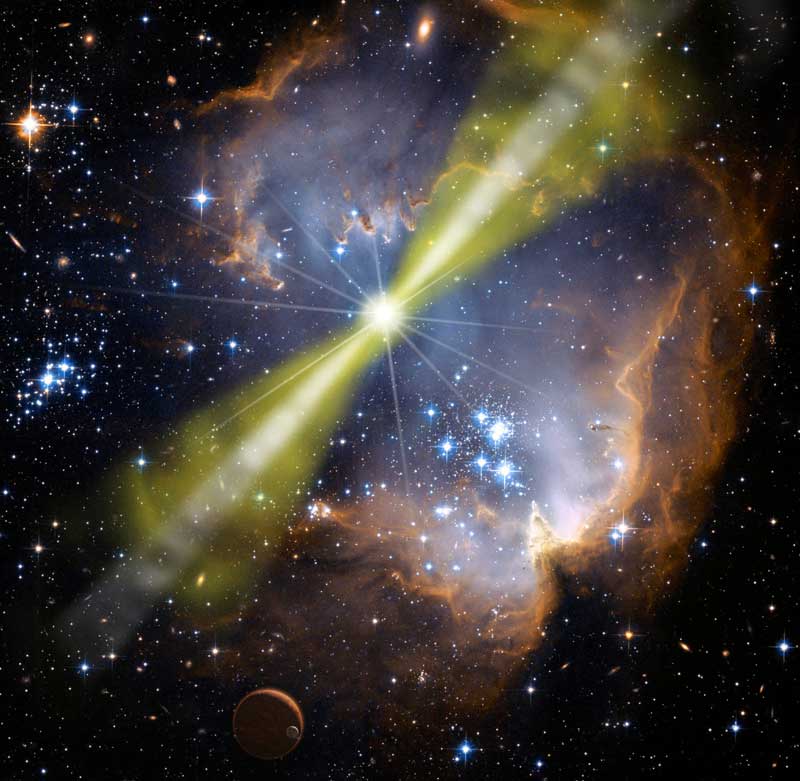 By Pete Spotts, CSM – “An exploded star some 3.8 billion light-years away is forcing scientists to overhaul much of what they thought they knew about gamma-ray bursts – intense blasts of radiation triggered, in this case, by a star tens of times more massive than the sun that exhausted its nuclear fuel, exploded, then collapsed to form a black hole.
Last April, gamma rays from the blast struck detectors in gamma-ray observatories orbiting Earth, triggering a frenzy of space- and ground-based observations. Many of them fly in the face of explanations researchers have developed during the past 30 years for the processes driving the evolution of a burst from flash to fade out, according to four research papers appearing Friday in the journal Science.
‘Some of our theories are just going down the drain,’ said Charles Dermer, an astrophysicist at the Los Alamos National Laboratory in New Mexico and a member of one of the teams reporting on their observations of the burst, known as GRB 130427A.
The event, dubbed a long-duration gamma-ray burst (GRB), is typically seen in the distant, early universe, Dr. Dermer said during a briefing Thursday. This one was much closer. And while typical long-duration bursts last from a few seconds to a few minutes, GRB 130427A put on its display for 20 hours.
The event’s duration, relatively close proximity, and the range of observatories in space and on the ground that could monitor it at a range of wavelengths has provided scientists with an unprecedented opportunity to explore the workings of one of the more extreme ends a star can inflict on itself.
The encouraging news: Traits seen in the gamma-ray emissions from initial burst through the afterglow compare favorably to the traits seen in the behavior of gamma rays in more-distant, long-duration bursts.
‘This suggests that GRBs in the contemporary universe and in the early, distant universe share a common central engine,’ Dermer said.” Read more.
Dark News: Sun’s Flipping Poles Could Mean Lights Out For America
 By F. Michael Maloof, WND – “A vulnerability test by the electric-power industry of the national electrical grid shows the system would fail during certain catastrophes – and would fail even if only some of the impacts of certain catastrophes were experienced.
That is the sobering message from a preliminary readout of the results of a vulnerability test called Grid Ex II.
It revealed that even though the test was done under circumstances that didn’t represent the full impact of what would occur in the event of a grid blackout – caused either by a cyber or electromagnetic pulse attack – the system failed.
The North American Electric Power Reliability Corporation, or NERC, led the nationwide exercise to examine just how vulnerable the nation’s electric power grid would be under a limited nationwide cyber or EMP attack.
The test, regarded by experts as presenting less of an impact than a real EMP, comes as the sun is about to ‘flip’ its own magnetic poles at the peak of its expected 11-year cycle.
The sun flips the polarity of its magnetic north and south, causing huge intergalactic geomagnetic storms which can affect the earth’s grid and communications including satellites.
The sun’s 11-year cycle started peaking a few months ago, and will continue through 2014, according to NASA scientists.
Todd Hoeksema, director of the Wilcox Solar Observatory at Stanford University, said the polarity change builds up throughout the 11-year cycle, and the sun’s magnetic field goes to zero before coming back with the opposite polarity.
It is during that time that flares sometimes are huge, and if one hit the earth directly, it could deliver a life-changing EMP blast.
‘Something big is about to happen on the sun,’ according to an August 2013 NASA statement. At the time, Hoeksema said the big event, the solar flip, was three to four months away – placing that time in a November-December 2013 time-frame.” Read more.
The Wall Street Journal: Something Strange Is Happening To The Sun
Luke 21:25, “And there will be signs in the sun, in the moon, and in the stars; and on the earth distress of nations, with perplexity, the sea and the waves roaring …”

Click for larger photo
By Robert Lee Hotz, The Wall Street Journal – “Something is up with the sun.
Scientists say that solar activity is stranger than in a century or more, with the sun producing barely half the number of sunspots as expected and its magnetic poles oddly out of sync.
The sun generates immense magnetic fields as it spins. Sunspots—often broader in diameter than Earth—mark areas of intense magnetic force that brew disruptive solar storms. These storms may abruptly lash their charged particles across millions of miles of space toward Earth, where they can short-circuit satellites, smother cellular signals or damage electrical systems.
Based on historical records, astronomers say the sun this fall ought to be nearing the explosive climax of its approximate 11-year cycle of activity—the so-called solar maximum. But this peak is ‘a total punk,’ said Jonathan Cirtain, who works at the National Aeronautics and Space Administration as project scientist for the Japanese satellite Hinode, which maps solar magnetic fields.
‘I would say it is the weakest in 200 years,’ said David Hathaway, head of the solar physics group at NASA’s Marshall Space Flight Center in Huntsville, Ala.
Researchers are puzzled. They can’t tell if the lull is temporary or the onset of a decades-long decline, which might ease global warming a bit by altering the sun’s brightness or the wavelengths of its light.
‘There is no scientist alive who has seen a solar cycle as weak as this one,’ said Andrés Munoz-Jaramillo, who studies the solar-magnetic cycle at the Harvard-Smithsonian Center for Astrophysics in Cambridge, Mass.
To complicate the riddle, the sun also is undergoing one of its oddest magnetic reversals on record.
Normally, the sun’s magnetic north and south poles change polarity every 11 years or so. During a magnetic-field reversal, the sun’s polar magnetic fields weaken, drop to zero, and then emerge again with the opposite polarity. As far as scientists know, the magnetic shift is notable only because it signals the peak of the solar maximum, said Douglas Biesecker at NASA’s Space Environment Center.
But in this cycle, the sun’s magnetic poles are out of sync, solar scientists said. The sun’s north magnetic pole reversed polarity more than a year ago, so it has the same polarity as the south pole.” Read more.
‘An International Concern’: CBS News Says This Week’s Fireball ‘Could Be The Prelude To Something Bigger’
Theoretical physicist Michio Kaku: “Sooner or later it’s inevitable a big one will hit the earth …”
Luke 21:25-26, “And there shall be signs in the sun, and in the moon, and in the stars; and upon the earth distress of nations, with perplexity; the sea and the waves roaring; Men’s hearts failing them for fear, and for looking after those things which are coming on the earth: for the powers of heaven shall be shaken.”
Scientists: More Asteroid Strikes Upon The Earth Are Coming – “When an asteroid exploded over the Russian city of Chelyabinsk in February, shattering windows for miles and injuring well over 1,000 people, experts said it was a rare event — of a magnitude that might occur only once every 100 to 200 years, on average. But now a team of scientists is suggesting that the Earth is vulnerable to many more Chelyabinsk-size space rocks than was previously thought.” Read more.
Stars Falling: Bright Lights In The Sky Reported Across Central And Southern California
 By Robert J. Lopez, Los Angeles Times – “The flashes and bright lights that were reported across Central and Southern California on Wednesday night likely were long-lasting meteor streams known as the South Taurids, according to the National Weather Service.
The Taurids are known for having exceptionally bright meteors. On Wednesday night, people used Twitter to describe what resembled a meteor shower, bright lights or fireballs in the sky.
Mary Slosson said she driving eastbound on the 10 Freeway when saw a ‘flareup’ that ‘looked like something burning up upon entry into atmosphere’ over the Culver City area.
The flash of light caused drivers to hit their brakes and swerve to catch a glimpse, Slosson said.
Another person in Hollywood said he saw what appeared to be a ‘pretty substantial fireball in the sky.’
In northern San Diego County, a woman said she saw the ‘sky light up super bright.’
And in Fresno, a woman said she ‘saw something that looked like a huge shooting star falling.'” Source – Los Angeles Times.
Scientists: Wait Till Next Week, You Haven’t Seen Anything Yet – “Scientists predicted a meteor shower that occurs every year about this time. But they also say we haven’t seen anything yet. So-called Taurid meteor showers, which seem to come from the direction of the constellation Taurus, will reach their peak this year on Nov. 16 through the early morning of Nov. 17. Observers, aided by a full moon, will see 10 to 20 large fireballs every hour.” Read more.
Scientists: More Asteroid Strikes Upon The Earth Are Coming – “When an asteroid exploded over the Russian city of Chelyabinsk in February, shattering windows for miles and injuring well over 1,000 people, experts said it was a rare event — of a magnitude that might occur only once every 100 to 200 years, on average. But now a team of scientists is suggesting that the Earth is vulnerable to many more Chelyabinsk-size space rocks than was previously thought.” Read more.
Surprise: 28 Solar Flares In The Last Seven Days, And More May Be Coming
 By Deborah Netburn, Los Angeles Times – “The sun has erupted more than two dozen times over the last week, sending radiation and solar material hurtling through space – and scientists say more eruptions may be coming.
This shouldn’t be unusual. After all, we are technically at solar maximum, the peak of the 11-year cycle of the sun’s activity. But this has been a noticeably mellow solar maximum, with the sun staying fairly quiet throughout the summer. So when our life-giving star suddenly let loose with 24 medium strength M-class solar flares and four significantly stronger X-class flares between Oct. 23 and Oct. 30, it felt like a surprise.
Many of the flares originated from sunspot AR1884, a particularly active region of the sun that is currently facing Earth, almost at the center of the star. If this region stays active, it will continue to hurl radiation and solar material our way for about another week until it rotates out of sight.
A sunspot is an area of the sun where the magnetic fields have gotten all twisted up. ‘You get a tangled bunch of magnetic fields, and they get too tangled and too stressed, they end up erupting,’ said Holly Gilbert, a solar physicist at NASA Goddard Space Flight Center.
The good news is that none of the rapid-fire solar flares of the last week have had much effect on life on Earth. Our atmosphere protects us from the sun’s occasional powerful bursts of light and radiation, but solar flares do occasionally interact with our communications systems. The radiation can mess with an upper layer in our atmosphere called the ionosphere and cause radio signals to act funky.” Read more.
Flashback: Puzzling: Solar Flare Creates Mysterious Pulse On Earth That Seemed To ‘Answer’ Sun’s Blast – “After an unusually long quiet period, the sun unleashed a solar flare on May 17 this year – but scientists are now puzzling over what happened on Earth. Neutron monitors all round the world lit up in response to the blast for the first time in six years, despite the fact it was an M-Class, or moderate, flare.” Read more.
Flashback: Signs in the Sun: Some Scientists Believe Bursts Of Solar Activity May Be Causing Natural Disasters On Earth – “Some scientists believe bursts of solar activity cause natural disasters on our planet, but until now the star has been too difficult to reach or explore in any detail. Some Russian researchers think they have the solution. Volcanic eruptions, earthquakes, tsunamis – apocalyptic pictures are becoming an ordinary part of news bulletins across the globe. And scientists are not giving out reassuring forecasts.” Read more.
 Israel National News
- Live updates stopping in honor of Seventh Day of Passover in North America
- Chag Sameach!
- Trump agrees to two-week ceasefire in Iran
- UN probe: Israeli tank killed one Lebanon peacekeeper, Hezbollah IED killed two
- NYC teen arrested for threatening to murder Jewish children in Brooklyn
- Middle East official: 'Good news coming' in US-Iran talks
- Iran-backed militia in Iraq releases kidnapped US journalist
- Pakistan PM urges Trump to extend Iran deadline by two weeks
- IDF says there may be an increase in fire toward Israel in the coming hours
- Report: Iran calls off US talks hours before Trump deadline
FrontPage Magazine
- Oh, Great, Peace in the Middle East Again
- A Tale of Two Rescues
- Why California Budgets Rise Even as Populations Drop
- Jamie Glazov on The Josh Hammer Show: United in Hate
- France: Muslim is ‘Seized by a Momentary Fit of Madness’
- Soleimani’s Niece and Grand-Niece to Be Deported
- India: Muslim Tries Twice to Open the Emergency Door Mid-Flight
- A Soldier of Allah in the U.S. Army
- War on the Cartel Front Continues
- PBS Smears All Republicans as ‘White With Fear’
Gatestone Institute
- Iran's Mohammad Bagher Ghalibaf Is No Moderate
- Trump and the End of Tehran's Illusion
- Germany's 'National Interest' and Fragile Support for Israel
- The 'New Syria': Same Old
- Same Regime, Different Face: The West's Recurring Mistake in Iran
- A War That Went Awry
- Trump Is Preventing the Nightmare of Nuclear-Armed Iran
- With Friends Like These: America and Its Fake Allies
- Islamic State Weaponising Social Media for Radicalisation: Exploding Threat in the Indo-Pacific
- Egypt's Dangerous Muslim Brotherhood Organization
Middle East – The Jerusalem Post
- Iran-backed Iraqi militias launch drone attacks near diplomatic facility, Baghdad Airport
- Iran's shattered economy means any success in war may be fleeting
- Iran shuts Strait of Hormuz in retaliation for Israeli strikes on Hezbollah - report
- A pause, not an end: What the two-week ceasefire with Iran really means - opinion
- Kurdistan Region of Iraq hopes ceasefire brings end to drone, missile attacks
- Pakistan takes on role of peacemaker, but it comes with risks - analysis
- Five things to watch amid the ceasefire with Iran
- Trump says he will work with Iran for 'very productive regime change, there will be no enrichment'
- Iran celebrates ceasefire amid critical war losses, says it 'forced America to accept its demands'
- Gulf States welcome ceasefire deal between US, Israel, and Iran, demand end to all attacks
Earthquakes & Volcanic Activity
- Volcanoes Today, 8 Apr 2026: Fuego volcano, Semeru, Shiveluch, Ibu, Dukono, Reventador, Mayon, Sangay
- Sakurajima Volcano Volcanic Ash Advisory: ERUPTED AT 20260408/1526Z FL090 EXTD NE OBS VA DTG: 08/1520Z
- Sangay Volcano Volcanic Ash Advisory: ONGOING VA EMS
- World Earthquake Report for Wednesday, 8 April 2026
- Ibu Volcano Volcanic Ash Advisory: VA TO FL070 REP FM GND AT 08/0423Z EST VA DTG: 08/1410Z to 7000 ft (2100 m)
- Sabancaya Volcano Volcanic Ash Advisory: ONLY STEAM AND GASES
- Shiveluch Volcano Volcanic Ash Advisory: POSS ERUPTION OBS AT 20260408/1320Z FL260 EXTD N OBS VA DTG: 08/1330Z to 26000 ft (7900 m)
- Reventador Volcano Volcanic Ash Advisory: PSBL VA EMS
- Semeru Volcano Volcanic Ash Advisory: VA TO FL150 REPORTED FROM GROUND AT 08/1111Z to 15000 ft (4600 m)
- Mayon Volcano Volcanic Ash Advisory: ERUPTION AT 20260408/0915Z FL100 EXTD WSW REPORTED OBS VA DTG: 08/0910Z
Islamic Terrorist Network In America

Click For Larger Version

Click To Learn What Makes This An Idol

 MidnightWatcher - Prophecy in Motion
Recent Comments