Archive
Australia: At Least 1,400 Fish Found Dead Along 8 Mile Stretch Of Swan River
 By JANE HAMMOND, The West Australian – “More than 1,400 fish have gone belly-up in the Swan River since June 1.
The fish, mostly black bream have been found in a 13km stretch of the river between Bassendean and West Swan.
Swimmers have been warned to avoid the water, not to catch or eat sluggish or dead fish found in the river and to keep pets away from the dead or dying fish.
Parts of the water have turned red and a fishy odour has also been reported associated with a deadly algal bloom.
The deaths are thought to be associated with levels of the potentially fish-killing microalgae Karlodinium veneficum in the upper Swan River.
Microalgae activity levels reported in the Trust’s weekly Microalgae Activity Report have been kept on alert since May 24.
A spokeswoman for the Swan River Trust said officers were on the river today undertaking a cleanup operation.
‘The oxygenation plants at Guildford and Caversham are continuing to be operated to maintain oxygen levels, which is critical as the algae affects the capacity of fish to extract oxygen from the water.
‘The algae is still prevalent in the area, but declining in density,’ a statement on the Trust’s website said.
Karlodinium microalga is found in most West Australian waterways and tends to increase in density between mid-summer and autumn.
‘The Karlodinium veneficum does not present a direct risk to public health but sensible precautions should be taken,’ the statement said.
The fish kill is the second major event of its type this year and follows the death of more than 4000 fish in the river in late January.” Source – The West Australian.
‘Bizarre’: Thousands Of Dead Sardines Wash Ashore In Isumi City Of Chiba Prefecture, Japan
 RocketNews24 – “Something terribly fishy is going on at the fishing port of Ohara (pronounced Oh-hara) in Isumi City of Chiba Prefecture, and it has nothing to do with espionage or political corruption. There are tons and tons of dead sardines washing up on the shore, and not only is the sight disturbing, but the huge amount of dead fish is literally smelling up the entire surrounding area.
According to the news, the dead fish started washing up around noon of June 3rd, and as of early afternoon on June 4th, the situation still remained pretty much out of control. The amount of dead sardines that has washed up is thought to total several dozen metrics tons, so you can imagine how bad the smell of rotting fish must be.
We’ve seen the pictures uploaded onto Twitter, and the port looks completely filled with fish – it almost looks like a carpet of sardines. It doesn’t seem likely that any fishing boats will be setting sail from this port soon. There are also, of course, the usual posts and comments on the internet on how this could be an omen, a sign of a coming great natural disaster.
When we inquired with a local inn, we were told that the port was scheduled to be closed from June 1st to 5th, but given the emergency, local fishermen are currently out in full force trying to resolve the situation. Already more than 2 full days into the bizarre occurrence, the smell has to be almost unbearable, but the people of Ohara still have no idea when they will be able to get rid of all the sardines. We sincerely hope they will be able to solve the problem quickly.” Source – RocketNews24.
A ‘Sudden Occurance’: Authorities Investigate Thousands Of Fish Deaths In Ohatchee, Alabama
 By Dixon Hayes, WBRC – “OHATCHEE, AL (WBRC) – Investigators are trying to find out what caused a massive fish kill below Neely Henry Dam in Ohatchee.
The fish were discovered Monday morning by an Alabama Power worker reporting to his shift at the dam. He saw a few dead fish before dawn, then in daylight saw many more.
The state Department of Conservation’s Wildlife Division joined officials with ADEM and Alabama Power Monday morning to take fish, temperature and water samples. They estimate some 13,000 fish were killed in a very short period of time either late Sunday night or early Monday morning.
Most of the fish were smaller fish like shad and drum, but some larger game fish, including crappie, catfish, and bass, also started washing up.
Dan Catchings, who works with the Wildlife Division’s Eastaboga office, says it wasn’t an oxygen problem because the fish had plenty of oxygen. He also doesn’t believe it was bacteria or parasites, because the fish would’ve died more gradually if that were the case.
‘A bacteria kill, or disease kill, will begin at low numbers and will accumulate over a period of days, the numbers will increase. But this has been a real sudden occurance,’ Catchings told Fox6 News
‘There’s apparently something toxic in the water that’s working on the fish,’ Catchings added. ‘Something affected them very quickly and very acutely.'” Read more.
China: Red Tide Kills 55 Million Abalone Off The Coast Of Fujian Province
 Xinhua – “Eight red tides have occurred this year off the coast of east China’s Fujian province, and the algal blooms have killed millions of abalone, according to local authorities.
A 278-square-km red tide covering a sea area of Pingtan county in Fujian was threatening local abalone farms, according to the Ocean and Fisheries Department of Pingtan County.
The department said that the algal bloom had suffocated 55 million abalone since Saturday, and inflicted direct economic losses of more than 220 million yuan (35 million U.S. dollars).
‘I will lose over 2 million yuan,’ said Zhuo Ronglan, a Pingtan abalone farmer.
Red tide can devastate fishery and aquaculture industries as the algae removes oxygen from the water, suffocating sea creatures.
Red tide might be caused by seawater pollution, changing water temperatures, lingering rains and over fishing, according to the department’s website.
Abalone is considered a delicacy for many and Fujian exports thousands of tonnes of it to Japan, the Republic of Korea as well as China’s Hong Kong and Taiwan each year.” Source – People’s Daily Online.
Philippines: Officials Investigate Cause Of Large Tilapia Fish Kill In Laguna de Bay
“SAN PEDRO, Laguna—The agriculture office in Calamba, Laguna province, on Friday ordered fish pen operators in their coastal area to bury the tons of dead tilapia plucked out from Laguna de Bay.
This was while they were waiting for the results of the water sampling tests by the Bureau of Fisheries and Aquatic Resources (BFAR) and the Laguna Lake Development Authority (LLDA) at the onset of a fishkill that hit parts of the lake. Results of the water test are expected to come out next week.
Calamba City agriculture officer Severino Caraan said that as of Friday, about 10 metric tons of dead tilapia were recovered from the Laguna Lake, particularly in the coastal villages of Masili and Sucol.
‘The fish pen operators said the fishkill started last week but our office only received their reports on Monday,’ Caraan said.
He said the fishkill has affected more than 20 fish pen operators, who reported losing around 60 kilos of tilapia daily in the past two weeks, equivalent to about P250,000 based on the farmgate price of P25 per kilo.
LLDA information officer Elsie Mistica said fishkills were also reported in Jala-jala, Rizal, and Pangil, Laguna, last week.
Lake officials initially suspected oxygen depletion due to sudden weather changes in which the surface water is pushed down and the bottom water surfaces.
The same had happened in Taal Lake last year killing more than 700 metric tons of milkfish.
‘However, we still have to wait for the water test results to conclude this,’ Mistica said.” Read more.
Washington State Fish Farm Kills Stock After Deadly Virus Found
 Associated Press – “BAINBRIDGE ISLAND — A deadly fish virus has been detected in Washington state waters for the first time, forcing a fish farm to kill its entire stock of Atlantic salmon.
Tests this month confirmed the presence of an influenza-like virus called infectious hematopoietic necrosis at a salmon farm off Bainbridge Island across from Seattle on Puget Sound, the Kitsap Sun reported.
The virus, or IHN virus, does not affect humans. It occurs naturally in wild sockeye salmon and can be carried by other fish, such as herring, which sometimes pass through fish net pens.
John Kerwin, fish health supervisor for the Washington Department of Fish and Wildlife, said the virus is a big concern.
‘Any first time it occurs, you don’t fully understand the impact to wild fish,’ Kerwin told the newspaper. ‘We know it can impact (farm) fish. If we move fast, we can try to minimize the amplification.’
Seattle-based American Gold Seafoods plans to remove more than a million pounds of Atlantic salmon from infected net pens in Rich Passage off the southern tip of Bainbridge Island. In April, the company noticed that fish were dying off at a fast rate. Test results this month confirmed the virus.
American Gold Seafoods, affiliated with Icicle Seafoods of Seattle, operates two hatcheries near Rochester, Wash., and has 120 pens off Bainbridge Island, Port Angeles, Cypress Island and Hope Island in Puget Sound.
‘It’s a very, very big loss for us,’ Alan Cook, Icicle’s vice president of aquaculture told the Kitsap Sun.” Read more.
Peru: Thousands Of Shellfish Found Dead Off The Coast Of Lima, Warm Water Blamed
 AFP – “Thousands of crustaceans were found dead off the coast of Lima following the mystery mass death of dolphins and pelicans, the Peruvian Navy said Friday.
The cause of death is under investigation, said Industry and Fishing Minister Gladys Triveno, warning that ‘it would be premature to give a reason for this phenomenon.’
The Navy said it presented a report on the find to the Agency of Environmental Evaluation and Control to determine the cause.
Biologist Yuri Hooker of Cayetano Heredia University said the species found on Pucusana Beach, 60 kilometers (37 miles) south of Lima, was a type of red krill about three centimeters (1.2 inches) long.
‘They live mostly along the coast of Chile up to the coast of northern Peru. What is happening is that these crustaceans are being affected by the warming of Pacific waters in the north of the country,’ he said, adding that the phenomenon occurs ‘with some frequency.’
Hooker explained that the warmer temperatures led the shrimp-like creatures that usually live far away from the coast to move in closer to land, where they died.
Nearly 900 dolphins washed up along Peru’s northern coast between February and April. A government study said the marine mammals died of natural causes, while environmental groups insist the massive toll was linked to offshore oil exploration in the area.
Peruvian officials have suggested that the dolphins, along with 5,000 dead sea birds — mostly pelicans — died due to the effects of rising temperatures in Pacific waters, including the southern migration of fish eaten by the birds.” Source – France24.
Utah: Mysterious Fish Deaths In Park City Baffles Neighbors, ‘Every Single One Of Them Are Dead’
 “PARK CITY — A couple tells police they returned home from a business trip to find over 100 fish dead, floating in their private pond.
It happened at 4 Hidden Splendor Court, located in the Thaynes Canyon neighborhood of Park City. Authorities are trying to determine if the fish had been poisoned and if the homeowners were the victims of a crime.
The pond is fed by a mountain spring and it is unclear if the water that flows into the pond is organically contaminated.
When the homeowners, Shan Ingleby and Loretta Paulus, returned from their trip at about 1 a.m. on Wednesday, they found fish either dead or thrashing about. They said the water level was slightly low, so they started filling it with a hose and the fish seemed to calm down. But by morning, they said, the bottom of the pond was covered with dead fish.
‘We have never in all of the years seen anything like this, so many dead fish here at a private property or in the wild,’ said Ingleby.
They called police and firefighters arrived as well to test the water for contamination. The couple is awaiting results.
‘I’m bothered that there could be something that’s going into our water, whether on purpose or not, that’s killing every living thing,’ said Paulus.” Read more.
North Carolina: Charlotte Investigating Scores Of Baffling Fish Deaths In Briar Creek, Water Quality Tests Normal
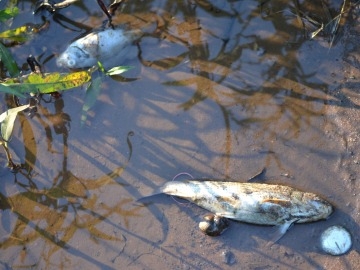 By Nick Needham, WBTV – “CHARLOTTE, NC (WBTV) – The city of Charlotte is investigating what may have killed hundreds of fish in Briar Creek.
The city discovered the dead fish in Briar Creek near Chantilly Park on Monday after several people reported it to the city’s Storm Water Services Department.
‘All of our water quality tests are normal,’ said Jennifer Frost with Storm Water Services. ‘The heavy amount of rainfall we’ve seen this week has helped clean out whatever was there.’
Frost said there are no water advisories in effect for the creek or its surrounding tributaries.
Frost said the city typically sees large amounts of dead fish when oxygen levels in the water become too low. This can occur naturally or from a chemical introduced into the water, Frost said.
The nearly 3 inches of rain that has fallen in the area since Monday has caused oxygen levels in the water to increase, making it difficult to trace what the cause of the kill was.
‘Our crews found no odor or discoloration in the water,’ Frost said.
Frost said there are no water advisories in effect for the creek or its surrounding tributaries.
The creek runs just of the park under Monroe Road and E. Independence Boulevard.” Source – WBTV.com.
Russia: Black Sea Ecologists Alarmed By Largest Mass Dolphin Die-Off To Date, ‘Death Toll Is Constantly Growing’
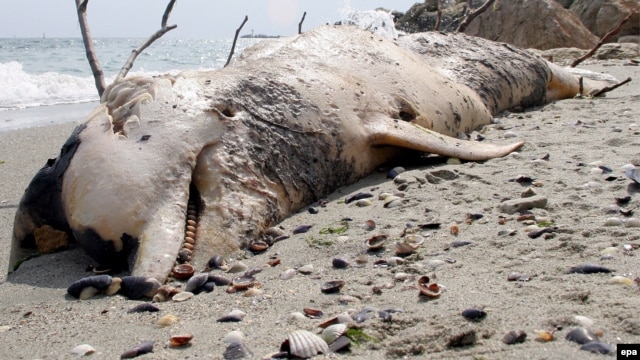 By Claire Bigg, Mariyat Shapsug – “Hardly a day goes by in Sochi, Russia’s picturesque Black Sea resort, without a dead dolphin washing up on the beach.
With the tourist season just kicking off, the unexplained deaths have yet to draw much scrutiny.
But environmentalists are increasingly alarmed. The dolphin carcasses are also turning into a real holiday spoiler for vacationers drawn to the region’s scenic beaches and pristine vistas.
Russian tourist Aida Kobzh was shocked to discover a group of dead dolphins last week at her local beach in Sochi.
‘Everyone stood there and stared at the dead little dolphins lying belly up. Poor creatures!’ Kobzh says. ‘There were some on the beach but also in the water, they were floating there, dead.’…
The dolphins started washing up along Russia’s Black Sea coast several weeks ago. They have also been spotted on Ukrainian shores.
Environmentalists are now talking about the biggest dolphin die-off to date in the region, with an estimated 300 animals dead so far.
Local authorities have made no serious attempt to investigate the deaths, saying the animals are too decayed by the time they reach the shore for laboratory tests to be conducted.
Officials have blamed poachers and fishing nets. They say the unusually cold winter has driven dolphins from the Sea of Azov to the warmer Black Sea.
Some experts, like local zoologist Konstantin Andramonov, point to a possible killer virus.
‘The death toll is constantly growing, unfortunately,’ Andramonov says. ‘We are now witnessing the same in Ukraine …'” Read more.
Georgia: More Fish Found Dead In Ogeechee River Just One Year After Largest Fish Kill In State History
 By Meredith Ley, WSAV – “STATESBORO, GA — Just one year after the largest fish kill in Georgia history, more fish have been found dead along the Ogeechee River banks–prompting a swimming and fishing advisory in Bulloch and Effingham counties.
Nearly forty thousand fish died in the Ogeechee River last year. A textiles company — King America Finishing — was found to be at least partly to blame.
Here is the breakdown:
King America was fined one million dollars for illegal dumping of several chemicals not allowed in its permit.
Those include formaldehyde and ammonia.
The dumping had been going on for five years.
Just after our story aired this Monday on news three at six a viewer called and said he had seen more dead fish at 301 landing.
The Ogeechee Riverkeeper spent most of yesterday searching the river, and found more.
Then Thursday, the DNR was out at Oliver Bridge near Statesboro collecting even more dead fish.
So far at least four species of fish, plus some crawfish, are dying. They say this raises concern because, whatever is causing it, it’s affecting many different kinds of life in the river.
DNR says there are a few things that could be causing this.
First, water levels are even lower than they were this time last year.
Combine that with warmer water temperatures and the lack of rain — and it makes the perfect breeding ground for bacteria.
The Environmental Protection Division determined that the fish last year died of Columnaris, a bacterial disease caused by environmental stressors…
Regular testing by King America Finishing and the company’s contractor shows the river meets water quality standards, and there are no areas of concern.” Read more.
‘A Very Serious Situation’: Oyster Growers Seeing Massive Die-Offs In Chesapeake Bay, Nearly 100% Mortality Rate In Areas
 Associated Press – “ANNAPOLIS, Md. — As oyster growers prepare to harvest their maturing spat in the coming weeks, things are not looking good.
An unusually rainy fall lowered salinity levels in Pasadena creeks and rivers, apparently causing massive die-offs among young oysters planted as part of the state’s efforts to reinvigorate the oyster population of the Chesapeake Bay. In some areas all the spat planted were wiped out.
‘It’s a very serious situation,’ said Chris Judy, manager of the Marylanders Grow Oysters program. ‘We don’t want to see our oysters die. In in the four-year history of the program, this is the first time we’ve had such an event, so it was very unusual.’
Spat, larva that settles and begins to develop a shell, need water with a certain salinity — typically at least four parts-per-thousand. Heavy rains in late August and September made the water too fresh for many spat to survive.
Under the program, the Department of Natural Resources in September gave participants spat and cages to hang from their piers, in which larval oysters were supposed to grow. The plan was to recover the oysters next month and place them on reefs, where they would filter local waterways.
But things didn’t go as planned.
Growers in Rock Creek experienced what appears to be a nearly 100 percent mortality rate, coordinator Chris Wallis said. All of the oysters in Stoney Creek died, said Mario Ricci, the program coordinator for that area.
In the Magothy River, growers are seeing 90 percent mortality rates or worse, volunteer coordinator Carl Treff said. Exact numbers for Bodkin Creek aren’t available yet, but cages have produced very few spat.
Mortality rates for the program typically range between 30 percent and 40 percent.” Read more.
 Israel National News
- No injuries reported in recent Hezbollah rocket barrage
- Iranian strike on energy facilities in Saudi Arabia
- Watch: New footage of IDF ground operations in Lebanon
- Sirens in south likely caused by Hezbollah launches from Lebanon
- Sirens sounding in the southern Israel
- Hezbollah fired 11 rockets at north and Sharon region, most intercepted, no injuries reported
- Anti-Israel coalitions join forces for ‘largest’ Gaza flotilla
- Sirens sounding in central Israel and Samaria due to launches from Lebanon
- Sirens sounding in the western Galilee
- Herzog: 'New immigrants' courage the answer to those who seek to undermine us'
FrontPage Magazine
- What Was Behind the Netanyahu Fake Death Rumor?
- There Were Warnings About Joe Kent
- House Sharia-Free America Caucus Keeps on Growing
- Did Bill Clinton Tell Trump He Wished He’d Bombed Iran?
- Counterterrorism Boss Joe Kent Resigns
- Canada: School Bans Kids From Eating To Not Offend Muslims During Ramadan
- Obama Presidential Center Shows Us Once Again How Socialism Really Works
- Wednesday Quick Takes
- Paul Ehrlich is Dead and Nobody is Eating Him
- Michael Finch Video: The Left’s Drive to Make a Cesspool out of America
Gatestone Institute
- Iran's 'Doomsday Clock' Against Israel No Longer Ticking But Guess Who Is Waiting in the Wings
- Why Applying the 'Venezuela Method' to Iran Would Be a Terrible Mistake
- Hamas Crimes No One Talks About
- Trump's Iran War Ending Xi Jinping's 'China Dream'
- Iran Gets a New Supreme Guide
- 'Trump Derangement Syndrome': The Danger of Hatred Clouding Perception
- Spain's Pedro Sánchez and His Extremist Problem
- Before Pouring Billions into Gaza, Trump's 'Board of Peace' Needs To Ask A Few Hard Questions
- If Saudi Arabia Wants U.S. Alliance, It Must End Support for Sudanese Armed Forces — Aligned with Muslim Brotherhood and Iran — Not Fund It
- UN and EU Condemn the Strike, Not the Regime: Double Standards, Selective Outrage
Middle East – The Jerusalem Post
- Orthodox news site Yeshiva World News hacked in apparent Iranian cyberattack
- US intelligence chief: Iran's regime intact but weakened by Operation Epic Fury
- Who are the most senior Iranian officials left alive after weeks of Israeli-US strikes? - explainer
- Iran's IRGC Navy chief threatens retaliatory strikes on oil facilities across Gulf
- Yemeni gov’t killed six protesters, wounded dozens in February demonstrations crackdown - HRW
- As Strait of Hormuz becomes key front in Iran war, how can US secure navigation? - analysis
- Iran attacks may shift Gulf states from de-escalation to backing regime defeat - analysis
- Iraq turns to Kurdistan pipeline as Iran war chokes oil exports and economy - analysis
- Who are the most senior Hamas, Hezbollah figures left alive? - explainer
- The ayatollahs’ eyes and ears: Inside Iran’s intelligence ministry - analysis
Earthquakes & Volcanic Activity
- World Earthquake Report for Wednesday, 18 March 2026
- Fuego Volcano Volcanic Ash Advisory: VA EMS LIKELY
- World Earthquake Report for March 2026
- Volcanoes Today, 18 Mar 2026: Fuego volcano, Semeru, Reventador, Mayon, Piton de la Fournaise, Sangay
- Mayon Volcano Volcanic Ash Advisory: ERUPTION AT 20260318/1404Z VA CLD UNKNOWN REPORTED OBS VA DTG: 18/1410Z
- Sangay Volcano Volcanic Ash Advisory: CONT VA EMS PSBL to 24000 ft (7300 m)
- Semeru Volcano Volcanic Ash Advisory: ERUPTION LAST REPORTED AT 18/0939Z EST VA DTG: 18/1030Z
- Fuego Volcano Volcanic Ash Advisory: ONGOING VA EM
- Mayon Volcano Volcanic Ash Advisory: ERUPTION AT 20260318/0559Z VA CLD UNKNOWN REPORTED OBS VA DTG: 18/0610Z
- Piton de la Fournaise volcano (La Réunion): lava flows continue to feed lava delta
Islamic Terrorist Network In America

Click For Larger Version


Click To Learn What Makes This An Idol

 MidnightWatcher - Prophecy in Motion
Recent Comments