Archive
Again: Thousands Of Dead Fish Wash Ashore In South Carolina’s Pawleys Island
 WMBF – “When you go to the beach you don’t expect to find hundreds of dead fish covering the shore.
Pat Hawkins was heading out to the beach Tuesday morning to enjoy the weather, but when she saw the sea of dead Menhaden fish she was in shock.
Pawleys Island isn’t the first place this week to see the dead Menhaden fish on their shores. DeBordieu Beach had the same issue the day before, according to Chief Michael Fanning of the Pawleys Island Police Department.
Events like this happen from time to time, last year an influx of Star Fish were found on the same beaches, Fanning said.
It may be confusing to the people who live nearby, but Fanning says the state is looking into what may have killed the fish.
Department of Health and Environmental Control (DHEC) and Department of Natural Resources (DNR) visited the area Tuesday and took water samples. No results were available at this time, but experts think a lack of oxygen caused the dead Menhaden to wash ashore.
The fish fell victim because they are more prone to feel the effects of the loss of oxygenated water, said Dr. Dan Hitchcock of Clemson University.
‘When it’s one species like that the species is menhaden all over the beach that’s usually indicative of a low dissolve oxygen situation because they tend to be more fragile,’ Dr. Hitchcock said.” Read more.
‘They Were Everywhere’: Hundreds Of Thousands Of Dead Fish Reported On Masonboro Island, North Carolina
 By Chris Phillips, WWAY – “State environmental officials report hundreds of thousands of dead Atlantic menhaden fish this week at Masonboro Island off of Wrightsville Beach.
If you are a coast watcher, you know the scene is always changing, but the changes at Masonboro Island were destructive.
‘I saw all these birds. More than I’ve ever seen,’ Richard Johnson said. ‘I took video of it. It was unbelievable, and when I got to shore, I understood why. There was about a million little menhaden fish in the water sunk. On the shore, they were everywhere.’
Johnson keeps close tabs on Masonboro Island. It is a passion. He is with Masonboro.org, the group dedicated to keeping the island clean.
‘Masonboro.org, we’re here because we want to keep the island open, public access, but to do that, we have to keep it clean. We’re the guys that clean the island every 4th of July. We had 50 volunteers last year. We removed 4,000 pounds of trash, so we’re out there to keep our island open,’ Johnson said.
While there has been dredging in the area, it is always hard to pinpoint the cause of a fish kill. North Carolina Coastal Reserve and Marine Fisheries are looking into the fish kill.
‘They’re studying it. They’re trying to figure it out. They’re taking samples. Maybe it’s chemical. It might come down to no one really knows,’ Johnson said.” Source – WWAY.
‘Disconcerting’: Thousands Of Humboldt Squid Wash Out Of Sea Of Cortez Near Baja Peninsula Onto California Shore
 KSBW – “SANTA CRUZ, Calif. — Thousands of Humboldt red squid washed up on shores stretching from Santa Cruz to Aptos this week.
Beachgoers said the squid first began washing up in masses on Sunday and their squishy, inky bodies captured a lot of attention at Rio Del Mar State Beach, Seacliff Beach, Hidden Beach and Main Beach. Large numbers of squid continued to show up on Tuesday as they lined the shore at Pleasure Point in Santa Cruz.
Beachgoers and marine biologists alike were perplexed while trying to figure out why so many squid would suddenly wash up on shore in Santa Cruz.
‘Twenty washed up right in front of me,’ Jim Morrison said of his squid sighting at Main Beach in Santa Cruz. ‘It was like they were committing suicide.’
‘We went down to the beach to check it out and they’re just littered everywhere,’ beach-goer Andrew Carroll said. ‘It’s kind of disconcerting.’
NOAA Biologist John Field collected some of the squid in hopes of finding an answer.” Read more.
Missouri: Scientists Baffled By Mass Deaths Of Birds In Springfield
 By Aaron Boll and Ben Knaup, KSPR News – “Springfield, MO–‘I can’t think of any explanation for what happened.’ says Judy Carmicheal who lives just about a hundred feet from where a flock of starlings died. On Saturday she came out to see the birds dead in the road on Fremont and Erie Street away from power lines and trees.
‘None were on the sidewalk. There weren’t any in the grass. They were just all right there and I just about counted everyone.’ says Carmichael. She counted about 100 birds. Garrett Lane works along the intersection and when he showed up some of the birds were still alive.
‘Most of the birds were standing right here just leaning up against the wall so when I walked up they wouldn’t fly away so that was kind of odd to me. Why aren’t the birds flying away–they just weren’t able to fly.’ says Lane. There were no dead birds on his lawn. He doesn’t know what happened to the birds that couldn’t fly.
Biologist with the Missouri Department of Conservation said in the winter starlings are usually in a flock for protection but they don’t know what happened. ‘When a bad event happens it impacts the whole flock and in this case the mystery is what was that event.’ says Francis Skalicky with the Missouri Department of Conservation.
The event couldn’t have been weather related since on Saturday morning conditions were mild and calm with a lot of sunshine. Theories are a truck could have hit the birds that were in the road. Also, something could have messed with a protective layer of oil on the bird’s feathers. ‘If something gets on the feathers, it can disperse that oil and it can cause them to get hypothermia and die.’ says Skalicky.
Other theories are the birds could have died from exhaustion while migrating. These ideas are just speculations. The experts we spoke to disagreed with each other on what could have caused the deaths.
‘If they were sick, they wouldn’t all just die right then and there.’ says Carmichael.” Read more.
Canada: ‘I’ve Never Heard Of This Many Swans Being Found Dead In One Place And At One Time’
 By Dan Dakin, St. Catharines Standard – “The Ministry of Natural Resources has been called in to investigate why 14 swans died over the weekend in Martindale Pond.
The swans were discovered by a rower near Henley Island, who called the Lincoln County Humane Society.
‘We picked up 13 dead swans Monday morning and another one was dropped off by a member of the public,’ said LCHS executive director Kevin Strooband. ‘This is very unusual for us to come across and because of that it raises flags. So we automatically investigate.’
Because of their orange and black beaks, the birds were most likely mute swans, which breed in the wild and are far more common than trumpeter or tundra swans.
Wild animals fall under the jurisdiction of the Ministry of Natural Resources, so it will be their responsibility to follow up once they reopen after being closed Monday for Remembrance Day, Strooband said.
There’s no initial indication what may have happened to the birds, but an Ontario swan expert called the deaths ‘very unusual.’
‘I’ve never heard of this many swans being found dead in one place and at one time.’ said Harry Lumsden, an Aurora man who used to work for the Ministry of Natural Resources and is now involved with the Trumpeter Swan Restoration program.
He said because the deaths are so unusual, the ministry will likely send a few of the birds to the Canadian Cooperative Wildlife Health Centre at the University of Guelph for a post-mortem examination.” Read more.
Thousands Of Birds Drop Out Of The Sky In England, ‘It Was A Harrowing Sight’
 By Alison Godfrey, Herald Sun – “EXHAUSTED and disoriented garden birds are dropping from the sky into the sea off England’s south coast.
Fishermen have reported seeing hundreds of common migratory birds plunging to the deaths in the past week.
‘While fishing about 10 miles south of Portsmouth, we witnessed thousands of garden birds disorientated, land on the sea and most drowning,’ one boat skipper told Britain’s Royal Society for the Protection of Birds (RSPB).
‘Species included goldcrests, robins, thrushes and blackbirds. The sky was thick with garden birds. I estimate I saw 500 birds die and that was just in our 300-yard sphere.
‘On the way home we just saw dead songbirds in the water: it was a harrowing sight.’
RSPB conservation director Martin Harper said the scale of the deaths was shocking and could affect the survival of the bird species.
Experts believe the birds fell victim to a combination of fog and heavy winds as they travelled across the north sea from Scandinavia.” Read more.
Ireland: Mystery Surrounds Cause Of 50,000 Dead Starfish Found Washed Ashore On Lissadell Beach
 By Pete Thomas – “It was a surreal and somewhat ghostly sight: that of perhaps 50,000 starfish that somehow had come ashore overnight, en masse, and perished on a secluded beach in Ireland. The Belfast Telegraph reports that harsh weather might have been responsible for last week’s peculiar and mysterious event, on Lissadell Beach.
Bill Crowe, a marine biologist at Sligo Institute of Technology, theorized that the starfish (also called sea stars) might have been lifted ashore while feeding on mussel beds in the nearshore tidal zone. They were spread over nearly 500 feet of coastline.
‘The most likely explanation is that they were feeding on mussels, but it is a little strange that none of them were attached to mussels when they were washed in,’ Crowe said.
A toxic algae bloom would seem another possible explanation, but no other type of marine life was affected. Only starfish, mostly adult size, were found on the beach.
Equally mysterious is that virtually all of the starfish were dead, meaning they had succumbed surprisingly quickly after coming or being delivered ashore.
Other experts agreed that the most likely explanation is stormy weather, and perhaps high surf that deposited the starfish on the beach.
‘They turned up almost certainly as a result of an exceptional storm event,’ said Tim Roderick, an officer with Ireland’s National Parks and Wildlife Service. ‘A storm hit the seabed where these sub-tidal animals were and lifted them up and washed them ashore.’
The bizarre incident, like a smaller-scale die-off that occurred earlier this year on another beach in Ireland, remains under investigation.” Read more.
Australia: Authorities Investigate ‘Millions’ Of Dead Fish Along The Shores Of Illawong Beach ‘As Far As The Eye Could See’
 CQ News – “MACKAY’S Pat McGee was heading out for a regular walk at Illawong Beach yesterday morning, when he came across a disturbing sight.
‘There were millions of these little fish, all dead, in a great strand, all along the beach,’ Mr McGee said.
‘The strand of dead fish went for miles, as far as the eye could see,’ he said.
‘I think they are whiting, but am not sure.
‘But I would like to know what might have caused this.’
However, as the tide was coming in, the fish kill had been washed away before officers from the Department of Environment and Heritage Protection were able to investigate.
‘We are investigating reports of dead fish along Illawong Beach in Mackay,’ the department’s executive director Reuben Carlos said.
‘While officers have been out to the site, the tide has washed away all of the fish, preventing any samples being taken.’
Mr Carlos said the department would continue investigation, but was ‘unable to determine the cause of the dead fish at this time’.
‘We would encourage members of the public to report any further sick or dead fish, or evidence of pollution in the area, to the department’s hotline on 1300 130 372,’ he said.” Source – CQ News.
Michigan: 11,000 Dead Deer Reported Is ‘By Far The Worst We Have Seen’ In History, And The Numbers Are Actually Much Higher
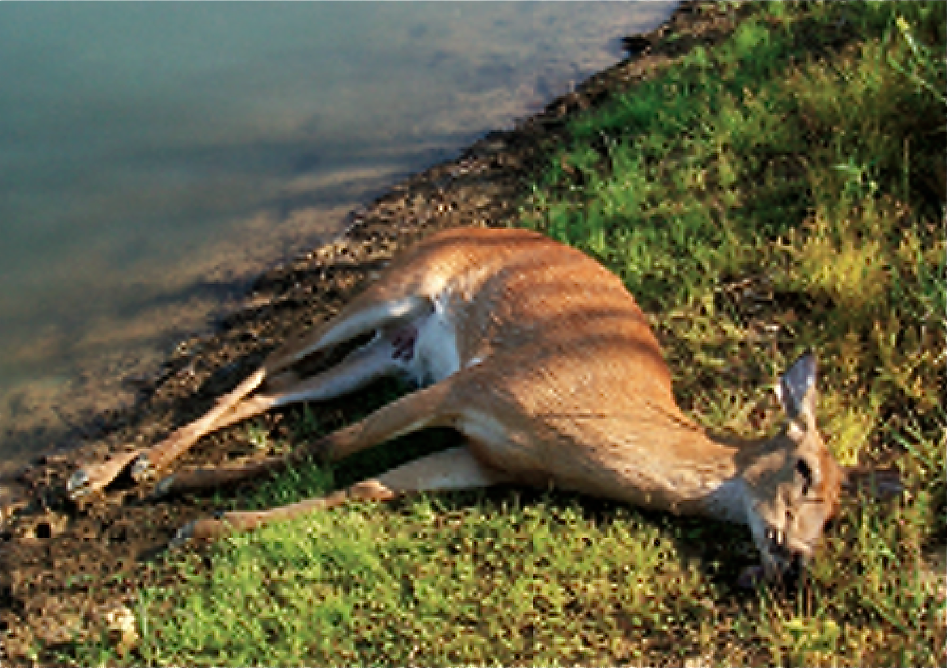 By Steve Kelso – “GRAND RAPIDS, Mich. (WOOD) – The number of Michigan deer dead of a virus continues to rise.
More than 11,000 deer that have been reported dead of epizootic hemorrhagic disease, or EHD, according to the Michigan Department of Natural Resources.
The disease causes extensive internal hemorrhages, according to the DNR. White-tailed deer usually develop symptoms seven days after exposure. Between eight and 36 hours after the start of symptoms like rapid pulse and breathing, fever and weakness, the deer lie down and die.
EHD is spread by a gnat called the midge — a species that multiplied well in this summer’s drought. It has been know to exist in Michigan for years, but this year’s outbreak is the worst in history.
‘It is way worse than any other outbreak. We have had a few that got over 1,000 or maybe over a thousand a few years back, but this is by far the worst we have seen it,’ said DNR Wildlife Biologist John Niewoonder.
The hardest-hit areas are in southwest Michigan, a DNR map shows. Ionia County has also seen a big outbreak. There have been 2,244 reported cases there. Kent County has had 1,637 reported cases.
The DNR says that the number of deer dead of EHD is actually much higher than the 11,000 or so reported, but admits that there is no telling exactly how many deer have died.
The DNR had hoped that by October, the numbers would be on the decrease because a hard freeze should kill off the midges.
Hunters should still feel free to hunt, the DNR says, and the agency will not put any limitations on deer hunting this year. But after this season concludes, the DNR will consider numbers gathered from deer check stations as they decide how many permits to issue next year.” Read more.
Iowa: Thousands Of Bass Found Dead Along Shores Of Dickinson County Lakes May Have Been Killed By Disease
 By Russ Mitchell – “Water temperatures are far warmer than usual for this time of year. Fish have had an extra long growing season and the arrival of yellow bass in the area a decade ago may have caused a population explosion in the Iowa Great Lakes.
Some, or all of those factors may be contributing to an unsettling scene along the shores of Dickinson County lakes this fall. Bass carcasses can be seen every few steps along the beach at Pikes Point State Park, which is on the northern shore of West Lake Okoboji. The die-off is affecting primarily East and West Lakes Okoboji and the lower chain of lakes.
‘It looks like a fairly significant fish kill,’ said Mike Hawkins of the Iowa DNR. ‘I wouldn’t say it’s minor. There’s thousands of fish being affected. I don’t have a real good handle on whether we’re still ongoing or if it’s finished up or curtailing. It’s kind of hard to tell, but we’re continuing to see dead fish on the shoreline.’
The fisheries biologist was first called out to the State Pier area near Arnolds Park Amusement Park on Sept. 4.
‘That’s where we could see some live fish, out away from shore — but they were acting sick,’ he said. ‘There were some dead fish on the shore.’
Hawkins then went to Brown’s Bay, on the south end of West Lake Okoboji.
‘By going down to Brown’s Bay, you’re looking at a different part of the lake,’ he said. ‘It’s pretty hard, in a lake that size, to put enough pollutant in to have an effect on fish. Seeing some dead fish down in Brown’s Bay is kind of an indicator that it is disease-related.’
Live bass samples have been sent to a wildlife service office in LaCrosse, Wis. Staff members at a fish health and disease center there will try to determine whether the bass disease is viral or bacterial.” Read more.
Indiana: Thousands Of Dead And Dying Deer Affected By Virus Statewide Will Affect Hunters For Years To Come
 By Kelly Roberts – “TIPPECANOE COUNTY, Ind. (WLFI) – This summer’s drought effects are expanding into hunting season. Thousands of the state’s deer are dying. Biologists believe the deer are infected with a virus that causes Epizootic Hemorrhagic Disease, or EHD.
‘It’s a virus, and it’s spread by a small biting insect called a midge,’ Department of Natural Resource’s District Biologist Dean Zimmerman said.
Zimmerman said EHD has been seen in deer since the 1990s, but this year’s outbreak is more extreme, and it can be blamed on the drought. Zimmerman said the dry weather is perfect for midge reproduction…
Zimmerman said a deer with EHD will have flu-like symptoms, and can act distracted. He believes dead deer found in Tippecanoe, Carroll and Cass counties had the virus…
As more dead deer are discovered, Zimmerman said it’s becoming more likely it will affect hunters for years to come.” Read more.
Flashback: Disease Kills Hundreds, Possibly Thousands Of Deer In The North Carolina Foothills, ‘They Are Decaying From The Inside Out’ – “A disease is killing deer by the hundreds in the North Carolina foothills… ‘They act sick; they stumble around; they hold their head low,’ Ray said… ‘I’ve never experienced deer smelling like these have,’ Haley said. ‘They are decaying from the inside out.’ Wildlife biologists fear the number of cases in Caldwell County may actually be much higher than 500. Those are just the reported cases — the number of deaths could be in the thousands.” Read more.
Flashback: Wyoming: Massive Black Hills Deer Die-Off Could Be Worst In Decades – “Wildlife officials knew some deer would die in the Black Hills this fall. No one expected what could be the worst die-off in decades… ‘Our deer numbers are down right now anyway, and this sure isn’t helping anything,’ said Joe Sandrini, a Wyoming Game and Fish Department biologist based in Newcastle.” Read more.
Illinois: Dead Birds Are On The Rise In Chicago, Investigators Try To Figure Out Why
 By Adam Morgan – “Residents all over Chicago have been reporting a bizarre increase in bird carcasses over the last few weeks–most of them without any visible wounds–while the City of Chicago picked up 150 dead birds in September, a 50% increase from the month before.
The phenomenon isn’t limited to a single species. Goldfinches have been found in Lakeview, a hawk in Andersonville, and a variety of other birds are dying mysteriously in the South Loop, Gold Coast, and Old Town, where one resident finds ‘about two new ones’ every day.
Residents have taken to EveryBlock.com to report and discuss their findings, and many fear that West Nile virus might be to blame, especially after the widely-publicized death of a Chicago firefighter last week who appears to have been infected with the mosquito-borne illness.
Luckily, humans can’t contract West Nile from birds. But if the virus is responsible for the increase in bird deaths, it could mean an increase in infected mosquitoes.
But researchers at Chicago Wildlife News and the Chicago Bird Collision Monitors have another possible explanation for the mysterious deaths. Autumn is migration season, so there are more birds in the air, which means more potential collisions with windows, cell towers, and glass skyscrapers.
The Chicago Department of Public Health will test the birds collected last month, which will determine how many of them–if any–were killed by West Nile.
If you spot a dead bird (or any dead animal, for that matter), call 311 as soon as possible, so that Streets and Sanitation can remove it and hand it over to the Department of Public Health for testing.” Source – Chicago Now.
Residents Finding Lots Of Dead Birds In Chicago, ‘It’s Kind Of Eerie’ – “Some Chicago residents say they’ve been noticing an unusually high number of dead birds in recent weeks. ‘It’s kind of eerie,’ said Britt Hughes, who spotted throughout September about eight to 10 small birds lying dead on the ground near her workplace in the South Loop. None of the birds had external wounds. Last week she also found a dead hawk near her home in Andersonville.” Read more.
 Israel National News
- Launches detected from Iran, sirens expected in southern Israel
- Report: Negotiations for 45-day ceasefire with Iran
- Sirens sound in the Galilee
- One lightly injured at impact site in Tel Aviv
- Missile barrage on central Israel: Reports of a woman who was severely injured in Petah Tikva
- Residents of central Israel permitted to leave shelters
- Reports of impact sites in central Israel
- Explosions heard in central Israel, MDA teams conducting searches at several sites
- Pakistan and Egypt channel US-Iran communications amid war
- Sirens in central Israel and Samaria following launches from Iran
FrontPage Magazine
- The Art That We Keep Or Destroy
- Jennifer Newsom, ‘First Partner’ of the United States?
- Cardinal Sarah Gives Us a Warning
- Texas Cities Approved Ramadan Proclamations Recognizing ‘Islamic Season’
- Anni Cyrus Video: ‘The Architecture of Jihad’
- Russia Providing Intelligence to Iran on American Bases in Middle East
- The Rapid Islamization of Britain
- The ‘Gold Standard’ in Journalism is Functionally Illiterate
- PBS Smears All Republicans as ‘White With Fear’
- Chicago Schools in Freefall
Gatestone Institute
- Same Regime, Different Face: The West's Recurring Mistake in Iran
- A War That Went Awry
- Trump Is Preventing the Nightmare of Nuclear-Armed Iran
- With Friends Like These: America and Its Fake Allies
- Islamic State Weaponising Social Media for Radicalisation: Exploding Threat in the Indo-Pacific
- Egypt's Dangerous Muslim Brotherhood Organization
- A Free World Opportunity
- Syria: Christians, Other Minorities Under Genocidal Attack During Leadership of Ahmed Al-Sharaa
- The Sham of 'Disarming' Hamas
- US Congress Confronts Bangladesh Genocide—But Ignores the Islamist Infrastructure Behind It
Middle East – The Jerusalem Post
- US, Iran discuss potential two phase deal including 45-day ceasefire - Axios
- Strait of Hormuz to remain closed until Iran is compensated for war damages, Iranian official says
- Trump initially feared radio message from downed US airman was Iranian trap - Axios
- Plan in place to strike strategic Iran sites if deal not reached, sources tell 'Post'
- Behind the US Air Force unit that spearheaded the mission to rescue downed airman
- Sources: IDF does not actually know how many ballistic missiles Iran has left
- IDF intelligence, strikes helped US rescue downed pilot, sources told the 'Post'
- RAF shoots down Iranian drones over Middle Eastern countries to protect British allies, interests
- Hamas claims disarmament request a 'way for Israel to continue genocide against Palestinians'
- IDF strike kills Head of Commerce at Iranian regime's oil headquarters
Earthquakes & Volcanic Activity
- Volcanoes Today, 6 Apr 2026: Fuego volcano, Popocatépetl, Semeru, Shiveluch, Ibu, Dukono, Reventador, Mayon
- Reventador Volcano Volcanic Ash Advisory: VA EMS RPTD IN VONA
- Popocatépetl Volcano Volcanic Ash Advisory: VA EMS OBSD to 20000 ft (6100 m)
- Semeru Volcano Volcanic Ash Advisory: VA TO FL150 OBS ON SAT IMAGE AT 06/0100Z, MOV SW to 15000 ft (4600 m)
- Fuego Volcano Volcanic Ash Advisory: VA EMS OBSD IN WEBCAM
- Dukono Volcano Volcanic Ash Advisory: VA TO FL100 OBS 06/0130Z EXT SW OBS VA DTG: 06/0130Z to 10000 ft (3000 m)
- Ibu Volcano Volcanic Ash Advisory: VA TO FL070 OBS AT 05/2230Z, MOV SW EST VA DTG: 06/0120Z to 7000 ft (2100 m)
- World Earthquake Report for Sunday, 5 April 2026
- Shiveluch Volcano Volcanic Ash Advisory: POSS ERUPTION OBS AT 20260405/2310Z FL290 EXTD N OBS VA DTG: 05/2330Z to 29000 ft (8800 m)
- Mayon Volcano Volcanic Ash Advisory: ERUPTION AT 20260405/2331Z FL100 EXTD SW REPORTED OBS VA DTG: 05/2330Z
Islamic Terrorist Network In America

Click For Larger Version


Click To Learn What Makes This An Idol

 MidnightWatcher - Prophecy in Motion
Recent Comments