Archive
Canada: Powerful Tornado Kills Man in Goderich, Ontario, ‘This Is The Worst Damage I’ve Ever Seen’
 “The most powerful tornado to hit the province in years swept through the southwestern Ontario town of Goderich Sunday afternoon, killing one person and devastating the picturesque community on the shores of Lake Huron.
Downtown businesses, century-old buildings and several churches lost their roofs and upper floors as the twister ripped through the town.
Images show downed power lines, trees and debris strewn across streets, while witnesses described cars being picked up and thrown like toys.
Police identified the victim as Norman Laberge, 61, of Lucknow, Ont., who was working in a salt mine in the town when the storm hit.
At least 37 people have been treated for minor injuries and no one has been reported missing, said Ontario Provincial Police Insp. Bill Klym.
Randy Mawson of Environment Canada said the town was battered by winds of up to 300 kilometres an hour, considered an F2- or F3-level tornado.
The province hasn’t seen a storm that powerful since 1996, he said.
‘This is the worst damage I’ve ever seen,’ said Mawson, who has been investigating storms for 36 years.” Read more.
Russia: Scientists Measure More Than 900 Seismic Tremors Over the Last 24 Hours Around the Kizimen Volcano
 By Armand Vervaeck – “This is what KVERT, Russian Kamchatka volcano scientific service, wrote on August 19 (this is the latest report we found from them):
Eruption of the volcano continues. Strong ash explosions up to 32,800 ft (10 km) ASL could occur at any time. Ongoing activity could affect international and low-flying aircraft.
Seismic activity was above background levels all week. Weak volcanic tremor continues to registering all week. According to video data, moderate fumarole activity was observing on August 14; sometimes a gas-steam plume rose up to 9,840 ft (3.0 km) ASL. The lava flows continues to moving on the eastern flank of the volcano. A big bright thermal anomaly was registering over the volcano all week at satellite images. Gas-steam plume extending about 35.4 mi (57 km) to the north-north-east from the volcano was noted on August 15, on satellite images.” Read more.
Iowa: Hailstones as Large as Baseballs Cause Extensive Damage in Southwest Iowa
 “Insurance adjusters and auto body shops in southwest Iowa are busy today after last night’s hailstorm.
Hailstones as large as baseballs shattered windshields and dimpled hoods, trunks and roofs. Jim Champion runs a body shop in Omaha/Council Bluffs and says if your vehicle’s windows were blown out and the interior got drenched, you’d better get that moisture out quickly.
‘If it’s allowed to stay inside there and the soaked carpets, it’s going to get mildew and mold and it is going to stink to high heaven,’ he says. Customers were already lined up waiting for estimates this morning when he arrived at work. In addition to the broken windows and wet upholstery, Champion says there is a possibility electronic parts that run under the floorboards could be damaged, too.” Read more.
—
Tropics About to Explode: Weather Specialist Reviews Recent Data, Says ‘Hurricane Season is About to Turn Quite Active’
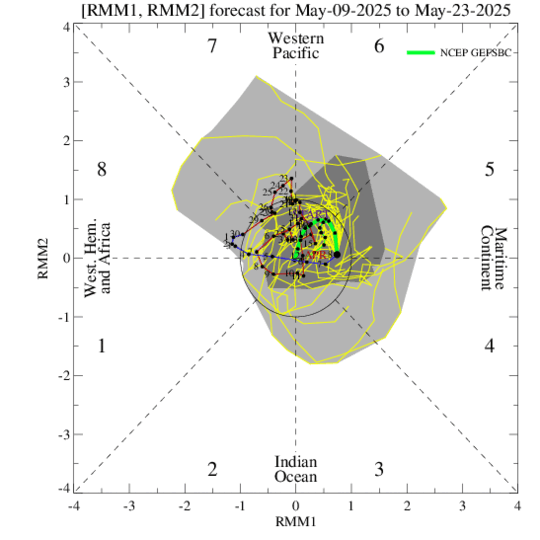
By Weather Specialist Josh Ketchen – “On many outlet sources and social media outlets on the internet some general agreement is surfacing that the Atlantic Tropical Season is about to unleash its rage. Although seven storms have formed already this season, they all have been relatively short-lived and rather weak in intensity. This; however, is about to change. As discussed in a few posts on MyWeatherTech.com, twitter, and facebook over the last two to three weeks I have been strongly suggesting this scenario. My hot spot has been the East Coast of the United States so over the next month it could be a very active and interesting time for those particular areas.
Above is an image of the Madden-Julian Oscillation Wheeler Plot forecast over the next two weeks. I know it is not that easy to read but the green and yellow line mixed with a gray spread that it depicts is right in the heart of Grid 1 and 2. This is a forecasting tool I look to forecast tropical development. When the oscillation index is in Grid 1 and 2 it signals two things to me. First, it signals a trough in the eastern United States. As you have noticed over the last week the high heat and the oppressive humidity has waned significantly. If you look at the Wheeler Plot it has been in Grids 1 and 2 for the majority of the time. Secondly, the likely enhancement of upward motion in the Tropical Atlantic also occurs in these grid areas. With the fact that we are approaching the peak of the hurricane season as we head toward late August and into September and the MJO oscillation moving right into the prime areas for development, suggestions can be made that the hurricane season is about to turn quite active.” Read more.
US: Record for Billion-Dollar Weather Disasters Tied, National Weather Service Chief Laments ‘New Reality’
 “With four months still to go in 2011, the United States has already tied its yearly record for the number of weather disasters with an economic loss of $1 billion or more, the U.S. government reported Wednesday.
With the bulk of the hurricane season ahead and winter storms after that, National Weather Service Director Jack Hayes said 2011 could surpass the record, first set in 2008.
‘I don’t think it takes a wizard to predict 2011 is likely to go down as one of the more extreme years for weather in history,’ he told journalists on a conference call.
The ‘new reality’ is that both the frequency and the cost of extreme weather are rising, making the nation more economically vulnerable and putting more lives and livelihoods at risk, Hayes said.” Read more.
US Sees Growing Losses From Extreme Weather – “The United States has already tied its yearly record for billion-dollar weather disasters and the cumulative tab from floods, tornadoes and heat waves has hit $35 billion, the National Weather Service said Wednesday. And it’s only August, with the bulk of the hurricane season still ahead. ‘I don’t think it takes a wizard to predict 2011 is likely to go down as one of the more extreme years for weather in history,’ National Weather Service Director Jack Hayes told journalists on a conference call. The agency’s parent organization, the National Oceanic and Atmospheric Administration, or NOAA, launched a campaign Wednesday to better prepare Americans for violent weather.” Read more.
Indonesia: Mount Lokon Erupts Again
 “MANADO, INDONESIA (BNO NEWS) — Indonesia’s Mount Lokon, which is located on the northern tip of the island of Sulawesi, erupted again on Wednesday, local authorities said.
Farid Ruskanda Bina, the Mount Lokon and Mahawu Kakaskaben monitoring post chief, said Mount Lokon began to spew volcanic ash at around 1.25 p.m. local time. Ash fell as far away as the Kinilow I village and the Tinoor areas in North Tomohon sub district, which is a short distance from Lokon’s crater.
Mount Lokon’s activity had been quickly increasing since Tuesday as more tremors were being detected, the Antara news agency reported. The monitoring post recorded 25 tremors from 1 to 6 a.m. local time on Wednesday.
Since June, Mount Lokon has shown constant volcanic activity, prompting authorities to raise its status to alert on June 27 and watch on July 10. A series of eruptions in mid July forced at least 5,269 locals from the villages of Kinilow, Kelurahan Kinilow I and Kakaskasen 1 to evacuate the area.
While most residents returned to their homes later that month, some 222 people remain at temporary refugee camps because their homes are in Mound Lokon’s red zone – 3 kilometers (1.86 miles) from its crater. After July’s activity, Mount Lokon’s alert level was lowered from watchful to alert, and has remained at this level since.” Read more.
California: Strange Smoke Coming from Hope Ranch Hill Near Santa Barbara
“Santa Barbara – An unsolved mystery is smoldering on a dirt hillside below Hope Ranch.
Smoke and steam are coming out of the soil, very similar to an event in October 2006.
Geologists have said a landslide five years ago may have opened up a crack in the bluff. That may have added oxygen to an underground super heated tar site.
The hot zone is being controlled with sprinklers spraying waters in all directions. A fence is also up in the area to keep inquisitive beach walkers away.
Santa Barbara County Fire officials say there is no immediate threat to the area or risk to the public.
KEY News Senior Reporter John Palminteri has the story.” Source.
Russia: Far Eastern Shiveluch Volcano on the Kamchatka Peninsula Churns Out More Ash
 “MOSCOW, Aug. 14 (UPI) — Scientists said ash continued to billow from a volcano in Russia’s Far East, which could have an effect on international air traffic in the region.
The Shiveluch volcano on the Kamchatka peninsula was pushing ash as high as 6,000 meters (20,000 feet) and creating ‘light-intensity’ tremors on the ground lasting as long as 40 minutes, the Far Eastern Institute of Volcanology and Seismology said in a written statement.
No towns in the area were considered threatened by the ash fall.
Shiveluch has been erupting periodically since 2009. The size of the mountain’s crater has grown 50 percent in that period, RIA Novosti said Sunday.” Source.
US Scientists Predict Eruption of Undersea Volcano Off the Coast of Oregon
 “Scientists from Oregon and New York have been monitoring Axial Seamount, 400 kilometres out to sea, since it last erupted in 1998, and predicted it would again before 2014.
On an expedition to the area on 29 July, researchers using a remotely operated robot discovered a lava flow that was not there the year before, and began noticing that the entire area looked unfamiliar.
‘When we first arrived on the seafloor, we thought we were in the wrong place, because it looked so completely different,’ said Bill Chadwick, an Oregon State University geologist who co-authored a 2006 study that forecast another eruption by 2014.
‘We couldn’t find our markers or monitoring instruments or other distinctive features on the bottom.’
The team was using bottom pressure sensors, the same tools used to monitor the sea floor for potential tsunamis after an earthquake. A couple of their recording instruments soon turned up, and scientists determined that the eruption happened on 6 April.
The team was excited at the discovery, but cautioned that most volcanoes remain highly volatile.” Read more.
Watch video below to see eruption of an underwater volcano near Tonga in the South Pacific:
Alaska: New Eruption Starts At Cleveland Volcano
 By Mark Dunphy – “One of Alaska’s most active volcanoes has started erupting, according to the Alaska Volcano Observatory (AVO).
The 1,730 m (5,676 ft) high Cleveland Volcano, also known as Mount Cleveland, began erupting early on Tuesday. However, the stratovolcano’s remoteness is limiting opportunities for its study, reported the AVO which is relying heavily on satellites for monitoring.
According to the AVO: ‘Without a real-time seismic network on the volcano, AVO is unable to track local earthquake activity related to volcanic unrest, provide forecasts of eruptive activity, or confirmation of explosive, ash-producing events. AVO is monitoring the volcano using satellite data as it becomes available. Such data suggests that effusive eruption of the lava dome in the summit crater is possibly continuing.’
One of the most active volcanoes in the Aleutian Arc, Cleveland has erupted at least 21 times in the last 230 years. A VEI 3 eruption in 1944 produced the arc’s only direct volcanic fatality. Most recently Mount Cleveland has erupted three times in 2009, and twice in 2010.
The volcano is primarily hazardous to aircraft; many of the flights over the north Pacific approach the vicinity of the volcano, and volcanic ash released from eruptions can damage sensitive electronic equipment and sensors.” Read more.
18 Indonesian Volcanoes on Alert Status
 “Eighteen Indonesian volcanoes are on ‘alert’ status, two of which are at Alert Level 3, which is called ‘Siaga’, the Volcanology and Geology Disaster Mitigation Center says.
Center head Surono said Sunday in Jakarta the erupting Mount Lokon in North Sulawesi and Mount Ibu in North Maluku were the two volcanoes at Siaga status.
The center has adopted four levels of alert status: ‘Normal’ (Level 1), ‘Waspada’ (Level 2), ‘Siaga’ (Level 3) and ‘Awas’ (Level 4).
Surono said the conditions at Mt Lokon and Mt Ibu were currently considered most worrisome because they had been consistently erupting searing clouds affecting a radius of 2.5 kilometers.
He added, however, that the eruptions had not yet endangered people living around the volcanoes.
‘The eruptions are heading west, while people are concentrated in east,’ he said as quoted by tempointeraktif.com.
Surono added that 16 other volcanoes were at Level 2 alert status, ‘Waspada’, including Mt. Papandayan and Mt. Guntur in West Java.
‘Locals have reported several quakes,’ he said.” Read more.
Indonesian volcano unleashes fresh burst – “A volcano that has been spewing lava and clouds of searing gas high into the air let out a new, powerful burst Monday, sending panicked villagers streaming down the sides of the mountain. One person was injured, said Ludianto, head of the search and rescue team, a man who fell as he was fleeing. The victim suffered only cuts and bruises, however, and no burns as earlier reported. Mount Karangetang on Siau — part of the Sulawesi island chain — started spitting clouds of gas and lava up to 600 meters on Friday, said volcanologist Surono.” Read more.
Russian Volcano Shows Signs Of Impending Eruption
 By MARK DUNPHY – “The Kamchatka Peninsula, along Russia’s Pacific coast, is currently the most volcanically active area in the world: four volcanoes are erupting simultaneously, and a fifth is showing signs of an impending eruption.
Ash plumes from two of these volcanoes are visible in this natural-colour satellite image.Along the northern (top) edge of the image Shiveluch emits a broad gray plume from the lava dome growing on its southern flank. 90 kilometres (60 miles) to the southwest a much smaller plume escapes from Bezymianny.
This image was acquired by the Moderate Resolution Imaging Spectroradiometer (MODIS) aboard the Aqua satellite on August 3, 2011. Bright green vegetation covers the river floodplains and mountainsides, which gives way to bare rock and eventually snow at higher elevations.” Source.
 Israel National News
- Residents of Misgav Am permitted to leave protected spaces
- Sirens in Misgav Am, northern Israel
- IDF issues evacuation warning to residents of Tyre in southern Lebanon
- Watch: Officer strikes child during protest for hilltop communities
- Iran confirms: Ali Larijani was eliminated
- Netanyahu to Iranians: 'Celebrate, we're watching from above'
- The Salalah Port Attack: Alienating Oman and dooming the Resistance Axis
- Unconditional surrender and reform
- Report: Russia giving satellite images of US forces to Iran
- Over 100 UNRWA employees under investigation for Hamas links
FrontPage Magazine
- Counterterrorism Boss Joe Kent Resigns
- Canada: School Bans Kids From Eating To Not Offend Muslims During Ramadan
- Obama Presidential Center Shows Us Once Again How Socialism Really Works
- Wednesday Quick Takes
- Paul Ehrlich is Dead and Nobody is Eating Him
- Michael Finch Video: The Left’s Drive to Make a Cesspool out of America
- Mojtaba’s Empire
- In London, A Sikh Restaurant Owner Posts ‘No Halal Meat Sold Here’ Sign
- A False Prophet in Texas
- Iranian Leader Who Threatened Trump Would Disappear Taken Out
Gatestone Institute
- Why Applying the 'Venezuela Method' to Iran Would Be a Terrible Mistake
- Hamas Crimes No One Talks About
- Trump's Iran War Ending Xi Jinping's 'China Dream'
- Iran Gets a New Supreme Guide
- 'Trump Derangement Syndrome': The Danger of Hatred Clouding Perception
- Spain's Pedro Sánchez and His Extremist Problem
- Before Pouring Billions into Gaza, Trump's 'Board of Peace' Needs To Ask A Few Hard Questions
- If Saudi Arabia Wants U.S. Alliance, It Must End Support for Sudanese Armed Forces — Aligned with Muslim Brotherhood and Iran — Not Fund It
- UN and EU Condemn the Strike, Not the Regime: Double Standards, Selective Outrage
- Why Fusion Energy Needs to Be American Born – Now More Than Ever
Middle East – The Jerusalem Post
- Two people killed, several wounded following latest Iranian missile barrage
- WATCH: IDF launches new round of strikes on Hezbollah, issues evacuation for southern Lebanon
- Reports of large US invasion to get Iran 60% nuke uranium likely overblown - exclusive
- Trump's operation in Strait of Hormuz could extend war with Iran by months, sources tell Post
- US encourages Syrian action against Hezbollah, Damascus is hesitant, sources say
- US intelligence says Iranian regime change unlikely, IRGC maintains power - report
- Despite pushing uprising, Israeli officials believe Iranian protesters will be slaughtered - report
- Turkey's Ambassador to Syria, Nuh Yilmaz, presents credentials to President Sharaa in Damascus
- Trump says US will leave Iran operation in 'very near future'
- Pressure building on Houthis to act as group stays on sidelines amid Iran war, expert tells 'Post'
Earthquakes & Volcanic Activity
- World Earthquake Report for Tuesday, 17 March 2026
- Volcanoes Today, 17 Mar 2026: Mayon volcano
- Mayon Volcano Volcanic Ash Advisory: ERUPTION AT 20260317/2059Z VA CLD UNKNOWN REPORTED OBS VA DTG: 17/2050Z
- Volcanic activity worldwide 17 Mar 2026: Fuego volcano, Shiveluch, Ibu, Reventador, Mayon, Piton de ...
- Fuego Volcano Volcanic Ash Advisory: OCNL VA EMS
- World Earthquake Report for March 2026
- Shiveluch Volcano Volcanic Ash Advisory: RESIDUAL VA to 32000 ft (9800 m)
- Reventador Volcano Volcanic Ash Advisory: PSBL VA EMS
- Sangay Volcano Volcanic Ash Advisory: NEW RPRT OF VA AT FL220 to 22000 ft (6700 m)
- Ibu Volcano Volcanic Ash Advisory: VA TO FL070 LAST REP AT 17/1104Z EST VA DTG: 17/1130Z to 7000 ft (2100 m)
Islamic Terrorist Network In America

Click For Larger Version


Click To Learn What Makes This An Idol

 MidnightWatcher - Prophecy in Motion
Recent Comments