Archive
Alaska: Cleveland Volcano Lava Dome Rises, Volcanologists Elevate Alert Level
 “A lava dome atop the massive Cleveland Volcano in Alaska’s Aleutian Islands has gotten larger in the past week, and officials keeping an eye on the restive mountain have raised eruption threat levels.
The lava dome, a viscous mass of lava belched up from inside the mountain but too thick to flow down its sides, widened by 33 feet (10 meters) over five days, to 164 feet across (50 m).
On the fifth day, Aug. 2, the Alaska Volcano Observatory raised the volcano alert level to “watch” and aviation color code to orange, the second-highest levels in each four-level scale.
‘The presence of the lava dome increases the possibility of an explosive eruption but does not necessarily indicate that one will occur,’ the latest report from the AVO stated.
The agency added that it does not anticipate any threat to air traffic from ash plumes or other airborne debris should Cleveland erupt. ‘Lava flows onto the flanks of the volcano may develop but would not be hazardous to aviation,’ the report said.
The 5,676-foot-tall (1,730 m) volcano, on the uninhabited island of Chuginadak, has erupted more than 20 times since 1828. The last eruption occurred over the course of a week in late July.
The mountain is part of the infamous Ring of Fire, a string of volcanoes strewn around the perimeter of the Pacific Ocean that produces some of the world’s most dramatic and dangerous eruptions.
The Cleveland Volcano could put on quite a show in coming days.” Read more.
Satellite Image Shows Ash Plume Drifting From Krakatoa
 By Mark Dunphy – “A newly released NASA satellite image shows an ash plume drifting from a volcano that produced one of the largest eruptions in modern history.
Anak Krakatau (also known as Krakatoa), a volcanic island in the Sunda Strait between the islands of Java and Sumatra in Indonesia, has been intermittently active for the past several decades.
The island exploded in 1883, killing approximately 40,000 people, although some estimates put the death toll much higher. The explosion is considered to be the loudest sound ever heard in modern history, with reports of it being heard nearly 3,000 miles (4,800 km) from its point of origin. The shock wave from the explosion was recorded on barographs around the globe.
On July 31, 2011, a wispy ash plume rose above the volcano and drifted west… The natural-colour satellite image was acquired by the Advanced Land Imager (ALI) aboard Earth Observing-1 (EO-1). Dark gray areas of Anak Krakatau are composed principally of lava flows deposited in the 1970s, ’80s, and ’90s. These flows are topped by a young cinder cone near the center of the island. Green vegetation covers older lavas along the eastern coastline.” Read more.
Italy: Mount Etna Wakes Up Again with One of the Most Intense Eruptions of the Year
 “Mount Etna on Sicily, Italy’s one of the most famous volcanoes, started erupting once again this weekend. Flames and sparks have been shooting into the air, reaching a height of about 250 meters, according to witnesses.
Whenever Etna comes alive, local authorities always fear that the ash clouds and heavy smoke could cut off the island from the continent by block flights out of Catania airport. However, strong winds helped this time. The ash has been blown away towards the Ionian Sea, with no flights cancelled or delayed.
Mount Etna, which remained inactive for six months, started erupting on Saturday morning and continued through Saturday and Sunday. With the latest activity, the grand total of Etna eruptions for this year stands at eight, which makes the year 2011 quite an active year for the Sicilian volcano.
Etna’s eighth paroxysmal eruptive episode of the year 2011 lasted less than one day, with a phase of lava fountaining activity lasting about 2-3 hours.
This was the most intense eruption since the first one in the night of 12-13 January this year. Unlike the earlier eruptions, except for the first one, the lava flow emitted during the 30 July paroxysm was longer. It immediately reached the sloping terrain to the north and northeast of Monte Centenari.” Read more.
Volcano in Canary Islands May Be Getting Ready for Eruption
 By Tammy Lee Morris – “The Hierro — or El Hierro — volcano located in the Canary Islands may be getting ready for eruption, according to information on the website Earthquake-report.com. An earthquake swarm that has numbered 700 or more small quakes under the volcano has occurred recently, raising concern that the volcano may be working up to an eruption.
What is an earthquake swarm? It is a series of small magnitude earthquakes that strike in the same location over a (usually) short time period. Earthquake swarms are common precursors and warnings to volcanic activity.
The Canary Islands are located off the northwestern coast of Africa, near the border between Morocco and Western Sahara. They are a chain of islands known as an archipelago and are legally a nationality of Spain. There are 13 islands in the archipelago and the Canaries are a popular tourist destination…
It is uncertain when El Hierro last erupted, but it is believed there may have been an eruption in 1793. The location of the current earthquake swarm is at the northwest part of the island near the El Golfo cone, which, according to Volcano Live, was the site of a landslide that was responsible for a tsunami 50,000 years ago that measured just over 300 feet in height.” Read more.
720 Earthquakes Recorded On El Hierro In The Canary Islands – “An unprecedented 720 earthquakes have been recorded on El Hierro, the smallest of the Canary Islands, during the past week. The earthquake swarm has even prompted the Canary Islands Government to convene the first ever meeting of the Steering Committee and Volcanic Monitoring, reflected in the Specific Plan Protection Civil and Emergency for Volcanic Risk, given what it described ‘the significant increase in seismic activity’.” Read more.
New York: ‘Horrifying’ Spiked Hail the Size of Baseballs Shatters Windows, Rattles Nerves In Queens Neighborhoods
 “NEW YORK (CBSNewYork) — The weather on Monday afternoon was unlike anything seen so far during this summer of severe weather.
Parts of the Tri-State area were pounded from the sky — with wind, lightning and ice.
Residents in Little Neck, Queens picked up the hail and put them in their freezers just to have evidence.
‘I’ve never seen anything, it was horrifying,’ Gail Kolidas told CBS 2′s Lou Young.
As intense as the damage was, it was also concentrated along the Queens-Nassau line.
The hail stones shattered car windows, punctured plastic lawn furniture and vinyl siding. It also did a good job of rattling nerves.
‘Unbelievable,’ remarked Sherly Mesten.
Hours after the storm ended, the hail was still melting where it pooled down into the lawn.
‘It looks like eggs,’ said Young Kim, ‘I see this, this is ice. Unbelievable.'” Read more.
Texas Lake ‘Full of Dead Fish’ as Water Turns Blood-Red
 By Stephanie Pappas – “A Texas lake that turned blood-red this summer may not be a sign of the End Times, but probably is the end of a popular fishing and recreation spot.
A drought has left the OC Fisher Reservoir in San Angelo State Park in West Texas almost entirely dry. The water that is left is stagnant, full of dead fish — and a deep, opaque red.
The color has some apocalypse believers suggesting that OC Fisher is an early sign of the end of the world, but Texas Parks and Wildlife Inland Fisheries officials say the bloody look is the result of Chromatiaceae bacteria, which thrive in oxygen-deprived water.
‘It’s just heartbreaking,’ said Charles Cruz, a fish and wildlife technician with Texas Parks and Wildlife in San Angelo, Tex.
Texas is experiencing major drought this summer, with 75 percent of the state’s area in an ‘exceptional’ drought, the highest level, according to the National Drought Mitigation Center (NDMC). The state had hoped for some relief from Tropical Storm Don last week, but the system fizzled and brought only an inch or two of rain to areas near the coast.
The drought has taken its toll on a number of reservoirs in West Texas, Cruz told LiveScience. OC Fisher has never been completely full, Cruz said, but it was stocked with catfish, bass, sunfish and other popular targets for fishermen.
‘We surveyed the lake, I believe it was last year, and we had a pretty good fish population out there,’ Cruz said. ‘It was pretty sickening going out there, watching lake levels just drop and drop and drop and seeing these nice trophy-sized bass just floating dead.'” Read more.
Signs in the Sun: Some Scientists Believe Bursts of Solar Activity May Be Causing Natural Disasters on Earth
 “Some scientists believe bursts of solar activity cause natural disasters on our planet, but until now the star has been too difficult to reach or explore in any detail. Some Russian researchers think they have the solution.
Volcanic eruptions, earthquakes, tsunamis – apocalyptic pictures are becoming an ordinary part of news bulletins across the globe. And scientists are not giving out reassuring forecasts.
‘Unfortunately, we’re expecting more severe cataclysms which may lead to large-scale human losses and destruction,’ says Baku-based Professor Elchin Kakhalilov of the Global Network for the Forecasting of Earthquakes. ‘I’m talking about even a possible shift of the centers of our entire civilization.’
The change in the Earth’s seismic activity coincides with the rise of activity on the sun. Scientists have been witnessing gigantic bursts of plasma on its surface and say they are affecting our planet, even though it is over 90 million miles away.
Each burst sends billions of particles into space which impacts the Earth’s magnetic field. This may trigger some of the processes going on deep bellow its surface, leading to earthquakes and volcanic eruptions.” Read more.
South Korea: Landslide Leaves 32 Dead, Dozens Injured
 By Jiyeon Lee – “Seoul (CNN) — A landslide near the South Korean town of Chuncheon killed 32 people and injured 24 others, authorities said Wednesday.
More than 750 rescue workers had been dispatched to the site after the collapse occurred at midnight, according to the Central Disaster Relief Center.
About 400 families have lost their homes and more than 14,000 were left without power.
The hillside gave way during a summer of record-setting rainfall, which has caused flooding and major traffic disruptions across portions of the country.
Chuncheon is about 75 kilometers (45 miles) northeast of the capital, Seoul, which has seen more than 400 millimeters (15 inches) of rain since Tuesday.” Read more.
New Zealand: Birds Feared Killed in Tens of Thousands, ‘We’ve Never Had Anything Like This Before’
By Laurel Stowell- “The number of prions that perished on the west coast of the North Island in last week’s stormy weather could be in the tens of thousands.
Though the species was not endangered, the birds might have ‘taken quite a good hit’, said Manawatu/Wanganui Bird Rescue co-ordinator Dawne Morton.
She was kept busy with the birds from Tuesday to Friday last week. They were picked up dead and alive along the length of the coast, from Wellington to North Cape.
More than 600 birds were being nursed back to health at Massey University, others by the Conservation Department in New Plymouth and Wellington Zoo.
At Massey the birds were put in warm water ponds, fed and re-waterproofed. Badly hurt birds were euthanised.
The prions’ small size put them at particular risk.
‘These guys lose 20g and they’ve had it,’ Ms Morton said.” Read more.
Ecuador: Reventador Volcano Showing Signs of Increased Activity, Government Officials Ask No One to Approach
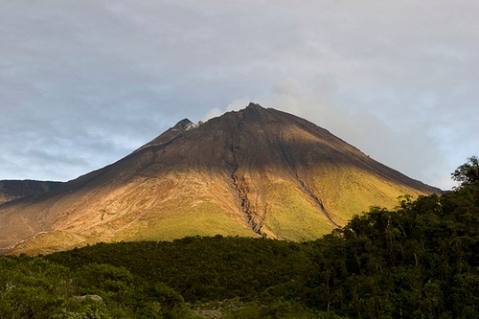 “The Reventador Volcano has shown increased activity and government officials ask no one to approach. Revenatador is located 90 km west of Quito and has a long history of activity. In November 2002 the volcano erupted for the first time in 26 years destroying roads between Quito and Lago Agrio. The 17 km high ash cloud affected 2 million people as it spread over the provinces of Pichincha, Napo and Suscumbios and forced the closure of the Quito Airport causing flights to be rerouted to Guayaquil or Latacunga. A subsequent eruption in November of 2008 effected residents of El Chaco in the Amazon basin.
The Geophysical Institute of Ecuador stated ‘it is clear that the volcano appears significantly more active than in previous months, this being much more noticeable in recent days’ Rash on the volcano Reventador occurs ‘significantly active than in previous months’ and ‘in these circumstances the presence of people near the crater of Reventador is dangerous and in no way recommended to climb to the summit.'” Source.
Remote Alaskan Volcano Poised to Erupt… Directly Under A Major U.S. Flight Path
 “Airlines have been told to prepare for travel chaos after scientists said an Alaskan volcano under a major U.S. flight route could erupt at any time.
Satellite images of the remote volcano on the island of Chuhinadak show that it could be poised for its first big eruption in ten years, according to experts.
The Alaska Volcano Observatory raised the alert level for the volcano and said it could erupt at any moment, spewing ash clouds up to 20,000 feet above sea level with little further warning.
The advisory was issued after ‘thermal anomalies’ were detected by satellite.
The 5,676 foot-tall (1,730 meters) Cleveland Volcano is located on the uninhabited island of Chuginadak in the Aleutian chain about 940 miles (1,500 km) southwest of Anchorage.
It is under the flight path between North America and Asia used by major airlines.” Read more.
Alaska: Alert Level Raised for Volcano in Aleutian Islands After Authorities Spot ‘Persistent Thermal Anomalies’
 ANCHORAGE, Alaska — The alert level for an Alaska volcano is being raised after officials say persistent thermal anomalies have been spotted in satellite data.
The Alaska Volcano Observatory on Wednesday raised the level Cleveland Volcano to advisory from unassigned.
There is no real-time seismic network at the volcano, located 939 miles southwest of Anchorage on an uninhabited island. Officials are not able to track local earthquake activity related to volcanic unrest.
Short-lived explosions with ash clouds or plumes exceeding 20,000 feet above sea level are frequent on Cleveland. It last showed signs of unrest last summer, with a small ash emission and lava flows on its upper flanks.” Read more.
July 16: Magnitude 6.1 earthquake shakes Alaska’s Aleutian Islands – “A 6.1 magnitude earthquake has struck Alaska’s Aleutian Islands, but no tsunami warning was issued. According to the U.S. Geological Survey, the quake on Saturday was centered 604 miles southwest of Anchorage on the eastern part of the Aleutian Islands. It had a depth of 43 kilometers.” Read more.
 Israel National News
- Chuck Norris hospitalized
- Iranian media reports: IRGC spokesperson eliminated
- Indictment: Reservist in Iron Dome system worked for Iranian agents
- New poll shows: Left-wing union won't help
- Sirens sound in Iftach, on Israel-Lebanon border
- Fragmentation missile fired towards central Israel, no injuries reported
- Siren sounding in the Jerusalem area
- Sirens sounding in central and southern Israel
- Missile launches detected towards Dead Sea area
- Missile alert detected towards Jerusalem, Judea and Samaria, and central and southern Israel
FrontPage Magazine
- Joe Kent and the Company He Keeps
- The Child Rapes of Cesar Chavez
- Inside the Manosphere
- Larijani’s Last Words
- First Muslim Judge Uses $100M Muslim Fraud to Stage DOJ Coup
- Jamie Glazov on Stakelbeck Tonight: Trump – The Last Line of Defense for Western Civilization
- Heartwarming Musical: Making Islam and Sharia Easy to Understand for Everyone of all Ages
- Prager U Video: FBI Warns of an Iranian Attack On U.S. Soil
- Democrats Side With the Mullahs
- Javier Bardem at the Oscars
Gatestone Institute
- US Direct Talks with Hamas: Legitimizing and Empowering Terrorists
- Why Iran Was Always a Threat to the US
- Iran Picked a Fight with the Wrong President
- Iran's 'Doomsday Clock' Against Israel No Longer Ticking But Guess Who Is Waiting in the Wings
- Why Applying the 'Venezuela Method' to Iran Would Be a Terrible Mistake
- Hamas Crimes No One Talks About
- Trump's Iran War Ending Xi Jinping's 'China Dream'
- Iran Gets a New Supreme Guide
- 'Trump Derangement Syndrome': The Danger of Hatred Clouding Perception
- Spain's Pedro Sánchez and His Extremist Problem
Middle East – The Jerusalem Post
- Six countries designate IRGC terrorist organization following discussions with Sa'ar
- Israel strikes across Iran, kills IRGC spox., damages at least 130 infrastructure sites
- Iran expels star striker Azmoun over 'disloyalty,' likely out of World Cup
- Ex-Home Front Command chief of staff: Civilians face shelter-or-slaughter dilemma amid threats
- European Union calls for moratorium on military strikes in Middle East on energy, water facilities
- UAE dismantles terror network tied to Hezbollah, Iran amid Gulf tensions, arrests suspects
- Iran's Princess Noor Pahlavi to ‘Post’: ‘Iranians have chance to reclaim their country’ - interview
- How the air force broke down Iran's air defenses: Operation Roaring Lion vs. Operation Rising Lion
- US F-35 hit, forced to make emergency landing, IRGC takes credit
- War could leave Iran with a more radical, nuclear-ambitious regime, IDF sources say
Earthquakes & Volcanic Activity
- Volcanoes Today, 20 Mar 2026: Fuego volcano, Popocatépetl, Merapi, Semeru, Shiveluch, Ibu, Dukono, Marapi
- Sangay Volcano Volcanic Ash Advisory: ONGOING VA EMS to 21000 ft (6400 m)
- World Earthquake Report for Friday, 20 March 2026
- Ibu Volcano Volcanic Ash Advisory: ERUPTION LAST REPORTED AT 20/0048Z EST VA DTG: 20/0530Z
- Shiveluch Volcano Volcanic Ash Advisory: VA STILL VISIBLE IN SATELLITE IMAGERY to 36000 ft (11000 m)
- Dukono Volcano (Indonesia) activity update Mar 19, 2026 - Continuing eruption
- Fuego Volcano (Guatemala) activity update Mar 19, 2026 - Continuing eruption
- Ibu Volcano (Indonesia) activity update Mar 19, 2026 - Continuing eruption
- Kanlaon Volcano (Philippines) activity update Mar 19, 2026 - Continuing eruption
- Lewotobi Volcano (Indonesia) activity update Mar 19, 2026 - Continuing eruption
Islamic Terrorist Network In America

Click For Larger Version


Click To Learn What Makes This An Idol

 MidnightWatcher - Prophecy in Motion
Recent Comments