Archive
The New Normal: Western North America Faces 21st Century ‘Mega-drought’
 ENS – “The climate’s ‘new normal’ for most of the coming century will parallel the long-term drought that hit western North America from 2000 to 2004 – the most severe drought in 800 years – scientists report in a study published Sunday.
‘The severity and incidence of climatic extremes, including drought, have increased as a result of climate warming,’ the researchers said, adding that these long-term trends are consistent with a 21st century ‘megadrought.’
Crops and forests died and river basins dried, but as bad as conditions were during the 2000-04 drought, in the future they may be seen as the good old days, a group of 10 researchers warned Sunday in the journal ‘Nature Geoscience.’
Climate models and precipitation projections indicate this period will be closer to the ‘wet end’ of a drier hydroclimate during the last half of the 21st century, the scientists said.
‘Climatic extremes such as this will cause more large-scale droughts and forest mortality, and the ability of vegetation to sequester carbon is going to decline,’ said Beverly Law, a co-author of the study, professor of global change biology and terrestrial systems science at Oregon State University, and former science director of AmeriFlux, an ecosystem observation network.
The 2000-04 drought had the effect of amplifying climate change as vegetation withered and could no longer take up the greenhouse gas carbon dioxide from the atmosphere.
This drought cut carbon sequestration by an average of 51 percent in the western United States, Canada and Mexico, the scientists calculate, although some areas were hit much harder than others. As the plants died, they released more carbon dioxide into the atmosphere, with the effect of amplifying global warming.
‘During this drought, carbon sequestration from this region was reduced by half,’ Law said. ‘That’s a huge drop. And if global carbon emissions don’t come down, the future will be even worse.'” Read more.
‘Unprecedented’: In Mere Days US ‘Extreme Drought’ Zones Triple In Size
 By Andrew Gully, AFP – “The drought in America’s breadbasket is intensifying at an unprecedented rate, experts warned, driving concern food prices could soar if crops in the world’s key producer are decimated.
The US Drought Monitor reported a nearly threefold increase in areas of extreme drought over the past week in the nine Midwestern states where three quarters of the country’s corn and soybean crops are produced.
‘That expansion of D3 or extreme conditions intensified quite rapidly and we went from 11.9 percent to 28.9 percent in just one week,’ Brian Fuchs, a climatologist and Drought Monitor author, told AFP.
‘For myself, studying drought, that’s rapid. We’ve seen a lot of things developing with this drought that were unprecedented, especially the speed.’
Almost two thirds of the continental United States are now suffering drought conditions, the largest area recorded since the Drought Monitor project started in 1999.
‘If you are following the grain prices here in the US, they are reflecting the anticipated shortages with a price increase,’ Fuchs said.
‘In turn, you’re going to see those price increases trickle into the other areas that use those grain crops: cattle feed, ethanol production and then food stuffs.’
In some rural areas, municipal water suppliers are talking about mandatory restrictions because they have seen such a dramatic drop in the water table that they fear being unable to fulfill deliveries to customers, Fuchs said.
‘Things have really developed over the last two months and conditions have worsened just that quick and that is really unprecedented,’ he added.
‘Definitely exports are going to suffer because there is going to be less available and the markets are already reflecting that.
‘It’s anticipated that this drought is going to persist through the next couple of months at least and conditions are not overly favorable to see any widespread improvement.'” Read more.
The Worst Drought In The Continental US Since The 1950’s And How It Will Affect You

Click For Larger Image
CNN – “With more than half the country in some state of drought, farmers are feeling the impact on their livelihood and consumers could expect to feel a hit in their wallet when they go to the supermarket soon, experts say.
The U.S. is facing the largest drought since the 1950s, the National Climatic Data Center reported Monday, saying that about 55% of the country was in at least moderate short-term drought in June for the first time since December 1956, when 58% of the country was in a moderate to extreme drought.
The hot, dry weather in June, which ranked as the third-driest month nationally in at least 118 years, according to the center, made the problem worse.
That has left farmers on the edge of their seat worrying about how much damage their harvests will sustain and how much of their livelihood they may stand to lose this year.
Throughout the Midwest, farmers are seeing signs of damaged crops. In the 18 states that produce most of our corn, only 31% of the crops were rated good or excellent this week, that’s down from 40% last week, according to the U.S. Department of Agriculture. This same time last year, 66% of corn crops were rated good or excellent. Soybean crops, which can be used in creating diesel fuel, are seeing similar troubles; 34% of the U.S. crop was rated good or excellent, down from 40% last week. This time last year, 64% were in that condition.
Derek Mullin, a farmer from Mount Pleasant, Iowa, told CNN’s Chris Welch that in a good year he can get 200 bushels of corn per acre, but this year he expects that number reduced by 25%.
That lost money will hurt him and his family and he said there is nothing he can do about it.” Read more.
Mali: 4.6 Million People Face Starvation Following Islamist Advances In The North
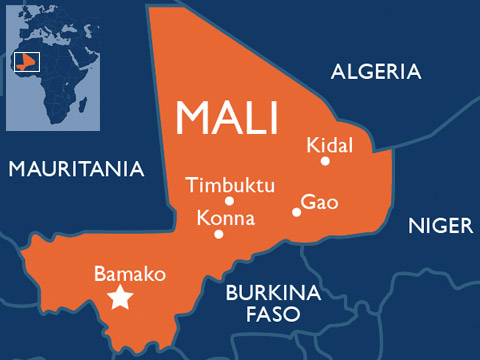
By David Blair, The Telegraph – “War is not the only reason why at least 340,000 people have fled their homes since gunmen loyal to ‘al-Qaeda in the Islamic Maghreb’ (AQIM), along with rebels from the local Tuareg tribe, began their advance across northern Mali in January. A desperate shortage of food is also taking hold in this arid Saharan region.
More than 1.6 million people in northern Mali are in a ‘situation of severe, close to extreme, food insecurity,’ according to the United Nations Office for the Coordination of Humanitarian Affairs.
This includes the great majority of the 1.3 million inhabitants of Timbuktu, Gao and Kidal, the three regions which AQIM and its allies now dominate. In total, some 4.6 million people in Mali – almost a third of the entire national population – are deemed ‘food insecure’.
Mohammed Samake fled Gao last month, largely because of hunger. ‘We were starving there,’ he said. ‘Our relatives were dying. We couldn’t even sleep: we lie down, but we don’t close our eyes.’
Mr Samake, 21, now lives with his extended family in the town of Segou in central Mali, just outside the area in AQIM’s grip. About 10,000 refugees have fled to Segou since the onset of the conflict.
Tom McCormack, country director of Save the Children, speaking from the capital Bamako, said: ‘We were talking about this potential food crisis – and then the conflict came in. That has had a profound impact’.” Read more.
When Islam Rises, So Do The Number Of Hungry
- Afghanistan: Starvation Threatens More Than 7 Million Citizens
- United Nations: 750,000 People in Somalia Face ‘Imminent Starvation’
- Somalia: Islamist Deprive 1.3 Million People Of Food, Clean Water And Health Care
- Syria: Islamist Rebels Prevent Food From Reaching The Sick And Hungry, City Slow Dies
- Chad: Children Starve To Death As Islamic ‘Doctors’ Throw Common Sense To The Wind
- Islamic State: Government Workers Forbidden From Giving Food Rations To Christians
- Sudan: Tens Of Thousands Of Christians Facing Bombings, Arrests, Starvation From Islamist Government
Germany: Field Mice Overrun Central Farms In Worst Plague In 30 Years
 Spiegel Online International – “Millions of field mice are overrunning the central German states of Thuringia and Saxony-Anhalt, much to the concern of local farmers. The rodents are devastating food crops, cutting yields by up to 50 percent. Getting birds of prey to hunt the critters didn’t help, and now farmers want to be allowed to use a banned rat poison.
Under normal circumstances, you might think the 12-centimeter (5-inch) long field mouse looks innocent, or even cute. But farmers in the central German states of Thuringia and Saxony-Anhalt wouldn’t agree at the moment. The furry rodents are currently wreaking havoc in the states, which are suffering the worst field mouse plague in over 30 years.
Farmers in Thuringia and Saxony-Anhalt are complaining that millions of field mice are devastating their food crops, including corn, barley and winter wheat. “They are eating everything,” said Matthias Krieg, who manages an agricultural firm near the town of Zeitz in Saxony-Anhalt. ‘Not even the sugar beets are safe.’ Farmers estimate that they may have to write off an average of 10 percent of their crops as a result of mouse damage, and up to 50 percent in extreme cases.
Farmers already noticed an increase in the field mouse population in 2011 and began to take counter measures. According to Reinhard Kopp, a spokesman for the Thuringian Farmers’ Association, agriculturalists set up hundreds of perches in their fields to lure birds of prey to kill the mice. But the operation was only moderately successful. ‘The birds got so fat from eating all the mice that they almost couldn’t fly any more,’ Kopp said. ‘But they still couldn’t keep up.'” Read more.
US: Feds Declare Drought Emergency Across 1,000 Counties, Worst Crop Conditions In 24 Years
 By Patti Domm, CNBC – “The U.S. government declared more than 1,000 counties in 26 states drought disasters, as the economic impact of the worst crop conditions in 24 years begins to be felt.
The U.S. Department of Agriculture announced Wednesday that farmers in those states can qualify for low-interest emergency loans as of Thursday. The USDA said it streamlined its disaster designation process, and the counties are designated as being in severe drought because of eight-consecutive weeks of drought during the growing season.
Earlier, the USDA released its crop report, showing sharply reduced expectations for this year’s harvest and a 12 percent decline in the expected corn crop yield.
The USDA had projected this year’s crop would be a bumper harvest, yielding 166 bushels per acre. It pared that expectation back to 146 bushels, the lowest in nine years. It now expects a total crop of 12.97 billion bushels, the third-largest on record but down from what would have been an all-time high of 14.8 billion bushels.
Grain prices jumped on the initial 8:30 a.m. EDT crop report, but sold off as rumors swirled ahead of the USDA announcement on drought disaster. Traders said there was a rumor the USDA had an announcement coming that would be a negative for grain prices. Futures prices stayed close to their lows after the announcement.” Read more.
‘Out Of Whack’: Corn Is Dying All Over America
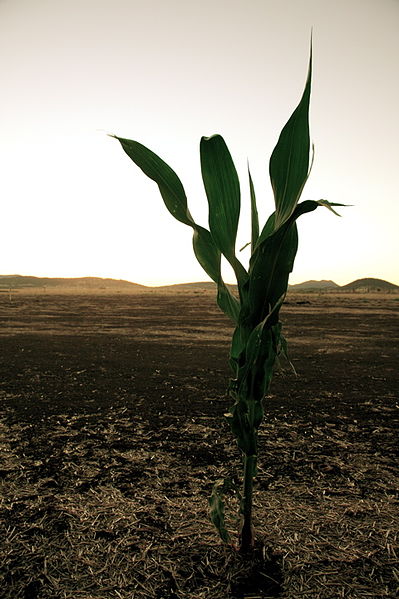 “All over America the corn is dying. If drought conditions persist in the middle part of the country, wheat and soybeans will be next. Weeks of intense heat combined with extraordinarily dry conditions have brought many U.S. corn farmers to the brink of total disaster. If there is not significant rainfall soon, many farmers will be financially ruined. This period of time is particularly important for corn because this is when pollination is supposed to happen. But the unprecedented heat and the extremely dry conditions are playing havoc with that process. With each passing day things get even worse. We have seen the price of a bushel of corn soar 41 percent since June 14th. That is an astounding rise. You may not eat much corn directly, but it is important to realize that corn or corn syrup is just about in everything these days. Just look at your food labels. In the United States today, approximately 75 percent of all processed foods contain corn. So a huge rise in the price of corn is going to be felt all over the supermarket. Corn is also widely used to feed livestock, and if this crisis continues we are going to see a significant rise in meat and dairy prices as well. Food prices in America have already been rising at a steady pace, and so this is definitely not welcome news.
The weather conditions in the middle part of the country during the last couple of months have been highly unusual. The following is from a recent article in the Los Angeles Times….
It’s not that the Midwest hasn’t been extremely hot before, and it’s not that it hasn’t been incredibly dry.
But it’s unusual for a vast swath of the Midwest to be so very hot and so very dry for so very long — particularly this early in the summer.
The current heat wave — which is spurring comparisons to the catastrophic heat of 1936 — is “out of whack,” meteorologist Jim Keeney said Friday in an interview with the Los Angeles Times.
Corn crops typically pollinate and mature in June and early July. That is why this time of the year is so vitally important for corn. We have reached a make it or break it moment.” Read more.
Nigeria: Hundreds Of Suspected Islamists Attack Christian Villages Near Jos, Dozens Killed
 Associated Press – “Raids and reprisal attacks have left 37 people dead in Christian villages near a Nigerian city where authorities have struggled to contain religious violence, authorities said Sunday.
Mustapha Salisu, spokesman for a special taskforce made up of policemen and soldiers deployed in the area to curb years of violence, said assailants launched ‘sophisticated attacks’ on several villages near Jos early Saturday.
‘They came in hundreds,’ said Salisu, ‘Some had (police) uniforms and some even had bulletproof vests.’
He said the special taskforce fought back for hours and lost two policemen in the battle.
He said 14 civilians were killed in the raids and that the taskforce killed 21 assailants.
‘More than 100 people have been displaced,’ said Andronicus Adeyemo, an official with the Nigerian Red Cross.
Authorities declined to comment on who they suspect, but similar raids have been blamed on Muslim herdsmen in the past.
Mark Lipdo, who runs a Christian advocacy group known as the Stefanos Foundation, gave a list of the 13 villages where he got reports of attacks. He said they were all Christian.
He blamed Muslim herdsmen of the Fulani ethnic group for the attacks.” Read more.
Dozens Of Christian Farms Destroyed – “‘On Thursday morning 43 Christian farms were destroyed by the Muslims. We went there to investigate. Nobody was arrested. But Saturday, the Muslim herdsmen regrouped and divided in nine groups and attacked about nine Christian communities,’ said a Christian leader who spoke to ICC. The leader remains anonymous for security reasons.” Read more.
‘Disaster’: Disease Threatens National Food Security In Kenya After Maize Crops Destroyed
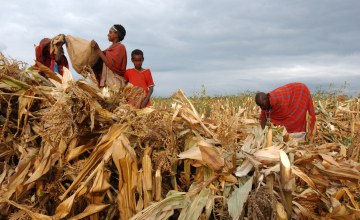 By Gilbert Kimutai – “Local leaders in Bomet county have asked the government to declare a disease that has destroyed maize crops in South Rift a national disaster and compensate the affected farmers.
The leaders said the disease is threatening the national food security and should be declared a disaster as the region will have no harvest this season. They also demanded that the government give alternative seeds to plant. ‘We demand that the farmers be compensated by the government either in monetary form or any other form for the loss they have incurred due to the outbreak,’ said former Bomet mayor Leonard Barsumei in a statement
Barsumei said farmers have suffered irreparable economic damage due to the disease saying the government is fully responsible since they did not act swiftly to avert spread of the disease. ‘We do not want to engage in blame game for the disease but the government is dragging in its feet in finding solution despite outcry from farmers,’ he said. They also expressed dissatisfaction on a visit by top Agriculture ministry official over the weekend to the region saying they did not give enough time to farmers to air their views.
Mr. Barsumei said the minister’s visit and her delegation was a Public relation gimmick meant to blind fold farmers that the government was working on a solution to the menace. Bomet Mayor Joyce Korir said the ministry should send official to access the damage and get the true picture so that farmers can compensate farmers. ‘If the government can had the ability to help flood victims and IDP through compensation then who are the farmers that are feed the entire nation not to be compensated?’ posed Mrs. Korir.” Read more.
Desert Locusts Swarm Across Libya And Algeria, Niger And Mali Warned Of Imminent Risk
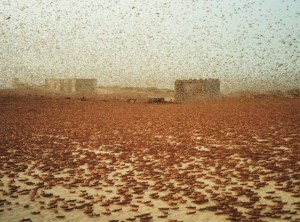 By Xan Rice, FT – “The death of Muammar Gaddafi continues to reverberate across Africa – this time in the form of desert locusts.
The Food and Agricultural Organisation of the United Nations warned on Tuesday that croplands in Niger and Mali were at imminent risk from locust swarms moving south from Libya and Algeria. The revolution in Libya played a major role in allowing the pests to breed, it said.
‘The fall of Gaddafi was an enormous factor, to be honest,’ said Keith Cressman, FAO senior locust forecasting officer. ‘It depleted the Libyans’ capacity to monitor and respond as they normally would.’
Insecurity along the Libya-Algeria border – a fallout from the uprising – meant that teams are still unable to properly spray the affected areas.
Desert locusts have the capacity to destroy vast areas of croplands. During a plague, a swarm can stretch for several hundred square kilometres comprising billions of locusts, each capable of eating its own weight in food a day.
A 2003-05 plague affected farmers in two dozen countries, mainly in Africa, and cost more than $500m to bring under control. The current infestation is nowhere near that level, but the FAO fears that the insecurity in Mali will hamper the response efforts there.
Desert locust swarms formed in Libya and Algeria in mid-May, after good rains and the resultant growth of vegetation on which they feed. The first swarms have already been sighted in northern Niger, which is currently experiencing a food crisis.” Read more.
Yemen Food Crisis Reaching ‘Catastrophic Proportions’
 By Sam Jones, The Guardian – “Yemen is facing a food crisis of ‘catastrophic proportions’, with almost half the population going hungry and a third of children in some areas severely malnourished, aid agencies have warned.
A coalition of seven humanitarian organisations – Care International, International Medical Corps, Islamic Relief, Mercy Corps, Merlin, Oxfam and Save the Children – is urging the international community to step up aid before Yemen slides further into poverty and political instability.
The Middle Eastern country’s already precarious state was highlighted on Monday when a suicide bomber attacked a military parade, killing more than 90 people and wounding at least 220. The bombing, one of the deadliest in recent years, was a setback in Yemen’s battle against al-Qaida-affiliated Islamists and has heightened concerns over a country in the frontline of the US global war on militants.
The aid agencies – which point out that the UN’s humanitarian appeal has received only 43% of the funding it needs – are urging delegates at Wednesday’s international Friends of Yemen conference to do more to tackle the food crisis.
The agencies say hunger in Yemen has doubled since 2009 and was exacerbated by last year’s political upheaval, which saw the dictator Ali Abdullah Saleh ousted from power after 33 years and replaced by President Abd-Rabbu Mansour Hadi.
Penny Lawrence, Oxfam’s international director, said that although donors were concentrating on politics and security, they had to focus on more basic and pressing issues. ‘Yemeni families are at the brink and have exhausted their ways of coping with the crisis,’ she said.” Read more.
Report: North Koreans In Rice Belt Starve To Death
 AFP – “Food shortages have worsened in North Korea, even in the southwestern rice belt where some residents have starved to death, a Seoul-based online newspaper said Monday.
‘Because of worsening food shortages this year there were reports of people starving to death even in South and North Hwanghae provinces,’ a Daily NK reporter told AFP, referring to the country’s agricultural heartland.
Six people — children or the elderly — died in just one village in Shingye county after the authorities released an emergency supply of only one or two kilograms (2.2-4.4 pounds) of corn to each household, the paper said.
It quoted another source as saying that about 10 people had died of starvation on each collective farm in and around the coastal city of Haeju by April, following shortages in late winter.
Good Friends, a Seoul-based aid group, also said on its website that starvation continued to claim victims throughout South Hwanghae. At Hwanghae Steelworks some workers had died because food rations stopped, it said.
The South’s unification ministry, which handles cross-border affairs, said it had no information.” Read more.
 Israel National News
- Sirens sounded in Misgav Am
- Photo: A baby rescued from the impact site in Petah Tikva from Iranian fire
- Wizz Air is suspending its flights to and from Israel until April 20
- Home Front Command: Residents permitted to leave shelters
- Reports of interception debris falling in the center; no injuries reported
- Missile from Iran fired on center intercepted
- Sirens in Upper Galilee due to firing from Lebanon
- Israel decided to halt defense procurement from France
- Sirens sounded on northern border
- Sirens sounded in southern Jordan Valley
FrontPage Magazine
- UN Sends Billions to Islamic Terrorists Who Kidnap its Staff
- Trump’s Iran Deal Must Be Nothing Like Obama’s
- Ten Years Ago, Three Jihad Suicide Bombers Blew Themselves Up in Brussels
- Nazi Germany and the Iranian Mullahs
- Iran Drives Gulf Toward Israel
- Democrats’ ICE Derangement Syndrome
- Jamie Glazov on Patriot Radio: Why Leftists Die at the Altar They Build
- America’s Accidental Tragedy vs. Iran’s Deliberate Atrocities
- Death and Resilience at Beit Shemesh
- Dems Struggle With Concept of ‘Election Day’
Gatestone Institute
- Syria: Christians, Other Minorities Under Genocidal Attack During Leadership of Ahmed Al-Sharaa
- The Sham of 'Disarming' Hamas
- US Congress Confronts Bangladesh Genocide—But Ignores the Islamist Infrastructure Behind It
- The War on Civilization: 'Israel Cannot Outsource Its Survival'
- Iran: The Danger of the Venezuelan Model
- Finish the Job: Leaving Iran's Regime in Place Guarantees Endless Regional Instability
- Iran's Fantasy of Strength: When Bazaar Tactics Collide with Reality
- Arabs Did Not Help the Gulf States: What Do they See as the Central Source of Instability in the Middle East?
- Birthright Citizenship is National Suicide
- Disarming Hamas Must Remain Trump's Top Priority in Gaza
Middle East – The Jerusalem Post
- Iran warns of death penalty, asset seizures for spying, aiding enemies
- Trump tells aides he is willing to end Iran war without reopening Hormuz, WSJ reports
- Gulf States pressure Trump to continue war with Iran until fall of Islamic regime - report
- Kuwaiti oil tanker was hit in Iranian attack at Dubai port, alerts raised for possible oil spill
- The architect of Iran’s military survival remains defiant
- Trump interested in calling on Arab states to help pay for Iran war, White House says
- Trump gives Iran one‑week deadline on deal, says US response to Haifa strike coming soon
- IDF investigating after UN says two peacekeepers killed in explosion in southern Lebanon
- Settler violence spikes amid Iran war, Herzog responds to Diaspora Jews' call for action
- Syrian army says recent drone attacks targeted its bases near Iraq, most shot down
Earthquakes & Volcanic Activity
- World Earthquake Report for Tuesday, 31 March 2026
- Volcanoes Today, 31 Mar 2026: Fuego volcano, Semeru, Ibu, Dukono, Mayon, Sangay, Sabancaya
- Sabancaya Volcano Volcanic Ash Advisory: SPORADIC PUFF to 25000 ft (7600 m)
- Mayon Volcano Volcanic Ash Advisory: ERUPTION AT 20260331/0529Z VA CLD UNKNOWN REPORTED OBS VA DTG: 31/0530Z
- Fuego Volcano Volcanic Ash Advisory: ONGOING VA EMS to 14000 ft (4300 m)
- Dukono Volcano Volcanic Ash Advisory: VA TO FL070 OBS EXT SE AT 31/0510Z OBS VA DTG: 31/0510Z to 7000 ft (2100 m)
- World Earthquake Report for Monday, 30 March 2026
- Sangay Volcano Volcanic Ash Advisory: OCNL VA EMS
- Ibu Volcano Volcanic Ash Advisory: VA TO FL070 OBS AT 30/2240Z MOV SE OBS VA DTG: 30/2240Z to 7000 ft (2100 m)
- Mayon Volcano Volcanic Ash Advisory: ERUPTION AT 20260330/2154Z FL090 EXTD SW REPORTED OBS VA DTG: 30/2200Z
Islamic Terrorist Network In America

Click For Larger Version


Click To Learn What Makes This An Idol

 MidnightWatcher - Prophecy in Motion
Recent Comments