Archive
Australia: Southern and Mid-North Farmers Warned to Prepare for Locust Onslought
 “Farmers are being urged to spray for locusts as more become evident across areas of South Australia, including the mid-north.
Biosecurity SA has had reports of high numbers near Narridy, Yacka and Spalding.
Entomologist Kym Perry says farmers need to act to help prevent the current generation laying eggs which could affect their seeding work.
‘Locusts are becoming more visible over the last few days. Now is actually the best time to spray hoppers and possibly even this week we’ll see them on the wing and then they’ll be much much harder to control,’ he said.
‘Pretty soon they’ll develop wings and become more mobile as adults. They may drift around looking for green feed.
‘We think these ones are unlikely to last long enough until seeding time, but the big question is whether they’ll lay more eggs and those eggs could develop into a population around seeding time.’
Merle Hosking from Narridy in the mid-north says the locust swarms have almost destroyed her garden.
‘They’ve burrowed into the agapanthus and eaten everything down the stem. The yuccas that were in the garden they’ve all been eaten and there’s great holes in the spiky leaves. Even the cacti, they’ve attacked and it’s just bare,’ she said.” Source – ABC News.
UNICEF: Number of Children in Sahel Countries Threatened by Famine to Double in 2012
Luke 21:9-11, “‘When you hear of wars and revolutions, do not be frightened. These things must happen first, but the end will not come right away.’ Then he said to them: ‘Nation will rise against nation, and kingdom against kingdom. There will be great earthquakes, famines and pestilences in various places, and fearful events and great signs from heaven…'”

“A million children living in the Sahel countries are at risk of famine or dramatic malnutrition in 2012. This is two times more than today, warned the United Nations Fund for Children.
Famine threatens children in Chad, Niger, Burkina Faso, Senegal, Mauritania and Mali and the northern territories of Nigeria and Cameroon, said David Gressly, regional director of UNICEF responsible for the countries in West and Central Africa. In 2011 in the region half a million children suffered from extreme malnutrition.
In the Sahel countries, a drought caused lack of water in the tanks, its levels also decreased in the rivers. This seriously threatens the crops and livestock , AFP writes.
‘This children’s crisis is going to be immensely challenging. We do not issue such warnings lightly, but the scale demands an appropriate response that needs to start now’, said David Gressley.
Sahel is a region stretching along the southern edge of the Sahara and the northern edge of the Sudan from Senegal to Somalia, Mauritania, Mali, Niger, Chad, Sudan and Eritrea.” Source – GreenFudge.org.
Texas: Worst Drought in State History Responsible for Largest-Ever One-Year Decline in Cattle Herd
 By BETSY BLANEY – “LUBBOCK, Texas (AP) – The worst drought in Texas’ history has led to the largest-ever one-year decline in the leading cattle-state’s cow herd, raising the likelihood of increased beef prices as the number of animals decline and demand remains strong.
Since Jan. 1, the number of cows in Texas has dropped by about 600,000, a 12 percent decline from the roughly 5 million cows the state had at the beginning of the year, said David Anderson, who monitors beef markets for the Texas AgriLife Extension Service. That’s likely the largest drop in the number of cows any state has ever seen, though Texas had a larger percentage decline from 1934 to 1935, when ranchers were reeling from the Great Depression and Dust Bowl, Anderson said.
Anderson said many cows were moved ‘somewhere there’s grass,’ but lots of others were slaughtered. He said that in Texas, Oklahoma, New Mexico, Louisiana and Arkansas, about 200,000 more cattle were slaughtered this year, a 20 percent increase over last year.
That extra supply could help meet increased demand from China and other countries, but the loss of cows likely will mean fewer cattle in future years.
‘Consumers are going to pay more because we’re going to have less beef,’ Anderson said. ‘Fewer cows, calves, less beef production and increasing exports.’
The U.S. Department of Agriculture estimates that beef prices will increase up to 5.5 in 2012, in part because the number of cattle has declined. That follows a 9 percent increase in beef prices in the past year.
Oklahoma, the nation’s second-largest cattle producer, also saw about a 12 percent drop in cows, Oklahoma State University agriculture economist Derrell Peel said.
Anderson said beef production nationally will be down 4 percent next year.
In Texas, the problem is primarily due to the worst single-year drought in the state’s history. From January through November the state got just 46 percent of its normal rainfall of about 26 inches.” Read more.
‘Disaster’: Unusual Drought Triggers Alarm Across Balkans
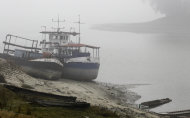 By AMER COHADZIC and MARKO DROBNJAKOVIC – “BEZDAN, Serbia (AP) — The waters of the mighty Danube are so low that dozens of cargo ships are stuck, stranded in ghostly fog or wedged into sand banks on what is normally one of eastern Europe’s busiest transport routes.
A lack of rain has triggered the worst drought in decades for this time of year, dropping river levels to record lows and sounding an alarm in parts of central and eastern Europe.
Power supplies are running low in Serbia, drinking water shortages have hit Bosnia, and crop production is in jeopardy in Romania, Bulgaria and Hungary. The Czech Republic is at its driest since records began in 1775.
Meteorologists say they are not sure why the region has had far less rain than average since August — but they don’t see any more coming quickly. That is bad news for shipping companies that are already reporting big losses.
‘This is a disaster,’ said Branko Savic, the manager of a privately owned Danube shipping company in Serbia that he says is operating at only a third of its capacity. ‘Traffic on the Danube is practically nonexistent. . . We are in dire need of enormous amounts of water, rain, or melting snow in order to better the situation.’
About 80 big cargo ships are stranded at the Serbia-Hungary border on the Danube, Europe’s second largest river, which winds 2,860-kilometer (1,777-mile) from Germany, passing through eight countries before flowing into the Black Sea.
‘In my many years of experience as a boat captain, I don’t remember a drought as harsh as this one,’ said Anton Balasz, whose ship is among those stuck where exposed sand banks are preventing boats from passing.” Read more.
Report: Extreme Weather Driving Up Food Prices
By Mike De Souza – “Extreme weather events caused by climate change are endangering global food supplies and driving up prices for consumers worldwide, says new research released Sunday by the humanitarian group, Oxfam.
In a briefing note prepared for media, Oxfam highlighted a pattern of events in 2010 such as wild fires in Russia, and extreme weather in other crop-producing nations with a spike in wheat prices on the global market.
‘When (the price of food) just spikes in a question of months, that tends to be related to particular events with crop production and we saw with the case of wheat,’ said Mark Fried, a policy coordinator for Oxfam Canada, noting that other factors such as rising oil prices also have an impact on the international food market.
Oxfam’s briefing note also said that the recent drought in the Horn and East Africa dealt a severe blow to over 13 million people, with some crops doubling or tripling in price last July.
‘When a weather event drives local or regional price spikes, poor people often face a double shock of having to cope with higher food prices at a time when the direct effects of the weather may have also depleted their assets i.e. their homes or crops destroyed; crops and livestock sold or gone,’ said the briefing note.
‘This toxic mix of higher prices and lower purchasing power has driven many people into crisis in the Horn and East Africa.’
Fried said the Canadian government must ensure that its existing pledge for ‘fast-start’ financing in developing countries offers at least half of its funds for adaptation to help these regions cope.” Read more.
West Africa: Millions Face Potential Food Crisis in Niger, Mauritania and Mali Because of Plagues of Locusts and Inadequate Rainfall
 “World Vision staff in West Africa are warning that the countries of Niger, Mauritania and Mali are on the brink of major food shortages.
A number of international agencies, including the United States Agency for International Development and the European Commission’s humanitarian relief organization, are reporing that inadequate rainfalls, combined with reports of grasshopper infestations, are causing major production shortfalls in rice and grain crops. This could lead to food shortfalls in West Africa in early 2012.
‘The combination of problems affecting the region is reducing the likelihood of a successful harvest,’ warns David Mbugua, World Vision’s Agriculture and Food Security Specialist. Mbugua adds that many of World Vision’s Area Development Programs (ADPs) in the southern region of Mauritania are affected by the current situation.
World Vision staff in West Africa are working with the World Food Programme to develop a number of cash-for-work and food-for-work programs. These programs, which would provide support for nearly 65,000 people, are also being supplemented by increasing clinical support to assist a stream of mothers with malnourished children.
A food crisis in Western Africa would be especially devastating as the area is still recovering from the severe drought of 2009-10.
‘World Vision is urging the international community to provide help for children and their families in the affected countries in West Africa,’ says Caroline Riseboro, Vice President, Marketing and Public Affairs for World Vision Canada. ‘By acting now, we can avoid a repeat of the humanitarian crisis that has occurred in Horn of Africa in 2011.'” Source – World Vision Canada.
Mexico Experiencing Its Worst Drought in 70 Years, Government Says
 “Mexico City – Mexico is suffering its worst drought in the past 70 years, a dearth of rainfall that has forced the government to supply water to nearly 2.5 million people, the Social Development Secretariat said.
The natural disaster is mainly affecting the northern states of Sonora, Chihuahua, Coahuila, Durango, Coahuila, Nuevo Leon, Guanajuato and Zacatecas.
Social Development Secretary Heriberto Felix Guerra, whose department is coordinating efforts to mitigate the drought, the most severe to hit Mexico since 1941, said it was ’caused in large part by the climate change affecting the entire planet.’
The secretariat has implemented an emergency water plan, bringing 700 tanks with 10,000 liters of water to ‘the most remote and vulnerable communities,’ Felix Guerra said.
All told, water has been distributed via 4,000 tankers to 1,500 communities across 12 Mexican states, benefiting 2.5 million people, the secretariat said.
‘Human beings come first. We must deliver all the assistance we can to people, who are the focus of our social policy,’ Felix Guerra said.” Source – Fox News Latino.
Heatwave Kills 200 Elephants and Other Wildlife in Zimbabwe, Situation Worsening
 “Approximately 200 elephants have died of thirst in Zimbabwe’s Hwange National Park due to searing heat and chronic water shortages, a local conservationist says.
Zimbabwe, which, as a southern hemisphere nation, is currently in summer, has been experiencing record-high temperatures since October.
‘There have been 200 elephants that have died so far, and they are dying every day,’ Johnny Rodrigues of the Zimbabwe Conservation Task Force said on Thursday.
He said other game in the park, the largest reserve in the country, were also dying for lack of water. Adding to the troubles caused by the heatwave, pumps used to fill artificial watering holes have also broken down.
To protect the few remaining watering holes, some of the elephants are now aggressively driving away other game, who are stranded with no means to quench their thirst, Rodrigues said in a telephone interview.
The park is located in western Zimbabwe, close to the Kalahari desert, a very dry region with little water or vegetation.
The death toll of 200 elephants marks a rapid increase from the official figure released last week, which said 100 of the giant land mammals had died from the heat.
National Parks Director General Vitalis Chadenga announced that rangers were trying to ‘actively manage’ the situation by pumping water from underground boreholes into surface-level watering holes.
Chadenga said there were too many elephants in the park, claiming there were an estimated 40,000 animals in a reserve that can only sustain around 25,000.
But Rodrigues insisted the crisis in not being caused by overpopulation. He places the blame instead on a lack of maintenance and mismanagement of the facilities.” Source – Sky News.
Afghanistan: Starvation Threatens More Than 7 Million Citizens as Over 90% of Country’s Agriculture Affected by Drought

The Khaama Press News Agency – “Officials in ministry of Rural Rehabilitation and Development on Tuesday expressed concerns over drought affects which threatens more than 7 million Afghans across the country.
Meanwhile, the parliamentarian commission for natural resources and environmental habitance also said, more than 90% of the Afghan agriculture were affected by drought this year.
Members of the commission for state emergency while speaking among the members of the parliament said, the country will face migration, regional conflict, animal deaths, and disease if the government does not step up actions to fight the natural disaster which threatens more than 7 million Afghans.
Jarullah Mansoori, Minister for Rural Rehabilitation and Development said urged the international community and donors to assist 7.3% of Afghan population who are facing serious hunger and starvation threats.
Head of the Parliament’s natural resources committee, Obaidullah Ramin confirming the issue warned that this coming winter will be a difficult one for those suffering drought.
In the meantime, Deputy Minister for Rural Rehabilitation and Development also expressed concerns about the probability of road blockage in 23 provinces because of heavy snow fall.
Head of the disaster prevention department Mohammad Daim Kakar said, droughts have affected around 14 provinces of Afghanistan threatening more than 2.6% of Afghan people in these provinces.
He also said, we are expecting aids by international donors for the drought affected areas before winter.” Source – Khaama Press.
US: Huge Drought Affecting 1/3 of Lower 48 States Is Pushing Food Prices Even Higher
 By David Zeiler – “A drought affecting one-third of the lower 48 states has hurt several key food crops, driving up prices this year and assuring widespread food inflation well into 2012.
According to the National Climatic Data Center, the drought has caused more than $10 billion in losses to agriculture and cattle, a number it expects to keep rising as the drought continues.
Meteorologists blame the drought on a La Niña weather pattern expected to last at least through the winter.
Crops most affected include corn and peanuts. In addition, the lack of rain dried cattle grazing pastures to dust, which has translated to higher beef prices.
‘Yes, we are going to see higher prices this Thanksgiving,’ Purdue University agricultural economist Corinne Alexander told The Atlantic.
The American Farm Bureau estimates that a Thanksgiving meal for 10 will cost 13% more this year than it did last year.
The U.S. economy already has inflationary pressure as a result of the stimulative policies of the U.S. Federal Reserve pumping it with hundreds of billions of dollars.
‘Ultra-low interest rates and excess money supply growth are what’s been driving inflation,’ said Money Morning Global Investing Strategist Martin Hutchinson. ‘They raise commodity prices, which over time feeds into inflation in general.’
Now the drought is pushing food inflation higher than overall inflation.” Read more.
US Food Supply Threatened: Foreign Insects, Diseases Got Into US Post 9/11, ‘Every Person in the Country is Affected by This’
 By TRACIE CONE – “FRESNO, Calif. — Dozens of foreign insects and plant diseases slipped undetected into the United States in the years after 9/11, when authorities were so focused on preventing another attack that they overlooked a pest explosion that threatened the quality of the nation’s food supply.
At the time, hundreds of agricultural scientists responsible for stopping invasive species at the border were reassigned to anti-terrorism duties in the newly formed Homeland Security Department — a move that scientists say cost billions of dollars in crop damage and eradication efforts from California vineyards to Florida citrus groves.
The consequences come home to consumers in the form of higher grocery prices, substandard produce and the risk of environmental damage from chemicals needed to combat the pests.
An Associated Press analysis of inspection records found that border-protection officials were so engrossed in stopping terrorists that they all but ignored the country’s exposure to destructive new insects and infections — a quietly growing menace that has been attacking fruits and vegetables and even prized forests ever since.
‘Whether they know it or not, every person in the country is affected by this, whether by the quality or cost of their food, the pesticide residue on food or not being able to enjoy the outdoors because beetles are killing off the trees,’ said Mark Hoddle, an entomologist specializing in invasive species at the University of California, Riverside.” Read more.
Report: Food Crisis Grips North Korea
 “HAEJU, North Korea – In a pediatric hospital in North Korea’s most productive farming province, children lay two to a bed. All showed signs of severe malnutrition: skin infections, patchy hair, listless apathy.
‘Their mothers have to bring them here on bicycles,’ said duty doctor Jang Kum Son in the Yellow Sea port city of Haeju. ‘We used to have an ambulance but it’s completely broken down. One mother travelled 72 kilometers . By the time they get here, it’s often too late.’
It’s also getting late for North Korea to get the massive amount of food aid it claims to need before the harsh winter sets in. The country’s dysfunctional food-distribution system, rising global commodities prices and sanctions imposed over Pyongyang’s nuclear and missile programs had contributed to what appears to be a hunger crisis in the North, even before devastating summer floods and typhoons compounded the emergency.
The regime’s appeals for massive food aid have gone mostly unanswered by a skeptical international community. Only 30 percent of a United Nations food aid target for North Korea has been met so far. The United States and South Korea, the two biggest donors before sanctions, have said they won’t resume aid until they are satisfied the military-led communist regime won’t divert the aid for its own uses and progress is made on disarmament talks.
South Korea also says the North is exaggerating the severity of its food crisis. Visiting scholars, tourists and charity workers have sent out conflicting views about it.
The U.N.’s Food and Agricultural Organization (FAO), for instance, said last month after visiting the North that ‘the damage was not so significant.’ Another U.N. body, the World Food Programme, which has a regular presence in the North, warned in March of growing hunger. The sharp divergence of views is one reason why the U.N.’s emergency relief coordinator will visit this month to assess the situation.” Read more.
 Israel National News
- Parshat Vayakhel\Pekudei: Perhaps Tucker Was Right...
- IDF strikes Iranian targets in three cities
- A cover-up of Biblical proportions
- When the siren sounds, the nation gathers
- Mossad in Farsi: 'Iran chose a dead man to lead it'
- IDF strikes bridge on the Litani River
- IDF launches wave of airstrikes in Tehran
- Oman announces two people killed in Iranian drone attack
- Military analyst: 'We crushed Hezbollah, now need to consolidate victory'
- President Trump should sever ties with Sánchez’s Spain
FrontPage Magazine
- 2 Islamic Terrorist Attacks in 1 Day
- We the People Never Voted for Mass Islamic Immigration
- Did Islamic Polygamy Lead to Record $14M PPP Fraud?
- Jihad at Old Dominion University
- Ohio HS Teacher Delivers Bonkers Anti-Trump Rant in Class
- Iran’s President vs. The Revolutionary Guards
- Video: Jamie Glazov Delivers A Wake-Up Call on the Ideological War Waged Against American Values
- The Pope at War: Pius XII, Hitler, and the Enigma of Silence
- Islamic Call Invades England’s Biggest Soccer Stadium
- The Boy Scouts Must Reclaim its Original Mission
Gatestone Institute
- Before Pouring Billions into Gaza, Trump's 'Board of Peace' Needs To Ask A Few Hard Questions
- If Saudi Arabia Wants U.S. Alliance, It Must End Support for Sudanese Armed Forces — Aligned with Muslim Brotherhood and Iran — Not Fund It
- UN and EU Condemn the Strike, Not the Regime: Double Standards, Selective Outrage
- Why Fusion Energy Needs to Be American Born – Now More Than Ever
- To Defend the Abraham Accords, Trump Must First Defend the UAE
- A Dangerous Prelude to Trump's 'Board of Peace' in Gaza?
- Make or Break Time for Iran's Remaining Allies
- Tehran Chooses the Samson Option
- The Only Brave Leaders Standing Against Iran's Reign of Terror
- The Curious Case of 'Anti-Zionists'
Middle East – The Jerusalem Post
- A changing battlefield: Five takeaways from Israel's war with Iran, two weeks in
- Two killed in Oman following drone strike, Iranian missile reportedly targets Turkish NATO airbase
- WATCH: IDF strikes over 200 regime terror targets across central, western Iran
- Iran threatens region's oil facilities if Israel, US target its energy infrastructure - report
- US Navy strikes Iranian ship after it sailed near USS Abraham Lincoln - report
- French officer killed, at least five soldiers wounded in drone strike on base in Iraq’s Makhmour
- Errors in Mojtaba Khamenei's first message dictated by IRGC raise questions about his condition
- Iranian diplomats in Australia, Denmark seek asylum as war rages on in their home country - report
- UN resolution condemning Iran leaves the country unexpectedly isolated - analysis
- Netanyahu: Iran not the threat it used to be, even if regime doesn't fall
Earthquakes & Volcanic Activity
- Aoba Volcano Volcanic Ash Advisory: UNKNOWN OBS VA DTG: NOT PROVIDED
- Volcanoes Today, 13 Mar 2026: Fuego volcano, Semeru, Shiveluch, Ibu, Mayon, Sangay, White Island, Sabancaya
- World Earthquake Report for Friday, 13 March 2026
- Fuego Volcano Volcanic Ash Advisory: CONT VA EMS OBS to 14000 ft (4300 m)
- Ibu Volcano Volcanic Ash Advisory: ERUPTION LAST REPORTED AT 13/0615Z EST VA DTG: 13/0650Z
- Sangay Volcano Volcanic Ash Advisory: PSBL CONT VA EMS to 21000 ft (6400 m)
- Akan volcano (Hokkaido, Japan): minor eruption
- Aoba Volcano Volcanic Ash Advisory: ERUPTION AT 20260312/1900Z LOW LEVEL ERUPTION to 10000 ft (3000 m)
- Shiveluch Volcano Volcanic Ash Advisory: NOT PROVIDED
- Mayon Volcano Volcanic Ash Advisory: ERUPTION AT 20260313/0105Z VA CLD UNKNOWN REPORTED OBS VA DTG: 13/0110Z
Islamic Terrorist Network In America

Click For Larger Version


Click To Learn What Makes This An Idol

 MidnightWatcher - Prophecy in Motion
Recent Comments