Archive
Pakistan: Flooding Affects Millions, Kills 347+, 31000 Villages Destroyed, Widespread Crop and Livestock Losses, 6000+ Stricken with Dengue Fever

“KARACHI, Pakistan, Sept. 19 (UPI) — Weeks of flooding in southern Pakistan killed at least 347 people and injured more than 600, the national disaster authority said Monday.
The region, with Sindh Province being the worst hit, has been devastated by massive flooding unleashed by torrential monsoon rains since early August.
Millions of people have been affected by the floods. CNN reported about 500,000 are sheltered in refugee camps.
Pakistani Prime Minister Syed Yousuf Raza Gilani canceled his trip to New York for the U.N. General Assembly session so he could supervise flood relief work, his spokesman said Friday.
In Sindh, water was standing anywhere from ankle-high to above the knees on empty lands where homes once stood, CNN reported.
United Nations agencies are distributing food and supplies to the affected areas.
The World Food Program estimates that 73 percent of the food crops and 36 percent of the livestock have been lost in the flooded areas.” Read more.
More than 6,000 struck with dengue fever in Pakistan – “Dengue fever has killed 25 people and affected more than 6,000 over the past two months in Lahore, Pakistan, a health department spokesman said Monday. In total, 6,400 cases of dengue fever have been documented, said Ikhlaq Ahmed, spokesman for the health department of Punjab province. Of those, 6,000 are in Lahore, a city of more than 6 million people known as Pakistan’s cultural capital. The 25 who died are all from Lahore, in eastern Pakistan. An average of 300 new cases of the virus-based disease, spread by mosquitoes, are being reported in the city daily.” Read more.
United Nations: 750,000 People in Somalia Face ‘Imminent Starvation’
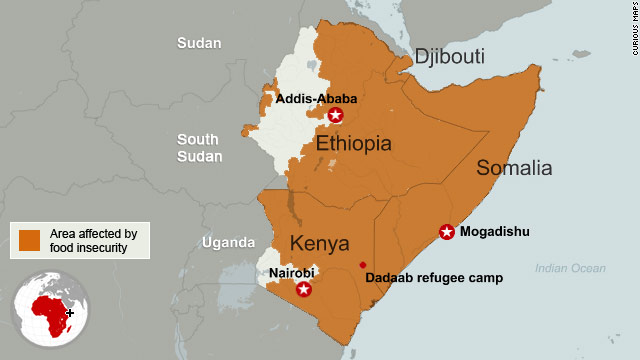
“(CNN) — A record 4 million people in Somalia need humanitarian aid and 750,000 people are in danger of ‘imminent starvation,’ the United Nations said on Monday.
Famine in the African nation has spread to the Bay region, which is now the sixth area in Somalia suffering from an acute shortage of food, according to the the U.N.’s Food Security and Nutrition Analysis Unit (FSNAU) and the Famine Early Warning Systems Network.
Officials are calling for a surge in response efforts as the crisis is predicted to get worse.
‘With the current food security outcomes famine conditions are expected to spread to agro pastoral populations in Gedo, Hiran, Middle Shabelle and Juba regions and riverine populations of Juba and Gedo in the coming 4 months,’ Grainne Moloney, FSNAU’s chief technical advisor, said in a statement announcing the latest survey results.
Of the 4 million people in need of emergency aid, 3 million are in the south. That figure is up from 2.4 million eight months ago.” Read more.
Disasters in US: An Extreme and Exhausting Year
 By SETH BORENSTEIN – “WASHINGTON (AP) — Nature is pummeling the United States this year with extremes.
Unprecedented triple-digit heat and devastating drought. Deadly tornadoes leveling towns. Massive rivers overflowing. A billion-dollar blizzard. And now, unusual hurricane-caused flooding in Vermont.
If what’s falling from the sky isn’t enough, the ground shook in places that normally seem stable: Colorado and the entire East Coast. On Friday, a strong quake triggered brief tsunami warnings in Alaska. Arizona and New Mexico have broken records for wildfires.
Total weather losses top $35 billion, and that’s not counting Hurricane Irene, according to the National Oceanic Atmospheric Administration. There have been more than 700 U.S. disaster and weather deaths, most from the tornado outbreaks this spring.
Last year, the world seemed to go wild with natural disasters in the deadliest year in a generation. But 2010 was bad globally, and the United States mostly was spared.
This year, while there have been devastating events elsewhere, such as the earthquake and tsunami in Japan, Australia’s flooding and a drought in Africa, it’s our turn to get smacked. Repeatedly.” Read more.
New Zealand: Airborne Kiwifruit Disease Spreads Beyond Contamination Zone
 By Tony Field – “The kiwifruit vine-killing disease PSA has spread beyond the initial contamination zone.
Pseudomonas syringae pv. Actinidiae has been found in 19 more properties in Te Puke and has spread to two vineyards in the previously-unaffected Tauranga region.
It has put more urgency on the research that is underway to combat the disease.
The scientists at Plant and Food Research are part of an international effort to develop new varieties of kiwifruit that are more resistant to PSA but that will take years, so for now they have more immediate goals.
Doctor Bruce Campbell says they are trying to buy time for the industry.
‘[What] we are doing right now is testing products that can be applied in orchards this coming season to slow the spread of the disease.’
170 orchards now have the more serious PSA strand of the disease.
John Burke of Kiwifruit Vine Health says the disease is airborne and is spread through weather events.
‘We have had weather over the summer period, and late autumn, that is not conducive to holding the disease.'” Read more.
Afghanistan: Ongoing Drought Now Forcing Nine Million to Face Food Shortages This Autumn
 “Ongoing drought in northern, northeastern and western Afghanistan is likely to push 1.5-2 million more people into food insecurity this autumn, according to the UN World Food Programme (WFP).
This is in addition to the seven million country-wide already facing food shortages.
The Ministry of Agriculture, Irrigation and Livestock (MAIL) is reporting a failure of the rain-fed wheat crop, which accounts for about 55 percent of the total domestic wheat yield.
Irrigated wheat, which tends to yield more per hectare, has also been affected by the drought. The average wheat yield (without fertilizers) on irrigated land is about 2.7 tons per hectare (3.5 tons with fertilizer), versus only 1.1 tons on rain-fed land, according to MAIL.
In a normal year Afghanistan produces 4.5 million tons of wheat and around one million tons are imported. The shortfall of 1.9 million tons of wheat this year means more will either have to be imported or secured from other sources.
‘Satellite derived rainfall estimates indicate that most of Afghanistan had an untimely and inadequate rain and snow season this year. As a result, there will be heavy losses in rain-fed wheat crops, underperforming irrigated wheat crops, poor pasture conditions, and low income earning opportunities in northern Afghanistan and the central highlands this year,’ said the US Agency for International Development’s FEWSNET.” Read more.
Japan: Rice Growing in a Rice Paddy With 35,000 Becquerels/kg of Radioactive Cesium?
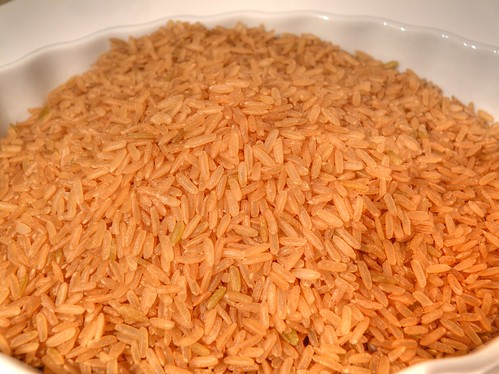 “No wonder the first trading of rice futures in Osaka fetched 40% premium over the exchange-suggested contract price.
If this number is correct, the harvest season in Japan will be indeed ‘chaos’.
From the tweet of Ryuichi Kino, who has attended and reported on almost all TEPCO/government press conferences regarding the Fukushima accident since March, reporting on the TEPCO/government joint press conference on August 8:
Germany’s ZDF Television is here. Said 35,000 becquerels/kg [of radioactive cesium, most likely] has been found in the soil of a rice paddy planted with rice, and asked if the government does any thorough check. Hosono [minister in charge of the nuclear accident] consulted with his staff for a very long time, and said they will confirm the number. He said the government will check the rice as they grow in the rice paddies.” Read more.
Stop claiming food is safe, ministry told – “Foreign Minister Takeaki Matsumoto has committed an about-face on policy by telling his ministry to refrain from vouching for the safety of Japanese food. The ministry stance changed after radiation-tainted beef was found to have been sold to consumers nationwide, sources said. The contaminated meat is coming from cattle that were fed rice straw contaminated with cesium isotopes ejected by the disaster-crippled Fukushima No. 1 nuclear power plant.” Read more.
Somalia: Famine Has Killed More Than 29,000 Children Under Age 5 in Last 90 Days

The United Nations has said previously that tens of thousands of people have died in the drought, the worst in Somalia in 60 years. The U.N. says 640,000 Somali children are acutely malnourished, a statistic that suggests the death toll of small children will rise.
Nancy Lindborg, an official with the U.S. government aid arm, told a congressional committee in Washington on Wednesday that the U.S. estimates that more than 29,000 children under the age of 5 have died in the last 90 days in southern Somalia. That number is based on nutrition and mortality surveys verified by the U.S. Centers for Disease Control and Prevention.
The U.N. on Wednesday declared three new regions in Somalia famine zones, bringing the total number to five. Out of a population of roughly 7.5 million, the U.N. says 3.2 million Somalis are in need of immediate lifesaving assistance.” Read more.
Record Percentage of United States Experiences ‘Exceptional Drought’
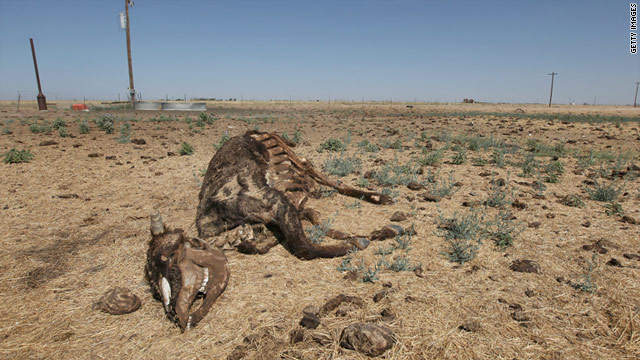 “(CNN) — Exceptional drought conditions spread across nearly 12% of the United States last month, a record number that shows the widespread impact of the dry weather conditions, according to a report released Monday.
Officials at the National Drought Mitigation Center said the July percentage is the highest recorded level of drought since the monitor began documenting conditions 12 years ago.
More than 40% of states faced abnormal dryness or drought, a report released by the center said.
The report tracks and ranks weather conditions from ‘abnormal dryness’ to ‘exceptional drought.’ A drought is considered ‘exceptional’ when the situation extends beyond what ‘could be considered part of normal risk management,’ according to the center’s website.
Dry weather has been pervasive throughout the South but particularly difficult for Texas, which hoped to find relief in Tropical Storm Don. The storm made landfall Friday between Corpus Christi and Brownsville but quickly fizzled into a tropical depression, disappointing residents looking for a break.
‘We were desperately hoping for some rain that didn’t come,’ said Tiffany Sunday, a resident of the Corpus Christi area.” Read more.
Somali Rebels Allege Famine Claim an Infidel Hoax
Revelation 6:8, “… They were given power over a fourth of the earth to kill by sword, famine and plague …”
 “For Somalia’s Al-Qaeda-linked rebels, the drought devastating parts of the country is being exploited by external enemies, claiming that local Muslims were adequately addressing the crisis.
The Al-Shebab insurgents have expelled several foreign aid groups from regions under their control since 2009 and reiterated recently that the ban was still in force after the United Nations declared famine in two regions they rule.
Shebab spokesman Sheikh Ali Mohamud Rage denied there was famine in the southern Somalia regions of Bakool and Lower Shabelle as declared by the UN, but admitted that there was drought.
In a speech to the rebel radio, Rage said local traders and other residents have been the main providers of help to the drought-hit population and that ‘God did not make them need an outside enemy or non-Muslims, the people in the country fed them very well.’
‘We need Muslim people to be aware that the external enemy especially non-Muslims have been thinking of a new strategy.
‘The new strategy is to transport them abroad, especially in Christian countries like Ethiopia and Kenya, so that their faith can be destroyed and that they could be staff and soldiers for the Christians,’ Rage charged.” Read more.
Somalia: Islamist Group Bans Samosas After Deciding They’re Too ‘Christian’ – “Somalia’s al-Shabaab group has banned samosas after ruling the popular snacks are ‘offensive’ and too Christian… Aid groups including the UN Food Programme say they were not given permission by militants to provide aid in the country, where it has been warned that 800,000 children could die from starvation. It is now thought islamist militants have taken offence at the three-sided samosa’s supposed resemblance to symbol of the Christian Holy Trinity.” Read more.
Somalia: Islamist Group Bans Samosas After Deciding They’re Too ‘Christian’ Because …
Apparently triangles are not halal in Somalia. These exceptionally deep-thinking Islamists would rather see children starve to death than see them eat a three-sided snack food. It might remind somebody of the Trinity. Finally, I understand my addiction to Doritos. And thank goodness it never snows in Somalia, otherwise Jack Handey bin Laden would have to issue a fatwa against Jack Frost bin Chillin, and we’d never enjoy a White Christmas ever again …
 “Somalia’s al-Shabaab group has banned samosas after ruling the popular snacks are ‘offensive’ and too Christian.
Militant Islamist fighters last week used vehicles mounted with loudspeakers to announce the bizarre ruling across the regions of the war-torn country it controls.
The extremist group has offered no official explanation for the ban on the triangular snacks, which are commonly cooked up and served across the Horn of Africa.
The bizarre ban comes just days after militants linked to Al-Qaida in Somalia refused to let some aid workers into the country as tens of thousands suffered in the nation’s massive famine.
Aid groups including the UN Food Programme say they were not given permission by militants to provide aid in the country, where it has been warned that 800,000 children could die from starvation.
It is now thought islamist militants have taken offence at the three-sided samosa’s supposed resemblance to symbol of the Christian Holy Trinity.” Read more.
Uganda: Thousands Face Starvation As Poor Rains Affect Harvest
 “Several districts in Uganda will need urgent relief aid to mitigate the risk of starvation following poor rains that have affected this year’s harvest, the Minister for Disaster Preparedness warned.
Most of the affected districts are in Karamoja where the situation was particularly unique because crop failure and a prolonged drought had aggravated the region’s food crisis, Musa Ecweru said.
‘Arrangements are under way by government to deliver enriched food supplements to help feed close to 2,000 severely malnourished children in that region,’ the minister told IRIN on 26 July.
Fifteen districts have been tagged a red-zone area (at risk of starvation if there is no urgent relief intervention) by the government, including Moroto, Napak, Kotido, Amudat, Kaabong, Nakapiripirit, Abim (all in Karamoja), Amuria, Katakwi, Adjumani, Arua, Koboko, Moyo, Yumbe and Bulambuli.
Karamoja has the lowest levels of human development in Uganda. Only 30 percent of the people have access to safe water; only 11 percent are literate and nearly 80 percent experience some degree of food insecurity, according to UN data.” Read more.
Somalia: Worst Famine in Decades Killing Tens of Thousands, ‘800,000 Children at Risk of Dying Without Urgent Assistance’
 By Katharine Houreld – “Tens of thousands of Somalis are feared dead in the world’s worst famine in a generation, a crisis so severe that the United States will allow emergency funds to be spent in areas controlled by al-Qaeda-linked militants as long as the fighters do not interfere with aid distributions.
Exhausted, rail-thin women are stumbling into refugee camps in Kenya and Ethiopia with dead babies and bleeding feet, having left weaker family members behind along the way.
‘Somalia is facing its worst food security crisis in the last 20 years,’ said Mark Bowden, the United Nations’ top official in charge of humanitarian aid in Somalia. ‘This desperate situation requires urgent action to save lives … it’s likely that conditions will deteriorate further in six months.’
The crisis was the worst since 1991-92, when hundreds of thousands of Somalis starved to death, Bowden said. That famine prompted intervention by an international peacekeeping force, but it eventually pulled out after two American Black Hawk helicopters were shot down in 1993.
Since then, Western nations have mainly sought to contain the threat of terrorism from Somalia – an anarchic nation where the weak Government battles Islamic militants on land and pirates hijack ships for millions of dollars at sea.” Read more.
Aid ban still in place in Somalia, Islamist militants say – “Islamist militants in Somalia have reversed a pledge to allow foreign aid agencies to operate in famine-struck regions in the nation. ‘The lift of ban on aid agencies doesn’t include the agencies that we banned earlier in areas we control because those agencies don’t do relief work, they are spies and work on political agendas’, Al-Shabaab spokesman Ali Mohamud Raage said Thursday on the militants’ radio station, Al Furqaan… Al-Shabaab originally banned foreign aid organizations from providing aid in southern Somalia in 2009, describing them as Western spies and Christian crusaders.” Read more.
Somali militants vow to block aid workers from famine-stricken south – “An al-Qaeda-linked militant group has said it will not allow banned aid organizations to return, meaning only a handful of agencies will be able to respond to the worsening famine in southern Somalia. Meanwhile, the UN children’s agency — one of the few groups that does operate in the area — said Friday that nearly 800,000 children are at risk of dying without urgent assistance.” Read more.
Flashback: Somali aid going to militants, UN staff: report – “The United Nations World Food Program said it is conducting an internal review following a report that as much as half of the food aid it distributes in Somalia ends up in the hands of corrupt contractors, radical Islamic militants and local UN staffers… The report, written by a panel of experts monitoring UN sanctions against the East African nation and obtained by CBC News, describes what it calls ‘large-scale, egregious and systematic obstruction of humanitarian assistance.'” Read more.
 Israel National News
- In the midst of the war: German parliament hosted 150 rabbis from across Europe
- The Defense Minister's dire warning to Lebanese leaders
- US confirms: 4 crew members killed in Iraq aircraft crash
- Drill: Terrorist infiltration and missile strike on town
- Are we fulfilling our responsibility?
- Parshat Vayakhel\Pekudei: Perhaps Tucker Was Right...
- IDF strikes Iranian targets in three cities
- A cover-up of Biblical proportions
- When the siren sounds, the nation gathers
- Mossad in Farsi: 'Iran chose a dead man to lead it'
FrontPage Magazine
- 2 Islamic Terrorist Attacks in 1 Day
- We the People Never Voted for Mass Islamic Immigration
- Did Islamic Polygamy Lead to Record $14M PPP Fraud?
- Jihad at Old Dominion University
- Ohio HS Teacher Delivers Bonkers Anti-Trump Rant in Class
- Iran’s President vs. The Revolutionary Guards
- Video: Jamie Glazov Delivers A Wake-Up Call on the Ideological War Waged Against American Values
- The Pope at War: Pius XII, Hitler, and the Enigma of Silence
- Islamic Call Invades England’s Biggest Soccer Stadium
- The Boy Scouts Must Reclaim its Original Mission
Gatestone Institute
- Spain's Extremist Muslim Problem: Sánchez and His Far Left
- Before Pouring Billions into Gaza, Trump's 'Board of Peace' Needs To Ask A Few Hard Questions
- If Saudi Arabia Wants U.S. Alliance, It Must End Support for Sudanese Armed Forces — Aligned with Muslim Brotherhood and Iran — Not Fund It
- UN and EU Condemn the Strike, Not the Regime: Double Standards, Selective Outrage
- Why Fusion Energy Needs to Be American Born – Now More Than Ever
- To Defend the Abraham Accords, Trump Must First Defend the UAE
- A Dangerous Prelude to Trump's 'Board of Peace' in Gaza?
- Make or Break Time for Iran's Remaining Allies
- Tehran Chooses the Samson Option
- The Only Brave Leaders Standing Against Iran's Reign of Terror
Middle East – The Jerusalem Post
- Explosion rocks Tehran square during Quds Day march, Iranian state media says
- A changing battlefield: Five takeaways from Israel's war with Iran, two weeks in
- Two killed in Oman following drone strike, Iranian missile reportedly targets Turkish NATO airbase
- WATCH: IDF strikes over 200 regime terror targets across central, western Iran
- Iran threatens region's oil facilities if Israel, US target its energy infrastructure - report
- US Navy strikes Iranian ship after it sailed near USS Abraham Lincoln - report
- French officer killed, at least five soldiers wounded in drone strike on base in Iraq’s Makhmour
- Errors in Mojtaba Khamenei's first message dictated by IRGC raise questions about his condition
- Iranian diplomats in Australia, Denmark seek asylum as war rages on in their home country - report
- UN resolution condemning Iran leaves the country unexpectedly isolated - analysis
Earthquakes & Volcanic Activity
- World Earthquake Report for Friday, 13 March 2026
- Popocatépetl Volcano Volcanic Ash Advisory: NEW VA EMS OBS to 20000 ft (6100 m)
- Volcanoes Today, 13 Mar 2026: Fuego volcano, Semeru, Shiveluch, Ibu, Mayon, Sangay, White Island, Sabancaya
- Aoba Volcano Volcanic Ash Advisory: UNKNOWN OBS VA DTG: NOT PROVIDED
- Fuego Volcano Volcanic Ash Advisory: CONT VA EMS OBS to 14000 ft (4300 m)
- Ibu Volcano Volcanic Ash Advisory: ERUPTION LAST REPORTED AT 13/0615Z EST VA DTG: 13/0650Z
- Sangay Volcano Volcanic Ash Advisory: PSBL CONT VA EMS to 21000 ft (6400 m)
- Akan volcano (Hokkaido, Japan): minor eruption
- Aoba Volcano Volcanic Ash Advisory: ERUPTION AT 20260312/1900Z LOW LEVEL ERUPTION to 10000 ft (3000 m)
- Shiveluch Volcano Volcanic Ash Advisory: NOT PROVIDED
Islamic Terrorist Network In America

Click For Larger Version


Click To Learn What Makes This An Idol

 MidnightWatcher - Prophecy in Motion

Recent Comments