Archive
Contagion: How Shock Waves Will Hit US If Greece Drops Euro, ‘The Unthinkable Suddenly Looks Possible’
 By MATTHEW CRAFT – “NEW YORK (AP) — The unthinkable suddenly looks possible.
Bankers, governments and investors are preparing for Greece to stop using the euro as its currency, a move that could spread turmoil throughout the global financial system.
The worst case envisions governments defaulting on their debts, a run on European banks and a worldwide credit crunch reminiscent of the financial crisis in the fall of 2008.
A Greek election on Sunday will determine whether it happens. Syriza, a party opposed to the restrictions placed on Greece in exchange for a bailout from European neighbors, could do well.
If Syriza gains power and rejects the terms of the bailout, Greece could lose its lifeline, default on its debt and decide that it must print its own currency, the drachma, to stay afloat.
No one is sure how that would work because there is no mechanism in the European Union charter for a country leaving the euro. In the meantime, banks and investors have sketched out the ripple effects.
They think the path of a full-blown crisis would start in Greece, quickly move to the rest of Europe and then hit the U.S. Stocks and oil would plunge, the euro would sink against the U.S. dollar, and big banks would suffer losses on complex trades…
Here’s where things get scary.
The European Central Bank and European Union would have to persuade investors in government bonds that they will keep Portugal, Spain and Italy from following Greece out the door. Otherwise, borrowing costs for those countries would shoot higher.
The main way European leaders have tried to calm bond markets is by lending to weaker governments from two bailout funds. Experts say these two funds, designed as a financial firewall to stop the crisis from spreading, need more firepower.
Much of the (EURO)248 billion ($310 billion) left in one of them, the European Financial Stability Facility, was pledged by the same countries that may wind up needing it, Vamvakidis says.
There’s also a (EURO)500 billion European Stability Mechanism that’s supposed to be up and running next month, but Germany has yet to sign off on it.
‘If they fail to reassure bond investors, all of the nightmare scenarios come into play,’ says Robert Shapiro, a former U.S. undersecretary of commerce in the Clinton administration.
The biggest danger is a fast-spreading crisis known in financial circles as contagion – a term borrowed from medicine and familiar to anyone who has watched a disaster movie about killer viruses on the loose.
‘It’s like a disease that spreads on contact,’ says Mark Blythe, professor of international political economy at Brown University.” Read more.
Useless Neanderthals: UN Appoints Saudi Arabia To Lead Counter Terrorism Initiative
I should be shocked, but given the UN’s laughable and cockeyed track record, I’m not. Picking the nation primarily responsible for the world’s terrorism to lead an initiative against world terrorism is like picking Hitler to hide Jews from the Nazis. Let’s see how long it takes before they begin pointing the finger north towards Israel. Defunding this kooky organization is long overdue …
 By Brooke Goldstein and Zack Kousnetz, American Thinker – “If the UN were to form an anti-terrorism group dedicated to attacking the menace on a global scale, who do you think would be asked to lead it? A nation with a proven track record of anti-terror initiatives? A nation that esteems human rights and freedoms above all else? Unfortunately, in the case of the UN Centre for Counter Terrorism (UNCCT), the answer is emphatically neither.
The UNCCT was formed in September 2010 with the purpose of executing the UN Global Counter-Terrorism Strategy, adopted by the General Assembly in 2006. In a move more befitting Alice in Wonderland than the United Nations, Saudi Arabia was named chair of the organization.
The Resolution that created the UNCCT highlighted four key ‘pillars’ in the fight against terrorism. The first of these pillars, ‘tackling the conditions conducive to the spread of terrorism,’ was undermined almost immediately upon the organization’s establishment. Three months after the UNCCT’s formation, WikiLeaks exposed a trove of diplomatic cables in which Secretary of State Hilary Clinton wrote ‘Saudi Arabia remains a critical financial support base for al-Qa’ida, the Taliban, LeT, and other terrorist groups, including Hamas.’ Clinton’s US embassy cables also revealed Saudi resistance to prioritizing the issue in terms of its own domestic policy.
These revelations are perhaps not so surprising in light of the Saudi kingdom’s lukewarm response to terrorism funding and recruitment within its borders. Remember when, in the months following the 9/11 attacks, Saudi Arabia denied the fact that 15 out of the 19 hijackers were Saudi citizens, before eventually confirming the undeniable truth in 2002? Even worse, this past February two former US senators involved in the 9/11 inquiries suggested in separate affidavits that the Saudi government may have played a direct role in the attacks themselves.
It’s an ironic twist that the UN appointed Saudi Arabia, a country historically labeled by groups like the CATO Institute as a state sponsor of terrorism, to chair the flagship effort to end such practices. The UN’s actions speak to a certain cluelessness it exhibits as a governing body: the organization bows to diplomatic and political courtesies while ignoring what’s happening on the ground.” Read more.
Flashback: Unfunctionally Nutty: Outrage as Syria Stays on UN Human Rights Body – “Campaigners have called a Unesco vote to keep Syria on the human rights committee a ‘lingering stain on the UN as a whole.’ The UN’s education, science and culture agency voted to keep Syria on its human rights committee, despite protests from the US and the UK. Syria will keep its seat on the Unesco board and human rights panel. The vote was 35 for, eight against, with 14 abstentions and one absent at the meeting in Paris today.” Read more.
Flashback: ‘An International Laughing Stock’: UN Appoints North Korea to Head Conference on Disarmament – “On Tuesday, the United Nations again made itself an international laughing stock – except perhaps to the American taxpayers who continue to foot 22 percent of the bill – by appointing North Korea chair of the U.N. Conference on Disarmament. That would be the same North Korea that, according to an article this week by Senator John Kerry, head of the Senate Foreign Relations Committee, has ‘twice tested nuclear weapons … is developing missiles to carry them … has built facilities capable of producing highly enriched uranium for more nuclear weapons’ and has defied a U.N. arms embargo by exporting weapons and sensitive technologies to rogue regimes…” Read more.
Flashback: Outrage: UN Rights Council Readies Resolution Praising Qaddafi Regime’s Human Rights Record – “Despite the council’s own inquiry this year finding evidence of war crimes by the Qaddafi regime, the UN Human Rights Council, according to the agenda of its current session, is planning to ‘consider and adopt the final outcome of the review of the Libyan Arab Jamahiriya,’ which lavishes praise on the disgraced regime. According to the council’s timetable, the lengthy report hailing Qaddafi’s human rights record will be presented on March 16, and then adopted by the council toward the end of the month.” Read more.
Fukushima: Pacific Ocean Will Not Dilute Dumped Radioactive Water
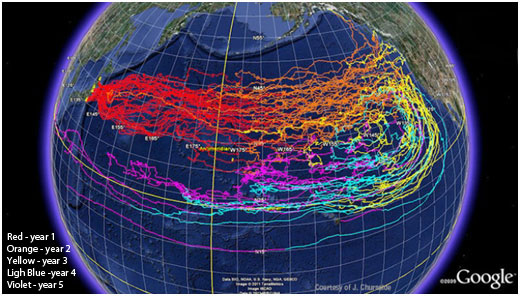 “The operator of the stricken Fukushima nuclear plant has been dumping something like a thousand tons per day of radioactive water into the Pacific ocean.
Remember, the reactors are ‘riddled with meltdown holes’, building 4 – with more radiation than all nuclear bombs ever dropped or tested – is missing entire walls, and building 3 is a pile of rubble.
The whole complex is leaking like a sieve, and the rivers of water pumped into the reactors every day are just pouring into the ocean (with only a slight delay).
Most people assume that the ocean will dilute the radiation from Fukushima enough that any radiation reaching the West Coast of the U.S. will be low.
For example, the Congressional Research Service wrote in April:
Scientists have stated that radiation in the ocean very quickly becomes diluted and would not be a problem beyond the coast of Japan.
***
U.S. fisheries are unlikely to be affected because radioactive material that enters the marine environment would be greatly diluted before reaching U.S. fishing grounds.
And a Woods Hole oceanographer said:
“The Kuroshio current is considered like the Gulf Stream of the Pacific, a very large current that can rapidly carry the radioactivity into the interior” of the ocean, Buesseler said.
“But it also dilutes along the way, causing a lot of mixing and decreasing radioactivity as it moves offshore.”
But – just as we noted 2 days after the earthquake hit that the jet stream might carry radiation to the U.S. by wind – we are now warning that ocean currents might carry more radiation to … some portions of the West Coast of North America than is assumed.” Read more.
‘Truly Frightening’: Higher and higher radioactivity levels expected to continue for years in bluefin tuna (Radio) – “It’s truly frightening. What happened was these fish were caught [and tested] five months after the accident…. but the research wasn’t published until June of this year… Scientists sat on this information for 8 or 9 months while they were waiting to get their report published… [The tuna] still had body burdens of both kinds of cesium — 134 and 137 — that were surprisingly high for a fish that had only been near Fukushima for a couple weeks. So my question is, ‘What’s been going on since then?’ cause we know that cesium has been continually released… It’s likely that the next catch of tuna that hasn’t made the scientific literature yet is going to be worse than the tuna that they caught. They caught 15 tuna and all 15 had high levels of cesium 134 and 137 in them… so one would expect that now as more and more tuna start to swim toward the United States we’ll see higher and higher levels of radioactivity in the tuna, and I don’t think that trend is going to stop for the next several years.” Listen to video below.
11th Hour Preppers: Greeks Withdraw $1 Billion A Day Ahead Of Vote, Begin Stocking Up On Non-Perishable Food Items
 Reuters, CNBC – “Greeks pulled their cash out of the banks and stocked up with food ahead of a cliffhanger election on Sunday that many fear will result in the country being forced out of the euro.
Bankers said up to 800 million euros ($1 billion) were leaving major banks daily and retailers said some of the money was being used to buy pasta and canned goods, as fears of returning to the drachma were fanned by rumors that a radical leftist leader may win the election.
The last published opinion polls showed the conservative New Democracy party, which backs the 130 billion euro ($160 billion) bailout that is keeping Greece afloat, running neck and neck with the leftist Syriza party, which wants to cancel the rescue deal.
As the election approaches, publishing polls is now legally banned and in the ensuing information vacuum, party officials have been leaking contradictory ‘secret polls’.
On Tuesday, one rumor making the rounds was that Syriza was leading by a wide margin.
‘This is nonsense,’ one reputable Greek pollster said on condition of anonymity. ‘Our polls show the picture has not changed much since the last polls were published. Parties may be leaking these numbers on purpose to boost their standing.’
The pollster said there was some consolidation, with voters turning to New Democracy and Syriza from smaller parties but the pool of undecided voters remained unusually large so close to the election and the result was impossible to predict.
Both parties say they want Greece to remain in the single currency but Syriza has pledged to scrap the bailout agreement signed in March which has imposed some of the toughest austerity measures seen in Europe in decades.” Read more.
Desert Locusts Swarm Across Libya And Algeria, Niger And Mali Warned Of Imminent Risk
 By Xan Rice, FT – “The death of Muammar Gaddafi continues to reverberate across Africa – this time in the form of desert locusts.
The Food and Agricultural Organisation of the United Nations warned on Tuesday that croplands in Niger and Mali were at imminent risk from locust swarms moving south from Libya and Algeria. The revolution in Libya played a major role in allowing the pests to breed, it said.
‘The fall of Gaddafi was an enormous factor, to be honest,’ said Keith Cressman, FAO senior locust forecasting officer. ‘It depleted the Libyans’ capacity to monitor and respond as they normally would.’
Insecurity along the Libya-Algeria border – a fallout from the uprising – meant that teams are still unable to properly spray the affected areas.
Desert locusts have the capacity to destroy vast areas of croplands. During a plague, a swarm can stretch for several hundred square kilometres comprising billions of locusts, each capable of eating its own weight in food a day.
A 2003-05 plague affected farmers in two dozen countries, mainly in Africa, and cost more than $500m to bring under control. The current infestation is nowhere near that level, but the FAO fears that the insecurity in Mali will hamper the response efforts there.
Desert locust swarms formed in Libya and Algeria in mid-May, after good rains and the resultant growth of vegetation on which they feed. The first swarms have already been sighted in northern Niger, which is currently experiencing a food crisis.” Read more.
Former Hedge Funder Presents A Terrifying Vision Of ‘The End Game’
By Max Nisen, Business Insider – “Everyday, we hear some pretty grim predictions about the markets and the economy. But this is one of the more comprehensive and most gloomy outlooks we’ve ever seen.
Raoul Pal expects a series of sovereign defaults, the ‘biggest banking crisis in world history’, and asserts that we don’t have many options to stop it.
Pal previously co-managed the GLG Global Macro Fund. He is also a Goldman Sachs alum. He currently writes for The Global Macro Investor, a research publication for large and institutional investors.
A note on the presentation; the last slide is not meant to suggest that we’re going back to the economic activity of 3000 years ago. It refers to the 3000 year old trade links between the nations along the Indian Ocean, which Mr. Pal believes will be the center of world’s opportunities. Just like the West 50 years ago, they have ‘…low debts, high savings and a young population’.” Source – Business Insider.
Serving Tuna With A Geiger Counter, ‘The World’s Food Chain Could Be Compromised’
 By The Oregonian Editorial Board – “The finding reported last week that bluefin tuna caught off southern California carried low levels of nuclear radiation from Japan was another signal the world’s food chain could be compromised. It also showed how efficient natural systems are at distributing radioactivity from the Fukushima-Daiichi plant that blew up last year.
Bluefin tuna spawn only off the coasts of Japan and the Phillippines, and some migrate to the waters off southern California and Baja. The tuna caught off southern California, according to the study published in the Proceedings of the National Academy of Sciences, contained elevated levels of cesium 134 — a radioactive isotope otherwise absent in the Pacific Ocean and linked with nuclear production. The fish also contained elevated levels of cesium 137, already present in the eastern Pacific.
The findings were a surprise to the researchers. But they prompted no warnings that eating bluefin tuna would pose an increased cancer risk, because even the elevated radioactivity levels detected were well below thresholds considered safe. Meanwhile, the fish tested were never intended for sale to food markets, so it seems as safe to order tuna sushi in Portland now as it was two or four years ago.
But the unmappable spread of radioactive particles reveals some large knowledge gaps. The migratory bluefin tuna was never before identified as a transport vector for radioactive particles.
Japan fell into a food emergency within days of the Fukushima-Daiichi failure and remains so. Radioactive particles quickly showed up in vegetables, beef, fish and even rice. Thousands of Japanese citizens, misled by their government’s early underestimates of radiation exposure, insist on the use of Geiger counters at markets and restaurants to ensure safety.” Read more.
‘The Worst Crisis We Have Ever Lived Through’: Spain Faces ‘Total Emergency’ As Global Markets Tumble
 By Ambrose Evans-Pritchard, The Telegraph – ““We’re in a situation of total emergency, the worst crisis we have ever lived through” said ex-premier Felipe Gonzalez, the country’s elder statesman.
The warning came as the yields on Spanish 10-year bonds spiked to 6.7pc, pushing the ‘risk premium’ over German Bunds to a post-euro high of 540 basis points. The IBEX index of stocks in Madrid fell 2.6pc, the lowest since the dotcom bust in 2003.
Chaos over the €23.5bn rescue of crippled lender Bankia has led to the abrupt resignation of central bank governor Miguel Ángel Fernández Ordóñez, who testified to the senate that he had been muzzled to avoid enflaming events as confidence in the country drains away.
Markets are on tenterhooks as Spanish yields test levels that forced the European Central Bank to respond last November with its €1 trillion liquidity blitz. ‘Nobody is short Spanish debt right now because they are expecting ECB intervention,’ said Andrew Roberts, credit chief at RBS. ‘If it doesn’t come — if we take out 6.8pc — we’re going to see a hyberbolic sell-off,’ he said.
Italy felt the full brunt of contagion from Spain on Wednesday, with 10-year yileds back near 6pc. The euro fell to a 2-year low of $1.239 against the dollar. Crude oil and metal prices plummeted and save-haven flight pushed rates on 2-year German debt to zero. Gilt yields fell to 1.64pc, the lowest in history.” Read more.
World markets tumble back into the red as fears grow Spain will need an EU bailout – “World markets tumbled back into the red today as fears grew Spain will need an EU bailout. The Dow Jones Industrial Average was down more than 1 per cent on doubts the nation will be able to afford to recapitalise its fourth biggest lender Bankia. There are also increasing worries that other Spanish banks will also need bailing out. The FTSE 100 Index was nearly 2 per cent or 96.8 points lower at 5295.3 as Spain saw the yield on its 10-year bonds rise to a record euro-era high of 6.68 per cent at one stage. This is close to the 7 per cent level that pushed Greece, Ireland and Portugal into taking a bailout in a sign that investors had little faith in the country’s ability to deal with its debts. Chris Beauchamp, market analyst at IG Index, said: ‘Investor confidence wanes by the day, and it could only be a matter of time before the Spanish government is forced to ask for financial aid.'” Read more.
Lloyd’s Of London Preparing For Euro Collapse As Greece Is Warned Of Possible Public Finances Collapse
 By Andrew Cave, The Telegraph – “Richard Ward said the London market had put in place a contingency plan to switch euro underwriting to multi-currency settlement if Greece abandoned the euro.
In an interview with The Sunday Telegraph he also revealed that Lloyd’s could have to take writedowns on its £58.9bn investment portfolio if the eurozone collapses.
Europe accounts for 18pc of Lloyd’s £23.5bn of gross written premiums, mostly in France, Germany, Spain and Italy. The market also has a fledgling operation in Poland.
Lloyd’s move comes as a major Franco-German provider of credit insurance for eurozone trade, Euler Hermes, said it was considering reducing cover for trade with Greece because of the risk the country might leave the eurozone.
When a company goes bust, it is often sparked by withdrawal of credit insurance for suppliers wanting to trade with it.
A spokesman for Euler Hermes, Bettina Sattler, told Bloomberg: ‘The outcome of the new elections in June remains highly uncertain. Consequently, the situation is further deteriorating. The risk of Greece exiting the eurozone has been revived.
‘In light of the recent developments, Euler Hermes will most probably have to switch to a more prudent approach. [We have] maintained a high level of cover for [our] customers until today. But now we are confronted with a changing situation.’
Lloyd’s fears are likely to be shared by a number of European businesses, which are watching developments in Greece.” Read more.
Greece warned of public finances collapse – “Greece’s public finances could collapse as early as next month, leaving salaries and pensions unpaid unless a stable government emerges from the June 17 election, according to Lucas Papademos, the technocrat prime minister who left office after this month’s inconclusive vote. Mr Papademos warned that conditions were deteriorating faster than expected with cash flow likely to turn negative in early June amid a sharp fall in tax revenues and a loosening of spending controls during two back-to-back election campaigns.” Read more.
Georgia: More Fish Found Dead In Ogeechee River Just One Year After Largest Fish Kill In State History
 By Meredith Ley, WSAV – “STATESBORO, GA — Just one year after the largest fish kill in Georgia history, more fish have been found dead along the Ogeechee River banks–prompting a swimming and fishing advisory in Bulloch and Effingham counties.
Nearly forty thousand fish died in the Ogeechee River last year. A textiles company — King America Finishing — was found to be at least partly to blame.
Here is the breakdown:
King America was fined one million dollars for illegal dumping of several chemicals not allowed in its permit.
Those include formaldehyde and ammonia.
The dumping had been going on for five years.
Just after our story aired this Monday on news three at six a viewer called and said he had seen more dead fish at 301 landing.
The Ogeechee Riverkeeper spent most of yesterday searching the river, and found more.
Then Thursday, the DNR was out at Oliver Bridge near Statesboro collecting even more dead fish.
So far at least four species of fish, plus some crawfish, are dying. They say this raises concern because, whatever is causing it, it’s affecting many different kinds of life in the river.
DNR says there are a few things that could be causing this.
First, water levels are even lower than they were this time last year.
Combine that with warmer water temperatures and the lack of rain — and it makes the perfect breeding ground for bacteria.
The Environmental Protection Division determined that the fish last year died of Columnaris, a bacterial disease caused by environmental stressors…
Regular testing by King America Finishing and the company’s contractor shows the river meets water quality standards, and there are no areas of concern.” Read more.
India: Thousands Of ‘The Most Resilient Species Of Fish’ Found Dead Along The Mula-Mutha River
 Pune Mirror – “The problem of fish dying in large numbers has come to the fore of the banks of the Mula-Mutha (Bheema) rivers again. Fish have been found dead along the banks of the Mula-Mutha because of rising pollution and the latest in the series was recorded at Hatvalan near the Pune-Daund border last week.
Since last week, thousands of Mozambique Tilapia fishes were found dead on the river banks at Hatvalan in Daund division, about 76 km from Pune.
The fish apparently died because of thick blackish water flowing in the river bed. Ironically, Mozambique Tilapia is considered as one of the most resilient species of fish, known to withstand unfriendly environmental conditions.
To make matters worse, the same dead fish were taken to market to be sold by local fishermen…
Dr Ashok Rasage, taluka medical officer of Daund, said, ‘For a week, large numbers of fish were found on the river banks. We have sent them and the samples of water to the state health laboratory and are waiting for the lab report.’
Dr Sudhakar Kokane, district health officer, also confirmed the incident but said he would get more information from officials.” Read more.
Former Finance Minister: Greece Crisis Threatens To ‘Open Door To Hell’, Could Cause Bank Run Across Continent
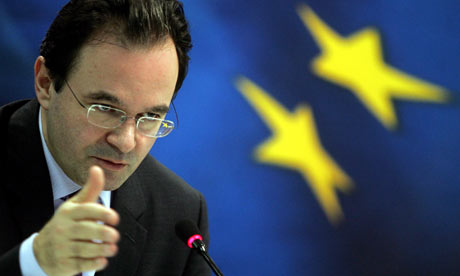 By Joel Hills, Sky News – “Greece’s former finance minister has told Sky News that if Greece reneges on its bailout deal with the EU and the IMF it will ‘open the door to hell’.
Sky News last interviewed George Papaconstantinou two-and-a-half years ago.
In December 2009 he told how Greece could survive independently and Greece’s creditors had nothing to fear – they would get back every euro they were owed.
A lot has changed since then.
Greece is in the process of borrowing 240bn euros of emergency loans from the EU and the IMF (in return for pledges to raise taxes, cut spending and balance the books) and investors holding Greek debt have been forced write off up to 50% of their money.
Even now Greece remains heavily in debt, deep in recession (now in its fifth year) and without a functioning elected government.
Mr Papaconstantinou lost his position as finance minister last summer, shortly after the second bailout package was agreed.
In the general election, two weeks ago, he also lost his seat as an MP. He was not alone as support for his Pasok party collapsed.
The result of the election was inconclusive and, ultimately, no party was able to form a coalition government. In four weeks’ time Greece will vote again.
The opinion polls suggest that were an election to be held tomorrow the result would, once again be inconclusive, but the Syriza party, which is promising to ‘tear up’ the bailout agreement with the EU and the IMF, continues to attract support…
Interestingly, he admits there are elements of the bailout deal that he would seek to renegotiate but he says if Greece were to do what Syriza’s leader, Alexis Tsipras, is proposing and fail to honour the promises the country has made in return for emergency funding then the results would be disastrous.
‘The extremist parties are lying to the Greek people because they are not telling them that reneging on the agreement means that you have opened the door to hell,’ he said.” Read more.
EU banks fear a Greek exit could cause bank run across continent – “… the continent’s financial system remains vulnerable to the prospect that stampedes of customers could yank their deposits from institutions perceived as shaky. That threat was shoved into the spotlight last week when customers withdrew more than €700 million from Greek banks in a single day… If Greece leaves the eurozone, it will almost certainly restrict bank customers from moving their money out of the country. That could prompt depositors in struggling countries such as Spain and Portugal to … pre-emptively transfer their funds out of their countries to avoid having their savings converted into rapidly devalued Spanish pesetas and Portuguese escudos. ‘That’s what markets are starting to worry about,’ Bodereau said. ‘It takes you to a whole different level of liquidity crisis.'” Read more.
 Israel National News
- Israel Air Force intercepts more than 90 percent of drones launched from Lebanon and Iran
- Alerts sounded on northern border following firing of rockets from Lebanon
- IDF begins wave of strikes on Hezbollah infrastructure in Beirut
- Wizz announces the cancellation of flights to Israel until April 14
- IDF bombed largest steel factories in Iran
- Israel and US are attacking steel plants in southwestern Iran and in the center of Isfahan
- IDF issues evacuation warning for the Arak area in western Iran
- Watch: Shayetet 13 exposes weapon found in a school in southern Lebanon
- Watch: Damage caused by interception debris to two buildings in Kfar Saba
- Footage from Dan Akadia hotel in Herzliya shows site of fallen shrapnel, no injuries reported
FrontPage Magazine
- Olympics Bans Men in Dresses From Competing Against Women
- Chinese Brother and Sister Planted Bomb at Air Force Base
- Rabbi Sentenced for ‘Vandalizing’ ‘Mural’ by Hamas Supporter
- The Jew-Hating Classroom
- Europe to Euthanize Girl Raped by Migrants
- Jews and Christians: United We Stand, Divided We Fall
- An Act of War From China?
- Supreme Court to Decide Definition of “In the United States”
- Video: Rare Moment of Truth at the UN
- Rama Duwaji, and Judging Mamdani by the Company He Keeps
Gatestone Institute
- Iran's Fantasy of Strength: When Bazaar Tactics Collide with Reality
- Arabs Did Not Help the Gulf States: What Do they See as the Central Source of Instability in the Middle East?
- Birthright Citizenship is National Suicide
- Disarming Hamas Must Remain Trump's Top Priority in Gaza
- Courage, Not Recklessness: Why Netanyahu and Trump Were Right on Iran
- The Quantum Giant That Will Demand Fusion Power
- China Is About to Lose Its Cuban Military Bases
- Begging Hamas to Disarm - The Misguided Approach of Trump's 'Board of Peace'
- 'What Do You Think Will Happen When They Are in the Majority?': The Persecution of Christians, December 2025
- One War and 5 Scenarios to End It
Middle East – The Jerusalem Post
- Iran's response to US peace proposal expected Friday, source says
- US, Israeli strikes hit Iranian nuclear development facilities, state media claims
- Huge Iranian missile fragments, intercepted by air defenses, lay scattered across Israel, West Bank
- Gulf states tell US ending the war is not enough, Iran’s capabilities must be degraded - analysis
- IDF finds Hezbollah tunnel near south Lebanon church as group 'exploits' Christian population
- US can only confirm about third of Iran's missile arsenal destroyed, sources say
- Russia aiding Iran with targeting data to distract from 'crimes' in Ukraine, German FM says
- IRGC issues evacuation warning for civilians close to US forces in Gulf States
- Iran war reshapes diplomacy as old dealmakers are sidelined - who replaces them?
- Pakistan says US-Iran backchannel talks continue despite Tehran rejecting 15-point plan
Earthquakes & Volcanic Activity
- World Earthquake Report for Friday, 27 March 2026
- Sangay Volcano Volcanic Ash Advisory: PSBL LGT VA EM
- Santiaguito Volcano Volcanic Ash Advisory: VA EM OBS to 14000 ft (4300 m)
- Volcanoes Today, 27 Mar 2026: Santiaguito volcano, Fuego, Semeru, Ibu, Reventador, Mayon, Sangay, Canlaon
- Reventador Volcano Volcanic Ash Advisory: NEW VA EMS. to 14500 ft (4400 m)
- Fuego Volcano Volcanic Ash Advisory: ONGOING VA EMS. to 14000 ft (4300 m)
- Mayon Volcano Volcanic Ash Advisory: ERUPTION AT 20260327/1224Z VA CLD UNKNOWN REPORTED OBS VA DTG: 27/1220Z
- Ibu Volcano Volcanic Ash Advisory: VA TO FL060 REP AT 27/1003Z MOV NE EST VA DTG: 27/1110Z to 6000 ft (1800 m)
- Semeru Volcano Volcanic Ash Advisory: VA REPORTED TO FL150 AT 27/0802Z EST VA DTG: 27/1030Z
- Mayon Volcano Volcanic Ash Advisory: ERUPTION AT 20260327/0532Z FL090 EXTD WSW REPORTED OBS VA DTG: 27/0530Z
Islamic Terrorist Network In America

Click For Larger Version


Click To Learn What Makes This An Idol

 MidnightWatcher - Prophecy in Motion
Recent Comments