Archive
Norway: 20 Tons of Dead Fish Suddenly Disappear from Norwegian Beach
Here’s an odd update on this story. I’d say that the whole thing smells fishy, but that’s kind of hard to do now with the fish all gone. They’re swimming with the fishes, as it were. It turns out that Tide isn’t only great for cleaning dirty clothes. It works on beaches, too …
 By Brad Lendon (CNN) – “Tons of dead herring that washed up on a Norwegian beach on New Year’s Eve are now gone, and no one is sure how they got there or where they went.
Local resident Jan-Petter Jorgensen told Norway’s TV2 he went to look at the thousands and thousands of fish after seeing a Facebook posting about them, according to a report on The Foreigner.
Joregensen said it was fortunate the icy cold prevented the mass of dead fish from raising a stink.
‘It is 15 degrees below zero today, so the cold means they don’t smell. Nevertheless, the smell will be pretty intense in the long run,’ he said, according to The Foreigner report.
Turns out that wasn’t a problem. Views and News from Norway reports that as of Tuesday, most of the dead fish were gone, perhaps pushed out to sea by tides and winds. The local mayor said they’ll likely sink in the ocean, according to the report.
Why they came to be on the shore remains a mystery.
Jens Christian Holst of the Institute of Marine Research in Norway told Norwegian Broadcasting the herring may have been chased ashore by predators, the Views and News report said.
‘In this area, we know there is a lot of (pollock) that graze on (herring),’ he said.
Seems like a reasonable explanation.” Read more.
India: Death of Hundreds of Crows Triggers Panic in Odisha
 By Akshya Rout, Jajpur -“The death of many crows triggered panic among residents in Jajpur Road on Thursday who have been advised by forest and veterinary officials not to touch the carcasses.
‘Around 250 crows died in Jajpur Road on Thursday . People of the affected areas were instructed not to handle the dead crows without gloves. They were also instructed to bury the dead crows by digging deep holes so that the disease cannot not spread to more areas’, said Dr K. Mohanty the Chief District Veterinary Officer (CDVO) of Jajpur on Thursday.
‘The panic is caused by the simple fact that crows tend to hover around human settlements and stay in close contact with humans and recently many crows died of the deadly disease bird flu or H5N1 virus in Jharakhanda areas bordering Odisha’, added Dr Mohanty.
Keeping in view the arrival of migratory birds in this winter , the veterinary department is ascertaining the sudden rise in the death of crows in Jajpur Road. , added Mohanty. A two member team of Animal Disease Research Laboratory (ADRL) collected samples of ten dead crows in Jajpur Road on Thursday which will be sent to the Bhopal’s Indian Veterinary Research Institute to ascertain the cause of the crows’ large-scale death , said Mohanty.” Read more.
Norway: Up to 20 Tons of Dead Herring Wash Ashore in Troms, Cause Unknown
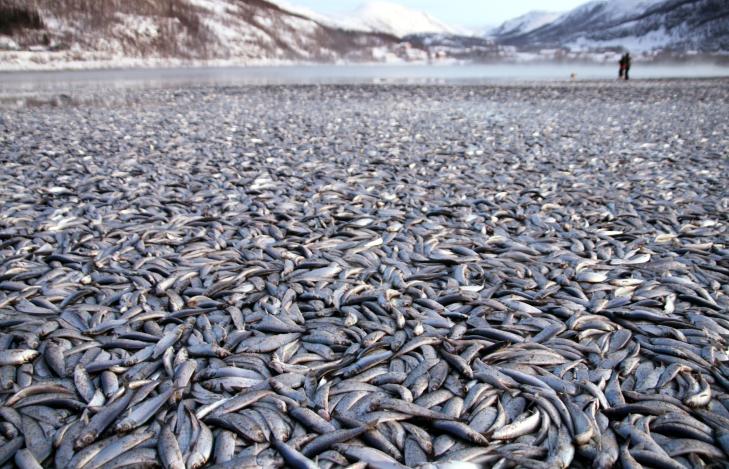 Update: They’ve all just ‘disappeared‘ …
By Ralf Lofstad – (via Google Translate) – “(Dagbladet): The inhabitants of resin in Troms could hardly believe his eyes on the morning of New Year’s Eve, the beach was a large amount, an estimated tens of tons, dead herring, writes Northern Lights .
Various theories
No one knows for sure what’s happened in the popular hiking area in Nordreisa municipality. However, various theories have been tossed around, explains Jan-Petter Jorgensen (44), who took mass death in sight on the beach with his dog Molly.
– People say that something similar happened in the 80s, and there is speculation among others on the river which flows into the ocean behind a promontory on the site, may have had something to say. Maybe the fish have been caught in the long due, and then died of fresh water? Jorgensen says to Dagbladet.
He estimates each individual fish to be of 100-150 grams, and that the total might be about up to 20 tons. Now he’s worried about what might happen if no one comes and removing carcasses.
– When we talk about an environmental problem, the fish are in full resolution.” Read more.
Arkansas: Hundreds of Dead Birds Fall from Sky in Town For Second New Year’s Eve in a Row
 Associated Press – “BEEBE, Ark – Blackbirds have fallen dead from the sky in a central Arkansas town for the second New Year’s Eve in a row.
KATV showed a radar image that it said showed a large mass over Beebe a few hours before midnight Saturday. The Little Rock television station reported that hundreds of birds had died.
Beebe animal control worker Hearst Taylor told KATV the reason for the bird deaths isn’t yet known.
Last year, fireworks were blamed for the deaths of thousands of birds. It wasn’t immediately clear if year-end celebrations are again to blame.
Beebe police imposed an impromptu fireworks ban Saturday night.
Biologists said last year’s kill was caused by the birds being rousted from their roosts and flying into homes, cars, telephone poles and each other.” Source – Fox News.
Flashback: 5000 Blackbirds Fall From Sky in Beebe, Arkansas – “Times Square had the ball drop, and Brasstown, N.C., had its descending possum. But no place had a New Year’s Eve as unusual, or freakishly disturbing, as Beebe, Ark. Around 11 that night, thousands of red-winged blackbirds began falling out of the sky over this small city about 35 miles northeast of Little Rock. They landed on roofs, roads, front lawns and backyards, turning the ground nearly black and terrifying anyone who happened to be outside. ‘One of them almost hit my best friend in the head,’ said Christy Stephens, who was standing outside among the smoking crowd at a party. ‘We went inside after that.'” Read more.
India: Mysterious Fish Deaths Continue in Bavla Pond, The Water ‘Has Turned Black’
 “Five days after it was first reported, fish continued to die in a pond at Kerala village near Bavla in Ahmedabad district on Monday.
‘Everyday, fish in huge quantites are dying. The water has turned black and we still do not have any clue as to what has happened to the pond,’ Kerala sarpanch Subhash Thakar told The Indian Express.
The sarpanch said that more than four tonnes of fish have died mysteriously since last Wednesday. ‘As instructed by the health officials, we have buried the dead fish by using earth movers and tractors. We are also cleaning the pond,’ Thakor added.
C A Shah, Gandhinagar regional officer of the Gujarat Pollution Control Board (GPCB), said they were waiting for the results of the sample testing of water from the pond. ‘We have listed the samples as urgent. Normally, it takes four to five days for the results,’ Shah said.
V M Rupani, assistant director at Ahmedabad district fisheries department, confirmed that water body has turned black. ‘I suspect, effluent released by nearby industrial units is responsible for the phenomenon,’ he said.
There is a bearing manufacturing unit and a rice mill near the pond, which is spread over five acres.” Source – IndianExpress.com.
Scientists Test Sick Alaska Seals for Fukushima Radiation
Here’s an update on this story …
 By Bill Rigby – “SEATTLE — Scientists in Alaska are investigating whether local seals are being sickened by radiation from Japan’s crippled Fukushima nuclear plant.
Scores of ring seals have washed up on Alaska’s Arctic coastline since July, suffering or killed by a mysterious disease marked by bleeding lesions on the hind flippers, irritated skin around the nose and eyes and patchy hair loss on the animals’ fur coats.
Biologists at first thought the seals were suffering from a virus, but they have so far been unable to identify one, and tests are now underway to find out if radiation is a factor.
‘We recently received samples of seal tissue from diseased animals captured near St. Lawrence Island with a request to examine the material for radioactivity,’ said John Kelley, Professor Emeritus at the Institute of Marine Science at the University of Alaska Fairbanks.
‘There is concern expressed by some members of the local communities that there may be some relationship to the Fukushima nuclear reactor’s damage,’ he said.
The results of the tests would not be available for ‘several weeks,’ Kelley said.” Read more.
Alaska: Deaths of Ringed Seals Declared an ‘Unusual Mortality Event’, Cause Remains Unknown – “The National Oceanic and Atmospheric Administration today declared the recent deaths of ringed seals in the Arctic and Bering Strait regions of Alaska an unusual mortality event, triggering a focused, expert investigation into the cause of these deaths. Since mid-July, more than 60 dead and 75 diseased seals, most of them ringed seals, have been reported in Alaska, with reports continuing to come in. During their fall survey, scientists with the U.S. Fish and Wildlife Service also identified diseased and dead walruses at the annual mass haul-out at Point Lay. A decision by the Service on making an an unusual mortality declaration for Pacific walrus in Alaska is pending.” Read more.
Greece: Environment Group Warns of Large Number of Marine Mammal Deaths After Dead Sea Turtles, Fish, Whales Found Dead
 “Corfu-based environmental group Archipelagos on Tuesday published a report warning of a large number of dead marine mammals and fish washed up on the coasts of the islands of the Ionian, Kathimerini has learned, following the alarming finding earlier this month of at least 10 dead whales on the coast of Corfu.
The report cited additional findings of dead sea turtles, hundreds of fish, more washed-up carcasses of large marine mammals such as the beaked whales and the disappearance of one Mediterranean monk seal from the Corfu coast, while also quoting fishermen who have noted a significant drop in fish populations throughout the western Greece coastal zone, from the western coast of Messinia in the south to the northern Ionian.
Samples taken by scientists working for Archipelagos from the dead beaked whales are being examined to determined what killed them, including high levels of toxicity and heavy metals, or disease.
‘This is without doubt a very painful event, which is taking place in the closed sea of the Mediterranean and which is of great concern to us and should alarm the scientific community and the authorities, given that the cause of death may be related — either directly or indirectly — to human activity,’ the group said in its report.” Read more.
Utah: Hundreds of European Starlings Found Dead in Davis County
 AP – “CLEARFIELD — Officials have spent the last few days cleaning up after a number of European starlings were found dead near a Davis County park.
It is estimated that close to 400 birds have been found in the area of Kiwanis Park, near 300 North and Vine Street, since Saturday, according to J.J. Allen, assistant Clearfield city manager. That said no one knows who made the decision to place pellets, which are clearly visible, in the area.
‘We had been told by the state Division of Wildlife Resources that the U.S. Department of Agriculture Wildlife Services Division had raided European starlings, but now DWR is retracting the statement,’ Allen said. ‘Nobody is taking responsibility.’
A large number of birds were also found dead near 1000 West and 1800 North in Clinton, said Clint Thacker, director of Animal Care and Control for Davis County. The cause of that incident was equally mysterious.
Mike Linnell of the U.S. Department of Agriculture said his organization was not responsible for the deaths. He explained that European starlings are an invasive species that are not protected and could be shot on sight.
Area resident John Egbert said he’s lived near Kiwanis Park since 1970 and had never seen such a large number of birds. He said they take up camp in 15 or so large pine trees in the park and look like “a big gob” that entirely cover the trees.
‘I have never seen the birds in the fall that come together — it’s not a flock, they’re like swarms,’ he said. ‘We’re talking thousands and thousands of birds. They come in and it looks like a cloud.’
But Allen said that, for now, whatever is killing the birds remains a mystery.” Read more.
Alaska: Deaths of Ringed Seals Declared an ‘Unusual Mortality Event’, Cause Remains Unknown
 ENS – “JUNEAU, Alaska, December 20, 2011 (ENS) – The National Oceanic and Atmospheric Administration today declared the recent deaths of ringed seals in the Arctic and Bering Strait regions of Alaska an unusual mortality event, triggering a focused, expert investigation into the cause of these deaths.
Since mid-July, more than 60 dead and 75 diseased seals, most of them ringed seals, have been reported in Alaska, with reports continuing to come in.
During their fall survey, scientists with the U.S. Fish and Wildlife Service also identified diseased and dead walruses at the annual mass haul-out at Point Lay.
A decision by the Service on making an an unusual mortality declaration for Pacific walrus in Alaska is pending.
Seals and walruses suffering from this disease have skin sores, usually on the hind flippers or face, and patchy hair loss. Some of the diseased animals have exhibited labored breathing and appear lethargic and do not flee from humans as they usually do.
Scientists have not yet identified a single cause for this disease, though tests indicate a virus is not the cause.
Dr. Stephen Raverty, veterinary pathologist with the Provincial Veterinary Diagnostic Lab in British Columbia, told reporters on a conference call today that the lesions on these animals are much more severe than the patchy hair loss usually seen.
‘These appear to be ulcerated lesions with secondary infections,’ he said. ‘Opportunistic yeast and fungi and bacteria have invaded.’
But Dr. Raverty said scientists still have not determined the cause or causes of these deaths. ‘Our analysis is not completed,’ he said. ‘It could be an environmental factor or more than one disease.’
‘We have forwarded the sampled tissues to labs – bacteria, mycology, virology,’ he said. ‘We are screening for 18 recognized pathogens, but all the lab results have come back negative.'” Read more.
New Mexico: Possibly Hundreds of Dead Crows Found in Mesilla Valley Bosque State Park, Many Perched on Trees ‘Just Fell Over Dead’
 By Ashley Meeks – “LAS CRUCES – The Mesilla Valley Audubon Society counts birds every year – but it usually focuses on birds of the living variety.
This year, during the 36th annual Christmas Bird Count, participants found something quite different: piles of dead crows, possibly hundreds of them, at the Mesilla Valley Bosque State Park, says participant Ken Stinnett, who’s been doing bird counts since 1969.
‘I discovered, in the river and along the west side of the river quite a few dead birds,’ he said Tuesday. ‘Ninety-nine percent of them, of course, were American crows. I saw one Chihuahuan raven and later I saw one Brewer’s blackbird had been affected.’
As part of the survey, participants are assigned to various portions of a 15-mile circle that includes the river, La Cueva near the Organ Mountains, parts of U.S. 70 in the north and portions of the South Valley.
While some of the birds were found dead at the water’s edge, others, ‘it was obvious they died when they were perched in the trees, and just fell over dead,’ said Stinnett. The only bodies of water that appeared to be affected were between the Mesilla Dam and the Santo Tomas Bridge, downstream from Las Cruces, Stinnett said.
‘There were other areas of water that had ducks, geese, sandpipers and killdeer that were not affected,’ Stinnett said. ‘There were crows drinking water there and flying off like crows do.’
Park rangers were notified and officials from the USDA picked up the carcasses to perform necropsies, said Stinnett, who said the sight was quite disconcerting.” Read more.
Australia: ‘Sea of Dead Fish’ at Buffalo Creek Blamed on Too Much Rain
 By ELLIE TURNER – “RAW sewage was the first suspect in the hunt for the killer.
But authorities say a sea of dead fish that yesterday scared hook-wielding locals at Buffalo Creek was probably the result of too much rain.
The NT News was alerted to the demise of hundreds of small water dwellers like salmon, white bait and mullet.
Nightcliff resident Peter Clipsy said he was leaving a nearby inlet when he saw the pontoon of death.
‘There are masses,’ he said.
‘The place is usually busy with fishermen – today there was nobody.’
But NT Amateur Fishermen’s Association chief Chris Makepeace said the ‘fish kill’ often came with the first big rains of the Wet when fresh water flushed out oxygen.
‘In billabongs there can be thousands of dead fish – big ones like barra.
‘Here is sounds like just the smaller fish were affected.
‘The storms are stirring up the water – there’s heaps of rain coming off banks and depending what’s happening in creek it can reduce the oxygen level.’
He said it looked bad but was only nature’s wicked way.
‘Some people say it’s the sewage that gets pumped in there but I don’t think we can blame it this time.
‘It’s a fish’s life.'” Source – NT News.
Texas: Worst Drought in State History Responsible for Largest-Ever One-Year Decline in Cattle Herd
 By BETSY BLANEY – “LUBBOCK, Texas (AP) – The worst drought in Texas’ history has led to the largest-ever one-year decline in the leading cattle-state’s cow herd, raising the likelihood of increased beef prices as the number of animals decline and demand remains strong.
Since Jan. 1, the number of cows in Texas has dropped by about 600,000, a 12 percent decline from the roughly 5 million cows the state had at the beginning of the year, said David Anderson, who monitors beef markets for the Texas AgriLife Extension Service. That’s likely the largest drop in the number of cows any state has ever seen, though Texas had a larger percentage decline from 1934 to 1935, when ranchers were reeling from the Great Depression and Dust Bowl, Anderson said.
Anderson said many cows were moved ‘somewhere there’s grass,’ but lots of others were slaughtered. He said that in Texas, Oklahoma, New Mexico, Louisiana and Arkansas, about 200,000 more cattle were slaughtered this year, a 20 percent increase over last year.
That extra supply could help meet increased demand from China and other countries, but the loss of cows likely will mean fewer cattle in future years.
‘Consumers are going to pay more because we’re going to have less beef,’ Anderson said. ‘Fewer cows, calves, less beef production and increasing exports.’
The U.S. Department of Agriculture estimates that beef prices will increase up to 5.5 in 2012, in part because the number of cattle has declined. That follows a 9 percent increase in beef prices in the past year.
Oklahoma, the nation’s second-largest cattle producer, also saw about a 12 percent drop in cows, Oklahoma State University agriculture economist Derrell Peel said.
Anderson said beef production nationally will be down 4 percent next year.
In Texas, the problem is primarily due to the worst single-year drought in the state’s history. From January through November the state got just 46 percent of its normal rainfall of about 26 inches.” Read more.
 Israel National News
- CJCS Gen. Dan Caine: Every mission designed to bring overwhelming outcomes
- Watch: US Army destroys Iranian ships
- Sirens sound in northern Israel
- Unusual discovery in Bnei Brak parking lot
- Arab dressed as haredi arrested for theft
- By The Numbers: Who are the IDF's reservists?
- IDF eliminates Basij Force soldier in western Iran
- History made in Samaria: IEC connects Homesh to electric grid
- End of Days
- A dependent existence
FrontPage Magazine
- 6 Squad Members, Including 2 Muslims, Lose in Illinois Dem Primaries
- Can Visa Bonds End Tourism Mass Migration?
- Joe Kent and Too Many Ex-CIAers in Politics
- Joe Kent Quit Because Iran ‘Posed No Imminent Threat to Our Nation’
- Mamdani Proposes ‘White Homes’ Estate Tax
- It’s Not Racist to be a “Culturist”
- The Feminists Who Hate MAGA More than They Hate the Mullahs
- Islam’s Classroom Takeover in Philly
- Jamie Glazov on The Shaun Thompson Show: United in Hate
- Establishing a Theocratic Totalitarian Rogue State
Gatestone Institute
- US Direct Talks with Hamas: Legitimizing and Empowering Terrorists
- Why Iran Was Always a Threat to the US
- Iran Picked a Fight with the Wrong President
- Iran's 'Doomsday Clock' Against Israel No Longer Ticking But Guess Who Is Waiting in the Wings
- Why Applying the 'Venezuela Method' to Iran Would Be a Terrible Mistake
- Hamas Crimes No One Talks About
- Trump's Iran War Ending Xi Jinping's 'China Dream'
- Iran Gets a New Supreme Guide
- 'Trump Derangement Syndrome': The Danger of Hatred Clouding Perception
- Spain's Pedro Sánchez and His Extremist Problem
Middle East – The Jerusalem Post
- Lebanon’s Bassil urges neutrality as Hezbollah-Israel clashes escalate
- Kataib Hezbollah signals temporary pause in Iraq attacks amid strict conditions
- Fanning flames of war, Iran appears to activate Gulf terror cells as conflict expands - analysis
- Iran hangs three, including national wrestling champion, in connection with January protests
- Iran revives ‘Zionist sorcery’ claims in propaganda against Israel
- Iran nears three weeks offline as regime braces for renewed demonstrations
- Iran attacks pushing Gulf's Arab states toward unity, possible action against Tehran - analysis
- Mossad slams regime's use of mosques as military posts, allegedly threatens Iranian commanders
- Iran considers transit fees for ships passing through strategic Strait of Hormuz
- IAF destroys IRGC helicopter at airport, targets Basij operatives in western Iran
Earthquakes & Volcanic Activity
- Volcanoes Today, 19 Mar 2026: Fuego volcano, Popocatépetl, Merapi, Semeru, Shiveluch, Ibu, Dukono, Marapi
- World Earthquake Report for Thursday, 19 March 2026
- Shiveluch Volcano Volcanic Ash Advisory: VA CONTINUOUSLY OBS IN SATELLITE IMAGERY OBS VA DTG: 19/1120Z to 36000 ft (11000 m)
- Ibu Volcano Volcanic Ash Advisory: ERUPTION LAST REPORTED AT 19/0633Z EST VA DTG: 19/1130Z
- Reventador Volcano Volcanic Ash Advisory: CONS VA EMS to 15000 ft (4600 m)
- Mayon Volcano Volcanic Ash Advisory: ERUPTION AT 20260319/0954Z FL110 EXTD SW REPORTED OBS VA DTG: 19/1020Z
- Lewotobi Volcano Volcanic Ash Advisory: VA TO FL090 REPORTED FM GND AT 19/0636Z MOV NNE to 9000 ft (2700 m)
- Piton de la Fournaise volcano (La Réunion): lava flow front continues to occupy shoreline by building new lava delta
- Aoba Volcano Volcanic Ash Advisory: ERUPTION AT 20260319/0500Z CONTINUOUS VA EMISSIONS to 15000 ft (4600 m)
- Fuego Volcano Volcanic Ash Advisory: VA EMS OBS IN WEBCAM
Islamic Terrorist Network In America

Click For Larger Version


Click To Learn What Makes This An Idol

 MidnightWatcher - Prophecy in Motion
Recent Comments