Archive
India: Hundreds of Crow Deaths Create Panic Among Local Residents in Bishnugarh
 “HAZARIBAG: After Jamshedpur, Bokaro and Ranchi, reports of deaths of 250 crows at a single spot in Bishnugarh and about 50 crows in Katkumsandi block of Hazaribag district in the past 48 years have created panic among the local people.
District animal husbandry officer Yamuna Prasad said after getting reports of such a largescale deaths of crows in some parts of the district, the department had deputed employees to create awareness among the villagers at every 5km with necessary instruction.
State coordinator of the Indian Bird Conservation Network (IBCN) Satya Prakash said the Union government had sent experts team to Jamshedpur and Bokaro to take blood samples of the dead crows and had mentioned that the crows died of H5N-1.
‘The birds died there because of some virus which may be the same that resulted in a large number of deaths in Jamshedpur, Bokaro and Ranchi,’ said Prakash who visited Katkumsandi to review the situation.” Read more.
Nepal: More Than a Thousand Chickens Die of Unknown Disease, Bird Flu Ruled Out
 “BOKSE: It has been proved that there is no bird flu after tests of the dead broiler chickens were made a few days ago in Ghurmi Bazaar of Lekhani VDC of Udayapur district.
Although bird flu was not found, the reason could not be revealed from the test in the Central Livestock Disease Control Lab in Kathmandu conducted for the past three days continuously, said livestock technician of the Livestock Office Udayapur, Amarendra Kumar Jha.
No bird flu was seen even in the test in Biratnagar Regional Lab before sending to Kathmandu and the chickens might have died because of cold weather and polluted feed.
Bird flu was suspected after more than 1,000 broiler chickens died a few days ago from unknown disease in the poultry farm of Hira Tamang and Lekh Bahadur Magar of Ghurmi in the district.” Source – The Himalayan.
Utah: Thousands of Migratory Birds Die On Impact After ‘Crash Landing’ in Walmart Parking Lot, ‘They’re Just Everywhere’
 “ST. GEORGE, Utah – Thousands of migratory birds died on impact after apparently mistaking a Wal-Mart parking lot and other areas of southern Utah for bodies of water and plummeting to the ground in what one wildlife expert called the worst downing she’s ever seen.
Crews went to work cleaning up the dead birds and rescuing the survivors after the creatures crash-landed in the St. George area Monday night.
By Tuesday evening, volunteers had rescued more than 2,000 birds, releasing them into nearby bodies of water.
‘They’re just everywhere,’ said Teresa Griffin, wildlife program manager for the Utah Division of Wildlife Resource’s southern region. ‘It’s been nonstop. All our employees are driving around picking them up, and we’ve got so many people coming to our office and dropping them off.’
Officials say stormy conditions probably confused the flock of grebes, a duck-like aquatic bird likely making its way to Mexico for the winter. The birds tried to land in a Cedar City Wal-Mart parking lot and elsewhere.
‘The storm clouds over the top of the city lights made it look like a nice, flat body of water. All the conditions were right,’ Griffin told The Spectrum newspaper in St. George. ‘So the birds landed to rest, but ended up slamming into the pavement.’
No human injuries or property damage have been reported.
It’s not uncommon for birds to mistake hard surfaces for water. However, Griffin noted most downing are localized, while ‘this was very widespread.’
‘I’ve been here 15 years and this was the worst downing I’ve seen,’ she told the newspaper.” Read more.
Japan: Study Shows Deeper Meltdown Than Thought at Fukushima Nuclear Reactor, Reactor 2 Temperature Off the Scale
 “TOKYO — Radioactive debris from melted fuel rods may have seeped deeper into the floor of a Japan’s tsunami-hit nuclear reactor than previously thought, to within a foot from breaching the crucial steel barrier, a new simulation showed Wednesday.
The findings will not change the ongoing efforts to stabilize the reactors more than eight months after the Fukushima Daiichi plant was disabled, but they harshly depict the meltdowns that occurred and conditions within the reactors, which will be off-limits for years.
The plant operator Tokyo Electric Power Co said its latest simulation showed fuel at the No. 1 reactor may have eroded part of the primary containment vessel’s thick concrete floor. The vessel is a beaker-shaped steel container, set into the floor. A concrete foundation below that is the last manmade barrier before earth…
Another simulation on the structure released by the government-funded Japan Nuclear Energy Safety Organization, or JNES, said the erosion of the concrete could be deeper and the possibility of structural damage to the reactor’s foundation needs to be studied.
JNES official Masanori Naito said the melting fuel rods lost their shape as they collapsed to the bottom of the vessel, then deteriorated into drops when water pumping resumed, and the fuel drops spattered and smashed against the concrete as they fell, Naito said.” Read more.
Temperature has gone ‘over scale’ at reactor 2 – “Today Tepco started their press conference 20 mins late, which is unusual. They did not even prepare documents to explain the current situation of the reactors. According to their statement, at least 3 troubles are happening. 1) At reactor 3 […] The water cooling system is not properly working. Water coming into the system and coming out of the system shows similar temperature. They assume it is because a valve was turned off. The last time it was checked was 11/19/2011. They don’t know why the valve got turned off. 2) At reactor 2 Gas pressure controlling room’s temperature has gone over scale. It’s in suppression chamber. Because the temperature has gone too high, heat gauge can not indicate accurately. They say other 2 heat gauges are indicating normal temperature ,but they are about 100m away from the place. Also, because the point is extremely radioactive, nobody can get close to check/replace the heat gauge.” Read more.
Florida: Massive Fish Kill Affects All of Estero Bay, ‘It’s Crazy, the Numbers’ of Dead Fish
By Kevin Lollar – “It’s a mystery: Something is killing mullet in Estero Bay, but nobody knows what.
Katie McFarland, an FGCU graduate student, first saw large numbers of dead mullet floating in the bay and washed up along the shoreline Friday.
Saturday morning, McFarland took another trip onto the bay to take water samples and saw hundreds of mullet between FGCU’s Vester Field Station and New Pass.
‘From what I’ve heard, it’s the whole bay,’ she said. ‘I’ve yet to see anything but mullet. It’s crazy, the numbers of them.’
Soon after he made that comment, McFarland found one dead Atlantic spadefish.
One suspect is red tide, a natural phenomenon that occurs when the toxic single-cell alga Karenia brevis undergoes a population explosion, or bloom.
To determine the strength of a red tide, scientists take water samples and count the number of Karenia cells per liter of water.
Fish can start dying when concentrations are ‘low,’ 10,000 to 100,000 cells per liter; the effects of medium concentrations, 100,000 to 1 million cells, are ‘probable fish kills.’
According to the state’s latest red tide status report, a Karenia bloom stretches for 30 miles along the shore from southern Lee County to northern Collier County and 30 miles offshore. Water samples taken Tuesday showed medium concentrations at Lighthouse Beach on Sanibel and low counts at Lynn Hall Park and Lovers Key State Park.
‘Satellite imagery shows that the bloom we had up in Sarasota County worked its way down off Captiva and kept heading south,’ said Gary Kirkpatrick, manager of Mote Marine Laboratory’s Phytoplankton Ecology Program. ‘Clearly it’s in the area, but I can’t tell what’s killing the fish without having somebody do a toxin analysis. It seems likely that it’s red tide.’
But if it’s red tide, which can kill any fish species, as well as birds, marine mammals and sea turtles, why is it killing almost exclusively mullet?” Read more.
Heatwave Kills 200 Elephants and Other Wildlife in Zimbabwe, Situation Worsening
 “Approximately 200 elephants have died of thirst in Zimbabwe’s Hwange National Park due to searing heat and chronic water shortages, a local conservationist says.
Zimbabwe, which, as a southern hemisphere nation, is currently in summer, has been experiencing record-high temperatures since October.
‘There have been 200 elephants that have died so far, and they are dying every day,’ Johnny Rodrigues of the Zimbabwe Conservation Task Force said on Thursday.
He said other game in the park, the largest reserve in the country, were also dying for lack of water. Adding to the troubles caused by the heatwave, pumps used to fill artificial watering holes have also broken down.
To protect the few remaining watering holes, some of the elephants are now aggressively driving away other game, who are stranded with no means to quench their thirst, Rodrigues said in a telephone interview.
The park is located in western Zimbabwe, close to the Kalahari desert, a very dry region with little water or vegetation.
The death toll of 200 elephants marks a rapid increase from the official figure released last week, which said 100 of the giant land mammals had died from the heat.
National Parks Director General Vitalis Chadenga announced that rangers were trying to ‘actively manage’ the situation by pumping water from underground boreholes into surface-level watering holes.
Chadenga said there were too many elephants in the park, claiming there were an estimated 40,000 animals in a reserve that can only sustain around 25,000.
But Rodrigues insisted the crisis in not being caused by overpopulation. He places the blame instead on a lack of maintenance and mismanagement of the facilities.” Source – Sky News.
Dozens of Whales Dead After Mass Strandings Off New Zealand and Australia
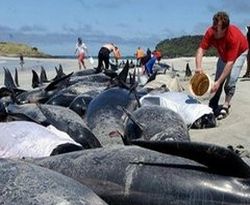 “THIRTY-two pilot whales were confirmed dead today while the lives of 34 others hung in the balance after a mass stranding on tidal flats off New Zealand’s South Island.
The remote location of the stranding meant rescuers were unable to help the marine mammals and their survival will depend on the tide, the Department of Conservation’s area manager, John Mason, told the Nelson Mail.
Mr Mason said the whales, up to five metres long, were stranded on the tidal flats at the tip of Farewell Spit in Golden Bay, located nearly three kilometres offshore at the northern end of South Island.
‘There’s really nothing we can do for them so we just have to hope that they manage to get out by themselves,’ Mr Mason added.
The deaths of the mammals follow the stranding in Australia’s island state of Tasmania over the weekend.
Twenty-three sperm whales, up to 18 metres long, died after they became stuck on Ocean Beach, near Strahan, on Saturday. One of the whales died overnight on Monday, leaving the sole surviving whale stranded off a nearby sandbank at Fraser Flats.
Rescuers had to abandon their attempts to refloat the final whale today due to wild weather, The Mercury reported.” Read more.
New Zealand: Thousands of Dead Unidentified Sea Creatures Wash Ashore
 “The identity of a mystery clump of alien-like creatures found beached in Lyall Bay yesterday has puzzled experts.
Thousands of the tiny creatures were spotted washed up yesterday afternoon.
The transparent creatures with black eyes and little legs could be from deeper water as they were darker than what is normal for intertidal species, a Niwa spokeswoman said. Auckland University associate professor Mark Costello said the creatures could be either Phronima or Hyperia amphipods.
Phronima lived inside salps – gelatinous animals that float in plankton – and fed on their innards while using the tube for their home. Hyperia live inside jellyfish.
Both swam through the water using their back legs and despite their gruesome appearance were harmless to humans.
‘I wonder if the maker of the movie Predator had seen them as they could inspire some good sci- fi,’ Mr Costello said.
But Victoria University PhD student Lisa Bryant said it appeared to be a Themisto australis, which is the only species found in coastal mainland New Zealand.
They formed in dense swarms and other strandings had been reported in places such as England and Canada.” Read more.
Guyana: Large number of birds and fish found dead – “Guyana’s government is trying to determine what is causing an outbreak of illness among Amerindians in the South American country’s gold mining region. Health Minister Leslie Ramsammy said Saturday that his agency has sent doctors to test dozens of people suffering from diarrhea and vomiting. He said an unusual number of birds and fish also have been found dead in the region near the western border with Venezuela. The World Wildlife Fund this week warned that mercury and other toxins are contaminating the region’s rivers and jungles as more people rush to seek gold due to record world prices.” Source – Taiwan News.
Florida: Nearly 400 Manatees Have Been Found Dead So Far This Year – “NORTH PALM BEACH, Fla. — A 1,000-pound manatee is being released after 20 months of recovery from severe injuries. The female manatee, named Illusion, is set for release Wednesday in North Palm Beach. Illusion was rescued in March 2010 in Riviera Beach after suffering deep lacerations in a boat strike. She went through rehabilitation at the Miami Seaquarium and the Cincinnati Zoo before being deemed ready for release. Nearly 400 manatees have been found dead in Florida so far this year.” Source- Miami Herald.
Australia: Mystery Disease Killing An ‘Unprecedented Number’ of Fish and Other Marine Life in Gladstone Waters

“An unprecedented number of fish with red spots, lesions and parasites, as well as dead dugongs and turtles, have been found this year.
Fishermen and conservationists blame the state of the marine life on dredging to widen Gladstone Harbour to accommodate carrier ships servicing the booming liquefied natural gas and coal seam gas industries.
But the Gladstone Port Corporation does not believe the dredging is causing the disease in fish, and authorities say last year’s wet summer may be a factor in the poor health of the harbour.
Water testing shows a number of sites within the harbour exceeded national guidelines for aluminium, copper and chromium. Experts say the levels pose a minimal risk to marine life; however, the Queensland Government has appointed an independent scientific panel to conduct more research.
View a gallery of photos of diseased marine life found in Gladstone waters, interspersed with quotes from local fishermen and stakeholders.” Read more.
Far North’s green sea turtles too hungry to breed – “Seagrass meadows from Mission Beach south to Townsville were devastated by cyclone Yasi in February and in the following months, reports of dead and sick turtles were highlighted right up the coast. Nine months after the monster storm, traditional turtle spots such as Cowley Beach are without nests and Mark Hamann from James Cook University’s School of Earth and Environmental Sciences said it was because the species failed to fatten up before the breeding season – leaving many with no extra energy for mating. ‘The turtles we are seeing are not in the best condition,’ he said. ‘Their shells have sunken in and in the lead-up to breeding season they would have been very hungry, so I will not be surprised if many traditional nesting spots don’t turn up any turtles this year.'” Read more.
Texas: Red Tide Kills Another 1.2 Million Fish Along Coast in Less Than Two Weeks
 “AUSTIN, Texas (AP) The algae bloom known as red tide has killed 1.2 million more fish along the Texas coast in less than two weeks.
The Texas Parks and Wildlife Department reported Monday that about 4.2 million fish have died since the red tide outbreak began in September. The agency on Oct. 20 estimated 3 million fish had been killed.
State health officials last week banned, until further notice, commercial and recreational harvesting of oysters, clams and mussels due to red tide. Tuesday would have been opening day for public harvest of oysters through April.
Experts say red tide, often present in the fall, is worse this year because of the Texas drought and recent excessive heat. The algae thrive in warm, salty water.
Red tide can cause respiratory problems in people.” Source – WTAW NewsTalk.
Unusually High Number of Dead Dolphins Washing Ashore in Mississippi and Alabama, ‘This Is Not Normal’
 By KAREN NELSON – “GULFPORT — So far in October, 14 dead dolphins have washed ashore in Mississippi and Alabama.
Three were found Friday in Mississippi — one on Deer Island, one floating 200 yards off the beach at Cowan Road and one on the beach in Long Beach.
‘Generally, you don’t see this in October,’ said Moby Solangi, director of the Institute for Marine Mammal Studies. ‘This is not normal.’
There was a time when one dolphin death was an unusual event.
But dolphins dying consistently, month after month, is something that has continued in the northern Gulf since the BP oil spill.
NOAA, the federal National Oceanographic and Atmospheric Administration, is investigating the deaths.
The agency said in a statement Thursday five of 21 dolphins that died in Louisiana in 2010 were killed by the bacterium brucella. That’s 21 of the 580 that have been discovered dead in the northern Gulf since February 2010, three months before the spill.
NOAA has said something was killing dolphins before the spill, but added exposure to the oil could have worn down the animals and made them more susceptible to disease.
NOAA hasn’t drawn any conclusion about the deaths, but the investigation is continuing.
Doug Inkley, senior scientist with the National Wildlife Federation, said Friday the fact that an unusual number of dolphins began dying before the spill “in no way means the oil spill did not contribute to dolphin deaths.
‘What we do know is that every single month since the oil spill began through present, dolphin deaths have been far above normal and this is a real cause for concern.'” Read more.
Florida: Die-Off Reported In Pensacola’s Oyster Beds, ‘Something Happened in August, And It Had To Be Massive’
 “PENSACOLA, Fla. — State scientists will head to the Florida Panhandle this week to check on East Bay oyster beds where oystermen are reporting a die-off.
Oyster season opened Oct. 1. Oystermen have reported pulling up dead oysters from beds that had been filled with large, healthy oysters at the end of the last harvest season on June 30.
‘We’re finding very few alive,’ Pasco Gibson, a main supplier of the East Bay oysters, told the Pensacola News Journal (http://on.pnj.com/t1Ziy7). ‘This time of the year, we should be catching 500 to 1,000 pounds per boat a day. We’re not even catching a hundred pounds.’
Gibson’s six oyster boats are mostly idle, and some of his freelance oystermen are heading to Apalachicola to look for work. He said the meager harvests have cost him 40 percent of his income.
Depending on what’s killing the oysters, once they start growing back, it could take up to three years to grow them large enough to harvest, he said.
‘Something happened in August, and it had to be massive because some of these beds are 10 miles apart,’ Gibson said of the beds scattered near the shorelines of East Bay.
Scientists from the Department of Agriculture’s Division of Aquaculture will check the oyster beds this week.” Read more.
 Israel National News
- Energy Minister: 'No significant damage to infrastructure sites in Israel'
- US F-35 jet makes emergency landing in Middle East after anti-aircraft fire in Iran
- Strike on oil refinery: Hazardous material leak ruled out
- New York: Jewish man dies in house fire
- Cleared for publication: Impact at Haifa refinery
- Iran claims it struck power station in Haifa
- Sirens sounding in central Galilee due to launches from Lebanon
- Power outages in several locations in the Haifa Bay area
- Photo: Interception over Pardes Chana
- Home Front Command: Now permitted to leave safe rooms throughout Israel
FrontPage Magazine
- 6 Squad Members, Including 2 Muslims, Lose in Illinois Dem Primaries
- Can Visa Bonds End Tourism Mass Migration?
- Joe Kent and Too Many Ex-CIAers in Politics
- Joe Kent Quit Because Iran ‘Posed No Imminent Threat to Our Nation’
- Mamdani Proposes ‘White Homes’ Estate Tax
- It’s Not Racist to be a “Culturist”
- The Feminists Who Hate MAGA More than They Hate the Mullahs
- Islam’s Classroom Takeover in Philly
- Jamie Glazov on The Shaun Thompson Show: United in Hate
- Establishing a Theocratic Totalitarian Rogue State
Gatestone Institute
- US Direct Talks with Hamas: Legitimizing and Empowering Terrorists
- Why Iran Was Always a Threat to the US
- Iran Picked a Fight with the Wrong President
- Iran's 'Doomsday Clock' Against Israel No Longer Ticking But Guess Who Is Waiting in the Wings
- Why Applying the 'Venezuela Method' to Iran Would Be a Terrible Mistake
- Hamas Crimes No One Talks About
- Trump's Iran War Ending Xi Jinping's 'China Dream'
- Iran Gets a New Supreme Guide
- 'Trump Derangement Syndrome': The Danger of Hatred Clouding Perception
- Spain's Pedro Sánchez and His Extremist Problem
Middle East – The Jerusalem Post
- ‘More than symbolic’: Doha’s expulsion of Iran’s military, security attache signals shift in Gulf
- Today will be most intense day of US strikes on Iran, Hegseth claims again
- Lebanon’s Bassil urges neutrality as Hezbollah-Israel clashes escalate
- Kataib Hezbollah signals temporary pause in Iraq attacks amid strict conditions
- Fanning flames of war, Iran appears to activate Gulf terror cells as conflict expands - analysis
- Iran hangs three, including national wrestling champion, in connection with January protests
- Iran revives ‘Zionist sorcery’ claims in propaganda against Israel
- Iran nears three weeks offline as regime braces for renewed demonstrations
- Iran attacks pushing Gulf's Arab states toward unity, possible action against Tehran - analysis
- Mossad slams regime's use of mosques as military posts, allegedly threatens Iranian commanders
Earthquakes & Volcanic Activity
- World Earthquake Report for Thursday, 19 March 2026
- Volcanoes Today, 19 Mar 2026: Fuego volcano, Popocatépetl, Merapi, Semeru, Shiveluch, Ibu, Dukono, Marapi
- Sangay Volcano Volcanic Ash Advisory: ONGOING VA EMS to 21000 ft (6400 m)
- Aoba Volcano Volcanic Ash Advisory: UNKNOWN EST VA DTG: NOT PROVIDED
- Shiveluch Volcano Volcanic Ash Advisory: VA CONTINUOUSLY OBS IN SATELLITE IMAGERY OBS VA DTG: 19/1120Z to 36000 ft (11000 m)
- Ibu Volcano Volcanic Ash Advisory: ERUPTION LAST REPORTED AT 19/0633Z EST VA DTG: 19/1130Z
- Reventador Volcano Volcanic Ash Advisory: CONS VA EMS to 15000 ft (4600 m)
- Mayon Volcano Volcanic Ash Advisory: ERUPTION AT 20260319/0954Z FL110 EXTD SW REPORTED OBS VA DTG: 19/1020Z
- Lewotobi Volcano Volcanic Ash Advisory: VA TO FL090 REPORTED FM GND AT 19/0636Z MOV NNE to 9000 ft (2700 m)
- Piton de la Fournaise volcano (La Réunion): lava flow front continues to occupy shoreline by building new lava delta
Islamic Terrorist Network In America

Click For Larger Version


Click To Learn What Makes This An Idol

 MidnightWatcher - Prophecy in Motion
Recent Comments