Archive
Tornadoes Strike North Minneapolis, Widespread Devastation
 By Tim Ballisty – “Several rotating supercells spawning a few tornadoes touched down across the Minneapolis area on Sunday afternoon.
The tornado or tornadoes tore roofs off buildings, downed power lines and toppled trees blocking streets. Early reports estimated the tornado touched down for around 30 minutes across the metro area.
Northwest and North Minneapolis was especially hit hard.
Television cameras revealed tremendous tree damage across North Minneapolis which then led to significant house damage.” Read more.
—
Iceland: Largest Volcanic Eruption in Grímsvötn in 100 Years
 “The current volcanic eruption in Grímsvötn on Vatnajökull glacier is the largest in that volcano 100 years and larger than the one in Eyjafjallajökull last year. It is similar to the eruption of 1873, according to geophysicist Magnús Tumi Gudmundsson. A large flood is not expected.
This morning the ash cloud was 15 to 18 kilometers high which means that the volcanic eruption is ten times more powerful than the last eruption in Grímsvötn in 2004, Gudmundsson told ruv.is.” Read more.
Ash could reach Scotland by Tuesday, airlines warned – “May 22 (Reuters) – Ash from an erupting Icelandic volcano could reach northern Scotland by Tuesday and parts of Britain, France and Spain by Thursday or Friday if the eruption continues at the same rate, airlines were warned on Sunday.” Read more.
Yellowstone National Park is Moving
 By Brent Hunsaker – “Yellowstone sits atop one of the world’s biggest, active volcanoes, one capable of laying waste to much of north America.
… Professor Emeritus Robert Smith of the University of Utah … says the park is in constant motion. Visitors can’t see it, but the ground at their feet is moving up and down as magma pushes against the thin crust and powers the park’s many geysers.
The changes are most evident at the Norris Geyser Basin. Henry Heasler, the Yellowstone Park geologist said, ‘It changes daily. Sometimes it’s hard to keep up with the change near boardwalks because that impacts visitor and employee safety.’
‘Why are all the hydrothermal features here?’ Heasler continued, ‘The geysers? The mud pots? The steam vents? The hot springs? It’s because of the heat beneath our feet.’
The heat from the volcano.
And beginning in 2004, volcanic pressure caused an amazing rise at the park: Three-inches a year for five-years.” Read more.
Iceland’s Most Active Volcano Erupts, Scientists Say
 “REYKJAVIK, Iceland — Iceland’s most active volcano has started erupting, scientists said Saturday — just over a year after another eruption on the North Atlantic island shut down European air traffic for days.
Iceland’s Meteorological Office confirmed that an eruption had begun at the Grimsvotn volcano, accompanied by a series of small earthquakes. Smoke could be seen rising from the volcano, which lies under the uninhabited Vatnajokull glacier in southeast Iceland.
A no fly zone has been designated for 120 nautical miles in all directions from the eruption. Isavia, the company that operates and develops all airport facilities and air navigation services in Iceland, described this as standard procedure around eruptions.” Read more.
Hundreds Evacuated from Nicaragua’s Telica Volcano
“MANAGUA, Nicaragua (AP) — Nicaraguan authorities have evacuated hundreds of people from the foothills of a volcano because of heightened seismic activity.
The Nicaraguan Institute of Territorial Studies says 600 workers have been moved from a factory near the Telica volcano in western Nicaragua. Women and children who live nearby have also been evacuated.” Read more.
—
Freak Hailstorm in South Africa Destroys Dozens of Homes
 “A hailstorm has damaged 53 houses in the Hoyi area of Komatipoort in Mpumalanga.
Some of the houses were totally destroyed in the storm on Tuesday night, the department of co-operative governance and traditional affairs said in a statement.
Blankets and tents were given to the 341 people affected.
‘The department of social development will distribute food parcels to the affected families today,’ the department said.” Source.
Eruption at Nicaragua’s Telica Volcano
 “Managua – Nicaragua’s Telica volcano spewed a massive cloud of gas and ash into the air Tuesday following several strong explosions.
Material was ejected 1.2 kilometres into the air above the crater of the 1,060-metre volcano, the seismological institute Ineter said. A total of 50 explosions were recorded.
Since May 9, Ineter has recorded 59 seismic shocks in the area, and Telica had ejected a large amount of sand on nearby cities since Friday.” Read more.
Japan Government Raises Alert Level for Erupting Mount Aso to 2+
 “KUMAMOTO, Japan, May 16 (AP) – (Kyodo)—The Japan Meteorological Agency raised the volcanic activity-related alert level Monday for Mt. Aso in Kumamoto Prefecture from 1 to 2, prompting local authorities to ban entry to areas within 1 kilometer of the crater of Mt. Naka, one of five peaks in the active volcano’s central cone group.
Volcanic rocks could be launched from Mt. Naka to within the off-limit areas.
The move came after the belch of a small amount of volcanic ash and a small eruption were observed at the mountain on Friday and Sunday, respectively. On Monday, a small eruption and some 500-meter high volcanic smoke were observed at around 10 a.m.” Source.
Farmers in Quebec, Canada Dealing with the Worst Spring Flooding in 140 Years
By Rene Bruemmer – “ST. PAUL DE L’ILE AUX NOIX, Que. — A fish is lying in the mud at farmer Jacquelin Bisaillon’s feet. It’s a silver-scaled carp about 30 centimetres long, and dead. Which is odd, because Bisaillon is standing three-quarters of a kilometre away from the nearest river in what should be his field of freshly planted corn.
Dealing with the worst spring flooding in 140 years along Quebec’s Richelieu River brings with it many unexpected challenges, farmers like Bisaillon are discovering, including how to pump out his flooded fields without having neighbours call the police, or being fined by Quebec’s Environment Ministry for harming carp swimming in the 4,000 hectares of farmers’ fields that are now lakes.
‘There are many problems we’ve never seen before,’ he said Sunday, standing next to the hectares of water covering his land. ‘Like trying to pump out our fields, but we can’t because the dikes holding back the river are broken, and they can’t be repaired because there’s too much water.'” Read more.
A week of rain in forecast for Quebec flood zone – “Water levels on the Richelieu River and Lake Champlain continue to fall, but there’s concern things could stall if the skies open up. Some 3,000 homes are flooded and 1,000 people have been evacuated since heavy rains and the spring thaw swelled waterways from Montreal’s south shore to the U.S. border. Quebec’s flood forecasting centre says precipitation should hit the region on Friday and continue into next week.” Read more.
Worst Drought in 50 Years: 400,000 Without Drinking Water in China, Yangtze River Too Dry for Ships
 By Tom McGregor – “The longest waterway in Asia, the Yangtze River, which is China’s most important shipping route, has been shut down by the worst drought in 50 years that has kept cargo ships stranded and 400,000 people without drinking water.
The Daily Telegraph of London reports that, ‘water-levels have sunk as low as 10 ft. in the main thoroughfare of the 3,900 mile long river that stretches from the glaciers of the Tibetan plateaus to the coastal city of Shanghai.’
The Yangtze River basin is home to 1/3 of China’s population and is responsible for 40 percent of the nation’s economic growth.” Read more.
New Eruption Started at Mount Etna in Italy
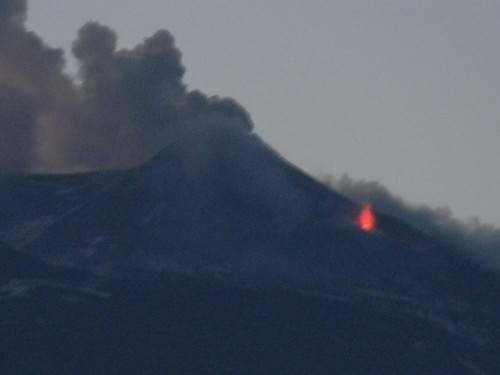 “This just came in via Dr. Boris Behncke (on Twitter) – after some signs such as increasing seismicity that activity was about to start on Etna, sure enough, the volcano has begun to erupt again (see below). The volcano has been sputtering earlier in the week with abundant steam/ash plumes and some strombolian explosions (top left) in the southeast pit crater. You can check out the Etna webcams to glimpse the action. Look for updates on the activity at the Etna Observatory.” Source.
Young and Old Rush to Fill Sandbags as Four MILLION People Face Record-Breaking Floods Sweeping the Mississippi Delta
 Thousands already evacuated across region from Illinois to Louisiana
- The flood water is expected to break an 84-year record of 48 feet
- Prisoners fill 120,000 sandbags as worried residents closely watch levels
- Could still be two weeks before some of the most severe flooding hits
- Aftermath could last for weeks as it may be June before areas dry out

Memphis residents of all ages and races are pitching in to fill sandbags in a desperate last-ditch attempt to ward off flood waters as the Mississippi River threatens millions of homes.
More than four million people living in 63 counties close to the Mississippi and Atchafalaya rivers from Illinois to the Gulf of Mexico could be affected by flooding in the coming days.
Communities all along the banks of the Mississippi have been carefully watching the river rise, like a giant bathtub filling up with water.
Record river levels, some dating as far back as the 1920s, were expected to be broken in some parts along the river. In Memphis, the river was expected to crest at 48 feet on Wednesday, just shy of the 48.7-foot record from the devastating flood of 1937.” Read more.
 Israel National News
- Vayikra: Maimonides and Korbanot
- The wondrous korbanot
- Dramatic footage: Missile shrapnel falls on Highway 431 in central Israel
- Actor and martial artist Chuck Norris passed away
- What are we really asking for?
- Suspect: TA resident attacked media personnel in Habima parking lot, released under restrictions
- Kingship
- Jerusalem: MDA teams searching following report of missile fragment striking Old City parking lot
- Chuck Norris passes away after medical event
- Senior Iranian Ministry of Intelligence commander eliminated in Tehran
FrontPage Magazine
- First Muslim Judge Blocks Ban on Trans Child Mutilation
- Joe Kent and the Company He Keeps
- The Child Rapes of Cesar Chavez
- Inside the Manosphere
- Larijani’s Last Words
- First Muslim Judge Uses $100M Muslim Fraud to Stage DOJ Coup
- Jamie Glazov on Stakelbeck Tonight: Trump – The Last Line of Defense for Western Civilization
- Heartwarming Musical: Making Islam and Sharia Easy to Understand for Everyone of all Ages
- Prager U Video: FBI Warns of an Iranian Attack On U.S. Soil
- Democrats Side With the Mullahs
Gatestone Institute
- The UAE Will Not Be Bullied by Iran — Nor Derailed From Peace
- Pakistan: Exponentiating Persecution of Religious Minorities
- US Direct Talks with Hamas: Legitimizing and Empowering Terrorists
- Why Iran Was Always a Threat to the US
- Iran Picked a Fight with the Wrong President
- Iran's 'Doomsday Clock' Against Israel No Longer Ticking But Guess Who Is Waiting in the Wings
- Why Applying the 'Venezuela Method' to Iran Would Be a Terrible Mistake
- Hamas Crimes No One Talks About
- Trump's Iran War Ending Xi Jinping's 'China Dream'
- Iran Gets a New Supreme Guide
Middle East – The Jerusalem Post
- Ukraine deploys 228 specialists to five Middle East countries to intercept drones
- Iran's Quds Force chief Qaani lauds anti-US, Israel ‘resistance front,’ Iran state media reports
- Khamenei urges media to avoid Iran's ‘weaknesses,’ accuses Israel of ‘false flag’ attacks
- US deploying thousands of Marines, sailors to Middle East as Iran war rages
- From revolutionaries to royalists? Why some of Iran's former leftists now back Reza Pahlavi
- Iran warns US, Israeli personnel unsafe worldwide after strikes killing regime officials
- Netherlands tightens security for Iranian dissidents after shooting of man critical of Iran
- Gulf states seek to balance diplomacy with deterrence policies as Iran war threatens region
- US intensifies campaign to reopen Strait of Hormuz, deploys A-10s, Apaches - report
- US airlines project confidence as fuel costs surge in wake of US-Israeli war on Iran - analysis
Earthquakes & Volcanic Activity
- Volcanoes Today, 20 Mar 2026: Fuego volcano, Popocatépetl, Merapi, Semeru, Shiveluch, Ibu, Dukono, Marapi
- Mayon Volcano Volcanic Ash Advisory: ERUPTION AT 20260320/1617Z VA CLD UNKNOWN REPORTED OBS VA DTG: 20/1620Z
- World Earthquake Report for Friday, 20 March 2026
- Fuego Volcano Volcanic Ash Advisory: OCNL TO FRQT VA EMS. to 15000 ft (4600 m)
- Sabancaya Volcano Volcanic Ash Advisory: NO VA ERUPTION
- Aoba Volcano Volcanic Ash Advisory: CONTINUOUS LOW-LEVEL ERUPTION EST VA DTG: 20/1511Z
- Canlaon Volcano Volcanic Ash Advisory: ERUPTION AT 20260320/1302Z FL090 EXTD SW REPORTED OBS VA DTG: 20/1320Z
- Popocatépetl Volcano Volcanic Ash Advisory: NEW VA EMS to 21000 ft (6400 m)
- Piton de la Fournaise volcano (La Réunion): increasing activity
- Shiveluch Volcano Volcanic Ash Advisory: NOT PROVIDED
Islamic Terrorist Network In America

Click For Larger Version


Click To Learn What Makes This An Idol

 MidnightWatcher - Prophecy in Motion
Recent Comments