Archive
Texas: Significant Damage Reported After Multiple ‘Large and Extremely Dangerous’ Tornadoes Strike Dallas, Fort Worth, Arlington and Other Areas
Fox News – “Tornadoes tore through the Dallas area on Tuesday, tearing roofs off homes, tossing trucks into the air and leaving flattened tractor trailers strewn along highways and parking lots.
The National Weather Service reported at least two separate ‘large and extremely dangerous’ tornadoes south of Dallas and Fort Worth. Several other developing twisters were reported as a band of violent storms moved north through the metropolitan area. Officials had no immediate information about injuries.
Footage from highway video cameras showed a large, dark funnel cloud moving on the ground not far from a major interstate early Tuesday afternoon. Crumpled orange tractor trailers were later visible in a Dallas County parking lot, as well as flattened trailers along the sides of highways and access roads.
In one Dallas County neighborhood, local television footage showed homes without roofs while other buildings were flattened. Plywood was strewn on the grass and on top of buildings. Residents could be seen walking down the street with firefighters and peering into homes, looking at the damage after the storm passed.
The storm pushed cars into fences and toppled trees over. Branches and limbs were scattered across lawns and in the streets. A tow-behind RV was torn apart and crumpled in a driveway where part of a roof of the home was torn off.” Read more.
Asia: Climate-Related Disasters Displaced At Least 42 Million Over Past Two Years
 “Climate-related disasters have displaced more than 42 million people in Asia over the past two years, the Asian Development Bank said Tuesday in a report calling for swift action to avert future crises.
‘Asia and the Pacific is the global area most prone to natural disasters, both in terms of the absolute number of disasters and of populations affected,’ said the report launched in Bangkok, which was itself affected by flooding last year.
About 31.8 million people in the region were displaced by climate-related disasters and extreme weather in 2010 — a particularly bad year — including more than 10 million in Pakistan owing to massive flooding.
A further 10.7 million were forced to flee their homes last year, it said, warning that such events will become more frequent with climate change.
‘While many of those displaced returned to their homes as conditions improved, others were less fortunate, struggling to build new lives elsewhere after incurring substantial personal losses,’ ADB vice president Bindu Lohani said in a foreword to the report, released at an Asian climate forum.” Read more.
Flashback: Millions Without Drinking Water As China’s Largest Inland Lake Dries Up; Half of Country’s Rice Fields Affected, 80% of Fish Stocks Die in Hubei Province – “The volume of water in Poyang lake in Jiangxi province, normally 100 miles-long and 10 miles-wide, is now a tenth of its normal level, according to Xinhua, the Chinese state news agency. Fishing boats and house boats have been left stranded on a vast stretch of the lake bed, now a lush grassland. The drought, which has seen no rainfall for two months, has struck the central Chinese provinces that are known as the country’s ‘home of rice and fish’. Almost half of all the country’s rice fields have been affected and four million people do not have access to drinking water.” Read more.
Fukushima – Did We Almost Lose Tokyo?
RT: “Kevin Kamps, Beyond Nuclear joins Thom Hartmann. In a little over a week – we’ll hit the one-year anniversary of the earthquake and tsunami that triggered a nuclear crisis at Fukushima in Japan. And this week – we’re learning that that nuclear crisis is even worse than was originally thought. On Wednesday – Japanese Scientists announced that twice as much radioactive cesium than estimated blew out of the plant after the earthquake and tsunami. That’s about 40,000 trillion bequerels. And it took just 18 days for those radioactive particles to encircle the planet – turning up in places as far away as Vermont. French scientists are now calling on Japan to remain vigilant in its inspections of fruit, milk, and game to prevent further radiation contamination.”
Flashback: Some parts of Tokyo now as contaminated as the worst area of Chernobyl – “The contamination level of Mizumoto Park turned out to be the same level of ‘off-limits zone’ in Chernobyl. The contamination level of the park was 23,300 Bq/Kg. According to Nuclear Safety Commission, it is converted to be 1.4 ~1.5 million Bq/m2. In Chernobyl, if the area is more contaminated than 1.48 million Bq/m2, it was labelled as off-limits zone, which was the worst level of the pollution. Because cesium doesn’t choose Mizumoto park intentionally, at least some parts are contaminated as the worst area of Chernobyl.” Read more.
Above-Normal Number of Tornadoes Expected in 2012
 “State College, Pa. — 21 February 2012 — AccuWeather.com reports following a near-record number of tornadoes in 2011, an active severe weather season with above-normal tornadoes is expected in 2012.
There were 1,709 tornadoes in 2011, falling short of the record 1,817 tornadoes set in 2004. In comparison, the average number of tornadoes over the past decade is around 1,300.
Last year ranks as the fourth most deadly tornado year ever recorded in the United States.
In 2011, there was a very strong La Niña, a phenomenon where the sea surface temperatures in the central and eastern Pacific around the equator are below normal. As a result, there was a very strong jet stream, which is a key ingredient for severe weather.
Often in a La Niña year, the ‘Tornado Alley’ shifts to the east, spanning the Gulf States, including Mississippi and Alabama, and the Ohio and Tennessee valleys. During the extremely active severe weather season of 2011, many tornadoes touched down east of the typical ‘Tornado Alley,’ which stretches from Texas to Kansas. Twisters frequently hit Texas to Kansas during the spring as warm, humid air from the Gulf of Mexico clashes with drier air coming out of the Rockies.
Above-normal tornadoes are anticipated again this year.
Warmer-than-normal Gulf of Mexico water is a key component to the active severe weather season anticipated in 2012. There will be a sufficient supply of warm and humid air to fuel supercell thunderstorms, the type of storms that spawn strong tornadoes, because of the warm Gulf water.
The weak to moderate La Niña during this winter is much weaker compared to last winter, and it is weakening even more now. There is evidence that warming is occurring in the equatorial Pacific, so the El Niño/La Niña Southern Oscillation (ENSO) is expected to turn neutral by April. In other words, the temperatures in the central and eastern equatorial Pacific will be near normal by spring.
‘Areas that seemed to miss out on frequent severe weather last year may see an uptick this year,’ AccuWeather.com Exert Senior Meteorologist Dan Kottlowski said regarding the difference in pattern.” Read more.
‘Fish Dying in Rivers’: Drought Declared in the South East of England, Water Restrictions Expected Within Weeks
 By Matthew Holehouse – “Some reservoirs, rivers and groundwater aquifers in the South East well below normal levels after two dry winters.
The state of drought in the region was declared after the Environment Department (Defra) convened a summit of water companies, farmers and wildlife groups today to discuss potential water shortages in England.
Following the summit, Thames Water warned that there was a high chance of water restrictions such as hosepipe bans this summer, unless there was significant rainfall or customers used less water.
Some rivers and groundwater levels are lower than during the drought of 1976.
The RSPB is warning that if the drought situation continues, it could spell potential disaster for wildlife.
Birds, mammals and bugs could be struggling to survive into the summer if the rain doesn’t fall in the next few weeks as valuable wetlands dry up.
Charlie Kitchin, RSPB Site Manager for the area said: ‘The breeding season of 2011 was not good at all for this nature reserve. Winter flooding is essential to attract the large numbers of wild swans and other wildfowl that the washes are renowned for and this winter has been the quietest for many years, for example our wigeon numbers are down from 20,000 to 3,000.'” Read more.
Take an ‘egg timer’ into the shower say water companies – “Residents are being sent waterproof ‘egg timers’ so they don’t linger in the shower, in attempt to preserve dwindling waters stocks by reducing consumption. Caroline Spelman, the Environment Secretary, was forced to declare drought in the most populated area of Britain after two dry winters in a row left reservoirs dangerously low and fish dying in rivers. The Anglia region was already in drought, meaning more than half of the population of the UK faces hosepipe bans in a matter of weeks. There could even be restrictions in London – part of the South East region – where thousands of litres more water will be needed because of the Olympics.” Read more.
Another Alaska Volcano Awakens, Kanaga Threat Level Raised to Yellow
 “First it was Alaska’s Mount Cleveland that awoke and threatened to erupt. Now Kanaga, another Alaska volcano is growing restless.
This weekend, the Alaska Volcano Observatory raised the threat level to yellow on Kanaga, located on Kanaga Island, one of the most southerly of the central Aleutian Islands chain.
‘Somewhat elevated seismicity continues at Kanaga Volcano,’ the observatory reported, adding that on Saturday a weak ash cloud may have been detected after a volcanic tremor.
Kanaga Volcano last erupted in 1994-1995. At least two significant ash plumes were recorded over the course of this eruption. The Aleutian community of Adak received a light dusting of ash and air traffic was disrupted due to continuing low-level activity and cloudy conditions, which prevented visual approaches to the Adak air field.” Read more.
Bolivia: Unprecedented Size and Longevity of Uturuncu Uplift Means ‘We Could Be Witnessing the Development of a New Supervolcano’
By Jean Friedman-Rudovsky – “UTURUNCU VOLCANO, Bolivia — The broad hill at the base of Uturuncu is unassuming. Its gentle arc fades naturally into the Andean landscape.
But the 43-mile-long stretch of rocky soil is now an object of international scientific fascination. Satellite measurements show that the hill has been rising more than half an inch a year for almost 20 years, suggesting that the volcano, which last erupted more than 300,000 years ago, is steadily inflating.
‘The size and longevity of the uplift is unprecedented,’ said Shanaka de Silva, a geologist at Oregon State University who has been studying Uturuncu since 2006.
Taken together with other new research, he continued, the inflation means ‘we could be witnessing the development of a new supervolcano.’
Such a volcano could produce an eruption of ash, rock and pumice 1,000 times the strength of the 1980 eruption of Mount St. Helens in Washington state, the worst volcanic event in modern American history, and 10,000 times that of the Icelandic eruptions in 2010 that paralyzed global air traffic for weeks.” Read more.
Japan: Signs of Volcanic Unrest Reported at Mount Fuji, Sakurajima Volcanoes

“Reports are appearing about unrest and signs of a possible awakening of Mt Fuji volcano in Japan.
According to a report which includes an unclear photo of the area, a row of new craters, the largest 50 m in diameter, has appeared on the eastern flank of the volcano at 2200 m elevation. Steam was observed erupting from these vents.
The observation joins other signs suggesting a gradual reawakening: A swarm of earthquakes including 4 of magnitude 5 have occurred northeast of Mt Fuji on and after 28 January. An earlier 6.4M quake occurred under the volcano on 15 March 2011. The report also mentions increased activity from a fumarole vent at 1500 m elevation and hot spring areas at the eastern flank observed since 2003.
These locations seem to be aligned geographically, and are probably connected. Dr. Masaaki Kimura of Ryukyu University is quoted to admit that there is an increased risk of and eruption on the eastern flank and that the status of the volcano should be closely monitored.” Source – Volcano Discovery.
Large Explosion Recorded on Sakurajima Volcano in Japan (Video)
Alaska: Cleveland Volcano’s Lava Dome is Growing, Could Blow Soon
 By CASEY GROVE, Anchorage Daily News – “A lava dome is growing at Cleveland Volcano as its current slow eruption continues, a sign that the restless Aleutian volcano could pop at any moment, the Alaska Volcano Observatory says.
Satellite images show the lava dome has expanded from about 50 meters to 60 meters across in the past week. The hardening lava still only occupies a small part of the roughly 200-meter crater, the observatory says.
The 5,676-foot volcano makes up the western half of Chuginadak Island about 940 miles southwest of Anchorage. If Cleveland’s eruption turns explosive — perhaps blasting ash up thousands of feet, into trans-Pacific flight paths — it could disable the engines of airplanes that fly through it.
The explosiveness is characteristic of Alaska volcanos, scientists say.
Lava extruding inside Cleveland Volcano is thick and pasty, ‘like peanut butter,’ volcanologist Steve McNutt said.
‘The lava’s so viscous, it doesn’t flow like you’re used to seeing in pictures of Hawaii, where it’s fluid and runny,’ McNutt said. ‘So it piles up and makes a round, dome-like lava flow.’
The molten rock flows out of vents inside the volcano’s crater and piles up, McNutt said. When the dome grows so big that it covers those vents, gas builds up behind it, he said.
Then, when the pressure is high enough: ka-boom.” Read more.
Australia: NSW Farmers Could Lose At Least $750 Million From Devasting Floods
 By Adam Bennett – “The agricultural industry is expected to suffer losses of at least $750 million as a result of the devastating NSW floods, with tens of thousands of livestock at risk.
As floodwaters from Queensland and northern NSW slowly flow towards western NSW townships such as Walgett and Bourke, farmers are already counting the cost of flooding around Moree and in the Brewarrina district.
Department of Primary Industries (DPI) Flood Incident Controller, Simon Oliver, said up 10,000 sheep had most likely been lost to the floodwaters, while extensive damage to crops, pastures and infrastructure was also being recorded.
A further 100,000 livestock in areas downstream were also at risk, and the DPI was now working to help farmers relocate animals to higher ground.
‘There is a conservative figure being thrown around from a preliminary estimate of $750 million, that includes all impacts on primary industries like damage to infrastructure, the cotton fields and roads, buildings and fodder storages, estimated stock losses, pasture losses and crop losses,’ Mr Oliver told AAP.
‘Obviously those figures are going to change significantly as we can get a better idea as the water clears.'” Read more.
Europe Freezes: State of Emergency Declared as Extreme Weather Kills Hundreds, Venice Waterways Frozen, Greece and Bulgaria Battle Floods

Around 400 people have now died from the cold weather in Europe since the cold snap began 11 days ago.
While there was some respite for people in Ukraine — where more than 130 deaths have been recorded — the mercury plunged overnight to minus 39.4 degrees Celsius in the Kvilda region of the Czech Republic.
More bodies were found either on the streets, in their cars or in their homes in Germany, Greece, Italy, Poland, Hungary and across the Balkans.
Authorities in Serbia said that 70,000 people were trapped in snow-bound villages in the south as officials declared an ’emergency situation.'” Read more.
Venice Freezes As Deadly Chill Grips Europe – “The famous waterways of Venice have frozen over as Europe continues to be gripped by a deadly chill. The big freeze has caused traffic problems throughout Europe, blocking roads and shutting down airports. Ten deaths in Italy have been linked to the extreme winter weather, including two people who were crushed under a collapsed roof south of Rome, and a 91-year-old woman in the northeast port of Trieste. In the north, stranded people had to be rescued from their homes, with deep snow reaching 3m (10ft) in some areas. Europe has struggled to cope with a week of bitter cold weather in which the number of dead, most of them homeless, continues to rise every day.” Read more.
Greece and Bulgaria battle flooding as Europe struggles with extreme weather – “A swollen river in Greece bursts its banks, flooding homes and forcing authorities to declare a state of emergency Tuesday, officials said, as rescuers scrambled to a Bulgarian village nearly washed away when a dam collapsed, killing eight people. Bulgaria’s civil defense agency warned that two other, bigger dams were also on the brink of overflowing after days of heavy rain and residents were urged to prepare for an evacuation. Authorities have started a controlled release of water from the dams to prevent overflow… A day after the dam burst, the Bulgarian government declared a day of mourning, and streets in the village of Bisser were covered with sticky mud as people returned to their water-logged homes. At least a dozen houses had collapsed, uprooted trees blocked roads and smashed cars sat abandoned along deserted streets. Veterinary officials were collecting the bodies of dead animals. Bisser Mayor Zlatka Valkova said she received a phone call about the dam burst and tried to get out of her office in time to alert people of the eight-foot-high (2.5-meter) torrent. ‘I rushed out on the street, but then I saw the wave,’ she said. ‘It was terrible, it came with such speed that I couldn’t do anything.'” Read more.
Alaska: Cleveland Volcano Lava Dome Forms, Alert Level Raised
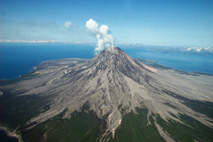 Associated Press – “The warning level for a remote Alaska volcano has been raised after a new lava dome began forming, indicating the mountain could explode and send up an ash cloud that could threaten aircraft.
he Alaska Volcano Observatory on Tuesday elevated the alert status for Cleveland Volcano.
Officials say the new lava dome was spotted in the summit crater. The observatory says as of Monday, the dome was about 130 feet in diameter.
There have been no eruptions since those on Dec. 25 and Dec. 29, which destroyed the earlier lava dome built up over the fall.
Cleveland is a 5,675-foot peak on an uninhabited island 940 miles southwest of Anchorage.
Authorities say sudden eruptions could occur at any time, and ash clouds 20,000 feet above sea level are possible.” Source – Anchorage Daily News.
 Israel National News
- IDF strikes large Hezbollah underground weapons storage facility
- Photo: Prime Minister Netanyahu ordering the elimination of top Iranian regime officials
- Lebanese Army says five of its soldiers wounded in Israeli airstrike in southern Lebanon
- Honor of Jerusalem under fire: Western Wall Rabbi condemns Iranian fire toward Jerusalem
- Special education institutions to resume operations in Jerusalem
- Greg Kelly: ‘I think we kind of just won the war’
- Ali Larijani's Telegram channel: Statement on his behalf to be published shortly
- IDF confirms: Commander of the Basij unit eliminated
- Basij commander Gholamreza Soleimani also among targets of overnight strikes in Iran
- IDF chief reveals: Dramatic elimination in Tehran safehouse
FrontPage Magazine
- California May Add 2 Muslim State Holidays While Christians Have Only One
- Zombie Jesse Jackson May Endorse After Death
- Trump Gets 200,000 Illegal Alien Truck Drivers Off the Road
- What Are You Doing on the ‘International Day to Combat Islamophobia’?
- Iran Could Have 8000 Ballistic Missiles by the End of 2027
- Halal Pressure in London
- The Heartland in Reprieve
- Ending the Ayatollahs’ 47-Year War on the World
- UN Human Rights Council Refuses to Defend Female Victims of Sharia
- IDF: Regime Change Was Never Our Goal
Gatestone Institute
- Why Applying the 'Venezuela Method' to Iran Would Be a Terrible Mistake
- Hamas Crimes No One Talks About
- Trump's Iran War Ending Xi Jinping's 'China Dream'
- Iran Gets a New Supreme Guide
- 'Trump Derangement Syndrome': The Danger of Hatred Clouding Perception
- Spain's Pedro Sánchez and His Extremist Problem
- Before Pouring Billions into Gaza, Trump's 'Board of Peace' Needs To Ask A Few Hard Questions
- If Saudi Arabia Wants U.S. Alliance, It Must End Support for Sudanese Armed Forces — Aligned with Muslim Brotherhood and Iran — Not Fund It
- UN and EU Condemn the Strike, Not the Regime: Double Standards, Selective Outrage
- Why Fusion Energy Needs to Be American Born – Now More Than Ever
Middle East – The Jerusalem Post
- Who was Ali Larijani, the senior Iranian official killed by the IDF? - explainer
- Killing Larijani sends message to surviving Iran leadership: Compromise or die - analysis
- Iran in talks with FIFA to shift World Cup games from US to Mexico amid security fears
- Over 200 US troops wounded in Operation Epic Fury as Iran war enters third week
- Trump warned Iran strikes could trigger retaliation on US Gulf allies, sources say
- Gulf sources warn incomplete US strikes could leave Iran a lasting threat to oil routes - analysis
- Gulf states use Israeli expertise against Iranian missiles, drones, ambassador to US says
- Pakistani air strike devastates Kabul rehab center as survivor recalls 'doomsday' scene
- US urges allies to label Iran’s IRGC, Hezbollah as terrorist groups amid Middle East tensions
- Iranian forces hit hard by US, Israeli strikes, continue to crackdown on potential protestors - WSJ
Earthquakes & Volcanic Activity
- World Earthquake Report for Tuesday, 17 March 2026
- Volcanoes Today, 17 Mar 2026: Fuego volcano, Shiveluch, Reventador, Mayon, Piton de la Fournaise, Sangay, Lewotolo, Aoba
- Shiveluch Volcano Volcanic Ash Advisory: REMNANT VA to 24000 ft (7300 m)
- Fuego Volcano Volcanic Ash Advisory: FQT VA EM to 16000 ft (4900 m)
- Sangay Volcano Volcanic Ash Advisory: ONGOING VA EM LKLY
- Piton de la Fournaise volcano (La Réunion): lava flows continue to feed lava delta
- Reventador Volcano Volcanic Ash Advisory: CONT VA EM LKLY
- Mayon Volcano Volcanic Ash Advisory: ERUPTION AT 20260317/0400Z VA CLD UNKNOWN REPORTED OBS VA DTG: 17/0410Z
- Lewotolo Volcano Volcanic Ash Advisory: VA TO FL060 LAST REPORTED AT 16/0309Z EST VA DTG: 17/0010Z to 6000 ft (1800 m)
- World Earthquake Report for Monday, 16 March 2026
Islamic Terrorist Network In America

Click For Larger Version


Click To Learn What Makes This An Idol

 MidnightWatcher - Prophecy in Motion
Recent Comments