Archive
India: Wildlife Department Mystified As Dozens Of Peacocks Drop Dead
 By Z Ali and Sajid Bajeer, The Express Tribune – “MITHI / HYDERABAD: The Sindh Wildlife Department believes that the peacocks which died in Thar were suffering from ‘Ranikhet’ or Newcastle Disease, which is a fatal and contagious virus found among birds, including chicken. However, blood tests of sick and dead peacocks have yet to be conducted.
Although no exact figure for the dead peacocks is available, the residents of Mithi say that more than 50 have perished within a week across half a dozen villages. The ones which have died in the forest or were eaten by animals have not been included in this figure.
Over a week after the birds started appearing ill, chief conservator Saeed Akhtar Baloch visited those villages in Mithi which reported the highest incidence of deaths.
‘If we had treated the peacocks in time, many of them would not have died,’ he admitted. He has also suspended assistant conservator Lajpat Sharma and game officer Ashfaq Memon for showing negligence.
He added that a team of vets from the Poultry Development Department will come to Thar on July 23 with medicines so that the ailing birds can be cured.
Earlier, vets from the livestock and poultry departments said the peacocks had been suffering from an acute deficiency of vitamins and minerals.” Read more.
Germany: Field Mice Overrun Central Farms In Worst Plague In 30 Years
 Spiegel Online International – “Millions of field mice are overrunning the central German states of Thuringia and Saxony-Anhalt, much to the concern of local farmers. The rodents are devastating food crops, cutting yields by up to 50 percent. Getting birds of prey to hunt the critters didn’t help, and now farmers want to be allowed to use a banned rat poison.
Under normal circumstances, you might think the 12-centimeter (5-inch) long field mouse looks innocent, or even cute. But farmers in the central German states of Thuringia and Saxony-Anhalt wouldn’t agree at the moment. The furry rodents are currently wreaking havoc in the states, which are suffering the worst field mouse plague in over 30 years.
Farmers in Thuringia and Saxony-Anhalt are complaining that millions of field mice are devastating their food crops, including corn, barley and winter wheat. “They are eating everything,” said Matthias Krieg, who manages an agricultural firm near the town of Zeitz in Saxony-Anhalt. ‘Not even the sugar beets are safe.’ Farmers estimate that they may have to write off an average of 10 percent of their crops as a result of mouse damage, and up to 50 percent in extreme cases.
Farmers already noticed an increase in the field mouse population in 2011 and began to take counter measures. According to Reinhard Kopp, a spokesman for the Thuringian Farmers’ Association, agriculturalists set up hundreds of perches in their fields to lure birds of prey to kill the mice. But the operation was only moderately successful. ‘The birds got so fat from eating all the mice that they almost couldn’t fly any more,’ Kopp said. ‘But they still couldn’t keep up.'” Read more.
Mystery Disease Killing Dozens Of Children In Cambodia Linked To Virulent Strain Of Hand, Foot And Mouth Disease
 Associated Press – “PHNOM PENH, Cambodia — A deadly form of a common childhood illness has been linked to the mysterious child deaths in Cambodia that sparked alarm after a cause could not immediately be determined, health officials said Monday.
Lab tests have confirmed that a virulent strain of hand, foot and mouth disease known as EV-71 is to blame for some of the 59 cases reviewed since April, including 52 deaths, according to a joint statement from the World Health Organization and Cambodian Health Ministry. The numbers were lowered from the initial report of 62 cases.
EV-71 is a virus that can result in paralysis, brain swelling and death. Most of the Cambodian cases involved children younger than 3 who experienced fever, respiratory problems that led to rapid shutdown and sometimes neurological symptoms.
Epidemiologists are still trying to piece together information about the cases by interviewing parents because some details may have been omitted or missing from medical charts and specimens were not taken from most children before they died, said Dr. Nima Asgari, who is leading the WHO investigation. Of 24 samples tested, 15 came back positive for EV-71.
‘As far as I’m aware, EV-71 was not identified as a virus in Cambodia before,’ Asgari said, adding that based on the information now available it’s likely that the majority of untested patients were infected with it.” Read more.
Arizona: Thousands Of Fish Found Dead Along 20-Mile Stretch Of The Salt River
 By Chelsey Davis, AZCentral – “An outbreak of golden algae killed thousands of fish this week in a 20-mile stretch of the Salt River, officials said.
The Arizona Game and Fish Department received reports from fishermen Tuesday of dead fish floating to shore. The reports ranged from east of Roosevelt Lake to Horseshoe Bend, said Jim Paxon, a spokesman for Game and Fish.
After taking water samples and testing the fish, investigators determined Friday that golden algae caused the die-off, Paxon said.
Authorities believe the drought, along with increased salinity in the water, led to the outbreak of golden algae, said Kirk Young, a Game and Fish fisheries biologist.
Officials are not sure what triggered the toxicity and salinity problem in the Salt River. Paxon said storms in the mountains could have washed ash and silt from the Wallow Fire into Black River to the White River, which turns into the Salt River.
Paxon said that the river is nearly 15 degrees cooler than Roosevelt Lake and that the algae problem subsides before entering the reservoir.
But in the Salt River, the amoebalike golden algae attacked the gills of fish and suffocated them, Paxon said.
Fish such as bluegill, buffalo, carp and catfish have been most affected in the river, Paxon said.” Read more.
Canada: Anthrax Feared In Mass Bison Kill In Northwest Territories
 CBC News – “Anthrax is believed to have killed 128 bison northwest of Fort Providence, N.W.T.
The carcasses were found close to Mills Lake during a routine anthrax surveillance flight this week.
The Department of Environment and Natural Resources has issued an anthrax emergency response plan to deal with the potential outbreak.
‘A field test on a couple of carcasses did turn out positive,’ said Judy McLinton, the department’s spokeswoman. ‘Given the number of carcasses and the chance when they looked at them that it was probably or potentially anthrax, we activated our emergency response plan.’
On Thursday, the department sent samples from the dead animals to a Canadian Food Inspection Agency lab in Lethbridge, Alta. for testing, she said. They expect the results in a week’s time.
McLinton said the department will start disposing of the carcasses. Typically they burn carcasses that have died of anthrax but given the number, she said that could take up to six weeks.
‘They’ll treat the carcasses with formaldehyde, tarp them, because we want to keep the anthrax spores intact, and then we’ll burn as we move along.'” Read more.
Texas: Hundreds Of Thousands Of Dead Fish Found At Lake Wichita
 “It’s another case of dead fish in Lake Wichita. Hundreds of thousands of dead fish were reported to Texas Parks and Wildlife officials Monday morning.
Fisheries Biologist Robert Mauk investigated the incident and took samples back to his lab. What he found was golden algae. The algae release a toxin into the water that make it difficult for the fish to breathe, eventually leading to suffocation.
Carp, catfish, crappie and other species are dead, some still struggling to survive. Mauk refers to this as a ‘major’ fish kill.
‘This is probably the 4th golden algae related fish kill at this lake,’ he said.
Mauk doesn’t expect a total fish kill. The cause of how the golden algae bloomed inside the lake is unknown. The area was hit hard by golden algae at the start of the year, now it’s happening again. Only this time it’s worse. To read our January report of golden algae at Lake Wichita click here.” Source – Newschallel6Now.com.
Florida Fish And Wildlife Conservation Commission Studying Lake Buffum Catfish Dieoff Near Fort Meade
 By Tom Palmer – “I received a report over the weekend about a fish kill on Lake Buffum near Fort Meade.
Instead of being the normal fish kill that involves a drop in oxygen levels caused by an algae die-off that leaves fish floating everywhere, this one affected only catfish, I was told.
I spoke with Eric Johnson, a fisheries biologist at FWC’s Lakeland office.
He confirmed the report. He said tissue samples have been sent to a state lab in St. Petersburg to get more accurate info, but tentatively it appears to be the result of bacteria or some other microorganism.
Johnson said this occurs occasionally and there’s really nothing that can be done about it but to let it pass. Fish populations eventually recover.
This has been going on for a few weeks, Johnson said.
I’m surprised no one had contacted us–they usually do–but public access to the lake has been limited for some time because of the drought has made the boat ramp unusable.” Source – Polk Outdoors.
Congo: Livestock Disease With 86% Mortality Called Worst Epidemic In Decade, 1.6 Million Goats And Sheep At Risk
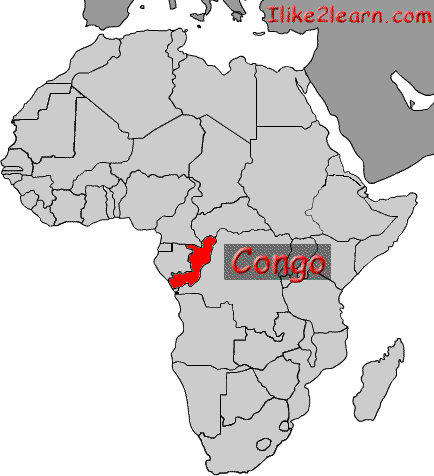 Associated Press – “ROME — A U.N. agency has warned that a livestock epidemic in Congo that has killed more than 75,000 goats is the worst in a decade and is now threatening goats and sheep in neighboring countries.
The disease, called peste de petit ruminants, or PPR, is highly lethal, with an 86 percent mortality rate among goats. It is caused by a virus that is similar to measles in humans.
The U.N. Food and Agriculture Organization said 1 million goats and 600,000 sheep are at risk of contracting the disease. To protect them, farmers have been moving their herds away from infected villages, but that has only spread the epidemic to healthy flocks of animals.
FAO said it plans to vaccinate at least 500,000 animals and will try to limit the animals’ movements.” Source – The Washington Post.
Hawaii: Avian Botulism Outbreak Kills At Least 67 Birds In Kahului
 RSOE EDIS – “Wetland biologists and others involved in managing lands with associated wetlands have been notified by the Department of Land and Natural Resources’ Division of Forestry and Wildlife (DOFAW) of a recent avian botulism outbreak affecting waterbirds on Maui. In just over a week, 67 birds have been found dead at Kanaha Pond Wildlife Sanctuary in Kahului including Hawaiian Stilt, Hawaiian Coot, and Hawaiian Ducks of adult and juvenile stages. The paralytic disease has killed adult birds on their nests, also causing the eggs to be lost. Because botulinum toxin can be produced in most wetlands, and transported to new wetlands by dead or dying waterfowl, landowners and managers, both public and private, are being asked to frequently survey their wetlands for sick and/or dead birds, remove any dead or dying birds from the wetland, and contact local DOFAW biologists for guidance. Earlier this year a botulism outbreak in Hanalei, Kauai resulted in over 300 sick and dead birds being collected by USFWS refuge staff. Additionally, numerous other botulism fatalities have also been reported at wetlands throughout the state. Botulism is a paralytic condition brought on by the consumption of a naturally occurring toxin produced by the bacterium Clostridium botulinum. It is an intoxication rather than an infectious disease. Botulism, type C is commonly found in Hawaiian soils and is NOT dangerous to humans.
Particular environmental conditions in wetlands will sometimes allow this bacterium to produce botulinum toxin; the toxin is then accumulated in aquatic invertebrates. It is consumption of these toxic invertebrates by waterfowl that leads to mortality.” Read more.
Researchers: Some Bird Flu Strains Only Three Mutations Away From A Pandemic
 By Alex Crees, FoxNews.com – “A new study raises concerns that it may be possible for airborne transmissible, human-to-human avian H5N1 flu viruses to evolve in nature.
The study looked at five mutations identified previously in the controversial bird flu studies published in the journals Nature and Science—led by Yoshihiro Kawaoka of the University of Wisconsin and Ron Fouchier of Erasmus Medical Center in Rotterdam, the Netherlands, respectively—which would make it possible for bird flu to spread from human to human.
In those studies, the researchers experimented with bird flu strains to show which mutations would be necessary for the virus to evolve to become transmissible between mammals.
The papers revealed with only five mutations (amino acid substitutions), or four mutations plus reassortment, bird flu can become transmissible between mammals – and potentially humans. Currently, bird flu can be transmitted from birds to humans, but not from humans to humans.
U.S. federal officials initially asked the journals to withhold publishing the papers, based on bioterrorism fears, but relented after an independent panel of experts determined there was no threat to public health.
Now, in an accompanying study, led by Professor Derek Smith and Dr. Colin Russell at the University of Cambridge, researchers analyzed all the surveillance data available on avian H5N1 flu viruses in the past 15 years and discovered two of the five mutations needed to make bird flu transmissible between mammals had already occurred in numerous avian flu strains that exist in nature.
Not only that, but a number of the virus strains had both of the mutations, the researchers added.” Read more.
Flashback: Bioterror Chief: There’s No Way to Stop Leak of Deadly New H5N1 Flu Strain, It’s ‘Going to Get Out’ Eventually – “The bioterrorism expert responsible for censoring scientific research which could lead to the creation of a devastating pandemic has admitted the information ‘is going to get out’ eventually. Professor Paul Keim, chairman of the US National Science Advisory Board for Biosecurity, controversially recommended that researchers be stopped from publishing the precise mutations needed to transform the H5N1 strain of birdflu virus into a human-transmissible version.” Read more.
Canada: Large Number Of Dead Fish Found At Buffalo Pound Lake, Saskatchewan
 By Carter Haydu, Times-Herald – “Noticeable numbers of fish are dying off at Buffalo Pound Lake.
But while the cause of the die-off is yet to be determined, Canadian Co-operative Wildlife Health Centre (CCWHC) regional director Trent Bollinger told the Times-Herald humans and their pets should not be in danger due to the ongoing situation.
‘It’s not a threat to people,’ he said on Tuesday. ‘This is a fish issue.’
Most heavily impacted seems to be yellow perch, which Bollinger said are washing up along the shoreline of the local lake. This is the second year in a row the local lake has experienced a fish die-off event, and researchers are taking samples, testing, and trying to diagnose the cause.
‘It looks like there’s a couple of different things,’ Bollinger said, adding the likely culprit is a bacterial organism causing Columnaris Disease.
‘This is a bacterial disease that impacts a range of fish species.’
Sampled fish at the lake have lesions, and cultured samples suggest Columnaris is the likely cause of death.
For more on this story, read an upcoming edition of the Times-Herald.” Source – Times Herald.
Australia: Mystery Illness Affecting Galahs, Birds Suddenly Unable To Fly
 “Following the mystery deaths of a large number of birds last winter, an equally curious affliction seems to be affecting galahs this year, with a number of mature birds suddenly unable to fly and falling about in what appears to be an unco-ordinated and drunken state.
The symptoms do not seem to match any of the usual listed galah sicknesses.
One of these birds was examined by a vet who could not find anything physically wrong, but suggested a couple of days of rest might do the trick.
A second bird that appeared to be in a similar state was also picked up and the pair were kept warm inside a box overnight and released into a large outdoor cage with feed and water available during the daytime.
After about a week the birds seem to have recovered enough to regain their flight skills although still appear somewhat wonky and not quite ready for release.
A number of dead birds were also seen around town, including in parks, about the same time, although grounded ones that aren’t picked up straight away can quickly fall victim to the cold and predators, including the unkind human kind.
Last year’s large number of galah deaths remained a mystery despite autopsies carried out by a vet and further testing at the Macarthur Institute in Sydney. These birds were found dead in spread wing positions under trees in parks, along the riverbank and in the grounds of the TAFE campus.” Source – Warren Advocate.
 Israel National News
- IAF takes aim at Iranian Space Agency
- Sirens sounding in additional areas in Samaria
- Sirens sounding in northern Samaria and northern Israel
- Missile launches detected towards northern Israel
- Home Front Command releases updated guidelines
- Senior Iranian intelligence officials eliminated
- Iran attempted to down Israeli fighter plane
- These are the areas where schools will reopen
- Sirens sound on the northern border
- Twelve-year-old moderately injured in Eilat missile strike
FrontPage Magazine
- Jeffrey Epstein Tried to Escape to Muslim World Before Arrest
- 2 Islamic Terrorist Attacks in 1 Day
- House ‘Sharia-Free Caucus’ Turns 50
- Iranian Muslim Immigrant DA Blames Muslim Terror Attack on Guns
- We the People Never Voted for Mass Islamic Immigration
- Did Islamic Polygamy Lead to Record $14M PPP Fraud?
- Jihad at Old Dominion University
- Ohio HS Teacher Delivers Bonkers Anti-Trump Rant in Class
- Iran’s President vs. The Revolutionary Guards
- Video: Jamie Glazov Delivers A Wake-Up Call on the Ideological War Waged Against American Values
Gatestone Institute
- 'Trump Derangement Syndrome': The Danger of Hatred Clouding Perception
- Spain's Pedro Sánchez and His Extremist Problem
- Before Pouring Billions into Gaza, Trump's 'Board of Peace' Needs To Ask A Few Hard Questions
- If Saudi Arabia Wants U.S. Alliance, It Must End Support for Sudanese Armed Forces — Aligned with Muslim Brotherhood and Iran — Not Fund It
- UN and EU Condemn the Strike, Not the Regime: Double Standards, Selective Outrage
- Why Fusion Energy Needs to Be American Born – Now More Than Ever
- To Defend the Abraham Accords, Trump Must First Defend the UAE
- A Dangerous Prelude to Trump's 'Board of Peace' in Gaza?
- Make or Break Time for Iran's Remaining Allies
- Tehran Chooses the Samson Option
Middle East – The Jerusalem Post
- Trump rejects Middle East efforts to broker Iran war talks as Epic Fury, Roaring Lion rage on
- IDF kills intelligence heads of Iranian emergency command in Tehran strike
- Iran threatens heavier missiles, ‘upgraded weapons’ as war with Israel intensifies
- Iranian official threatens Strait of Hormuz closure, says war will end only on Tehran’s terms
- Israel drops leaflets with QR codes over Beirut, urging action against Hezbollah
- After French soldier killed in Iraq, will Baghdad stop attacks?
- Hamas urges Iran not to strike neighboring countries, backs retaliation against Israel
- Lebanese ‘Patriotic Officers’ warn army not to confront Hezbollah, fueling fears over army unity
- Shi’ite cells in Gulf states are cooperating with Iran, leaking data, coordinates to IRGC
- US will be 'bombing hell out of shoreline' to get Strait of Hormuz open, Trump says
Earthquakes & Volcanic Activity
- Volcanoes Today, 14 Mar 2026: Santiaguito volcano, Fuego, Soputan, Tangkubanparahu, Merapi, Semeru, Shiveluch, Lokon-Empung
- World Earthquake Report for Saturday, 14 March 2026
- Marapi Volcano Volcanic Ash Advisory: ERUPTION REPORTED AT 14/1629Z EST VA DTG: 14/1640Z
- Aoba Volcano Volcanic Ash Advisory: UNKNOWN EST VA DTG: NOT PROVIDED
- Shiveluch Volcano Volcanic Ash Advisory: VA CONTINUOUSLY OBSERVED IN SATELLITE IMAGERY to 29000 ft (8800 m)
- Mayon Volcano Volcanic Ash Advisory: ERUPTION AT 20260314/1100Z VA CLD UNKNOWN REPORTED OBS VA DTG: 14/1100Z
- Dukono Volcano (Indonesia) activity update Mar 13, 2026 - Continuing eruption
- Great Sitkin Volcano (United States) activity update Mar 13, 2026 - Continuing eruption
- Ibu Volcano (Indonesia) activity update Mar 13, 2026 - Continuing eruption
- Kilauea Volcano (United States) activity update Mar 13, 2026 - Continuing eruption
Islamic Terrorist Network In America

Click For Larger Version


Click To Learn What Makes This An Idol

 MidnightWatcher - Prophecy in Motion
Recent Comments