Archive
President Obama Calls Jesus ‘A Son of God’ Who ‘Knew Doubt’ During Annual Easter Prayer Breakfast
By ICA
1 Thessalonians 5:21, “Prove all things; hold fast that which is good.”
 Reflecting upon the “triumph of the resurrection” of Christ and the “all-important gift of grace”, it seemed good at first glance to hear President Obama taking an apparent step forward at the annual Easter Prayer Breakfast, hosted by the White House yesterday. Knowing that speeches are planned and reviewed well in advance and that words are chosen carefully, it was therefore disappointing to then hear Obama refer to Christ as “a Son of God” — not as the Son of God, the only begotten [unique] Son of the Father — and that Christ was one who “knew doubt”:
It’s an opportunity for us to reflect on the triumph of the resurrection, and to give thanks for the all-important gift of grace. And for me, and I’m sure for some of you, it’s also a chance to remember the tremendous sacrifice that led up to that day, and all that Christ endured — not just as a Son of God, but as a human being.
Unlike President Obama, Scripture never refers to Jesus as merely “a” Son of God. Yes, Scripture declares all who believe in Him to be sons and daughters of God, but Christ is the preeminent and only begotten [monogenēs, “unique“] Son of the living God, a Truth to which every single related reference in the whole of Scripture testifies. It may sound trivial, but often something as seemingly insignificant as the word “a” can be what distinguishes sound Christian doctrine from the kingdom of the cults. Much of what is said can be truth or fall within the pale of orthodoxy, but it is then mixed with “tiny” lies, just enough to poison the meaning and the message. John 1:1, in referring to Jesus Christ as the Word [Logos], declares that “In the beginning was the Word, and the Word was with God, and the Word was God.” Yet the New World Translation used by Jehovah’s Witnesses, for instance, takes John 1:1 and changes the original text’s intended meaning to say that “the Word was a god” and, as such, teach that Jesus is not Almighty God, but rather a “mighty” yet lesser god only.
For like us, Jesus knew doubt. Like us, Jesus knew fear. In the garden of Gethsemane, with attackers closing in around him, Jesus told His disciples, “My soul is overwhelmed with sorrow to the point of death.” He fell to his knees, pleading with His Father, saying, “If it is possible, may this cup be taken from me.”
Jesus was fully man, but He was also fully God. Sure, the humanity that Christ took upon Himself would have naturally allowed Jesus to be tempted (Matt 4:1) or to feel apprehension and physical distress in knowing that His preordained purpose — to die an agonizing death for the sins of the world — was about to be fulfilled. It would have been a Read more…
The Incarnation, Crucifixion, and Resurrection – Is There Anything Else Islam Can Deny About Jesus?
By Jack Smith

I recently came across this website (www.ilovemuhammad.com) as I was doing a web search on the Muslim views of Jesus (see http://ilovemuhammed.com/questions/86-what-does-islam-say-about-jesus-pbuh). The highlights of my entry page were intriguing:
What do Muslims believe about Jesus [pbuh]?
Answer: Muslims revere, respect, and love Jesus. … No Muslim can be a Muslim if he/she rejects Jesus, it is a fundamental of faith for the Muslim to believe in Jesus,… The Quran tells us a lot about Jesus, who he was, his miracles, and his mission.
How can a site named “ilovemuhammad,” state, “No Muslim can be a Muslim if he/she rejects Jesus, it is a fundamental of faith for the Muslim to believe in Jesus”? It is one thing for a Muslim to state that “Jesus is only a prophet [and not the Son of God],” and quite another to state, ”No Muslim can be a Muslim if he/she rejects Jesus…”
As I reflect on what I call the ”dressed-down” version of Jesus that Islam has concocted, the above statement seemed to make sense after all. In a future post, I will discuss Muslim eschatology regarding the return of Jesus. Islamic end-time prophecy includes the descent of Jesus from heaven, along with his declaration that Islam is the one, true, religion, and Christianity is a fabrication by Jesus’ left-behind, over-zealous disciples! But that topic will have to await another post; for now, we will look at Islam’s “dressed down” version of the crucified, risen, Lord Jesus.
We begin with a summary of what the Bible says about Jesus Christ. I will call them the “essentials” of Jesus; however, it is not my purpose to write a theological treatise on Jesus; most of those reading this post will be quite familiar with the essentials that I will summarize. I will provide Biblical support for my conclusions, but my primary point in this post is to address what Islam views about Jesus. Nevertheless, how can you recognize the counterfeit unless you first know what the original looks like? Read more…
Palm Sunday – Why Wave the Palms?
By Jack Smith
We handed them out as people left church thatPalm Sunday– the Branches, that is; long, narrow, Palm Branches.

I had just finished preaching from John 12:12-19, a text familiar to most Christians. The text paints the picture of an expectant and exuberant crowd, most of them waving Palm Branches, as Jesus enters Jerusalem seated upon a donkey; a glorious celebration, no doubt. As my congregants left that Sunday morning, I remember crying out, “Wave your branches high,” as if the higher they were held the more “real” Jesus’ entry into Jerusalem was. But my cry was to little avail. As I reflect now, my congregants were more interested in waving good-by to one another than in waving Palm Branches. The Palms seemed like an after-thought, almost like a party-favor for attending church that day. But that was then, and now is now. Since then, I have learned about the plight of “dhimmis,” and what it meant when the Palm Branches were taken out of the their hands so many years ago. It is my prayer that a little history will make this Palm Sunday one you will never forget.
Islam swarmed the Christian Middle East in the 7th century A.D. much like an infestation of locusts engorging the countryside. The Christian Byzantine Empire was in control of most of the region at that time, having eventually become the religion of the land after Roman Emperor Constantine converted to Christianity in 312 A.D. Historian Ira Lapidus describes the Arabian conquest as follows (see Ira M. Lapidus, A History of Islamic Societies 2nd Edition, p. 32):
In the wake of the battle of Ajnadayn, the Arabs moved against the Byzantine province of Syria. They took Damascus in 636. Baalbek, Homs, and Hama soon surrendered. The rest of the province, however, continued to resist. Only in 638 was Jerusalem taken. Caesarea fell in 640. Finally, in 641, the Arabs took the northern Syrian and Mesopotamian towns of Harran, Edessa, and Nasibin. … The next Byzantine province to fall to the Arabs was Egypt [in 641].
The successful conquest of areas never before under the dominion of the Arabs could only be explained by Muslims in one way — Allah had willed it. Conveniently, Muhammad’s revelations that began in 610 A.D., and were recalled by him until Read more…
The Middle East: A Powder-Keg of Conflict
By Jack Smith

Jews Praying at the Temple Wailing Wall
Ever wonder why the Middle East is always such a powder-keg of conflict? What the roots of the conflict are between the Jews and all her “neighbors”? I got this question recently from a visitor to my book’s website, so I thought I would post my reply for all to read and comment.
Let’s begin with Abraham, the patriarch of the world’s three major monotheistic religions. Abraham left his homeland (Haran) along with his wife, Sarah, to journey to the land God was to “show him” (Genesis 12:1). God’s promise to Abraham was to “make [him] a great nation,” and “bless all the families of the earth” through his obedience (12:2-3). Fast forward to the 16th chapter of Genesis. Sarah, Abraham’s wife was unable to have children (Genesis 16:1-2). So, Sarah took things into her own hands, and gave Abraham her Egyptian slave, Hagar, to wed. Sarah’s plan was simple: any children born to Abraham and Hagar would be Sarah’s (16:2); after all, Hagar was her slave. Abraham was “happy” to oblige. In fact, he never asked God for His thoughts on the matter, even though in the preceding chapter, God had told Abraham that he would have a son (15:5-6). Abraham and Hagar conceived a child, Ishmael (16:4), but Hagar became prideful and “despised her mistress” (16:4). Sarah demanded that Abraham send Hagar away. Once again, Abraham consents to his wife’s demands, but it is Sarah who drives Hagar away. She runs away by way of a desert road to her homeland in Egypt, only to be visited by the angel of the Lord when she is near death. The angel directs her to return to her mistress, Sarah, and to submit to her hand (16:9). Hagar does return, but before she begins her journey back home, the angel of the Lord gives a prophecy about the son, Ishmael:
Genesis 16:12 “He will be a wild donkey of a man, His hand will be against everyone, And everyone’s hand will be against him; And he will live to the east of all his brothers.”
In Genesis 17, God appears, again, to Abraham and tells him that the very next year, Sarah, his wife will bear him a son. Abraham does not believe God, and laughs to himself (17:17). Abraham is 99 and Sarah is 90 years old. God tells Abraham that the son is to be named “Isaac” (literally, “he laughs” in Hebrew); and God will establish his everlasting covenant with him, and his descendants. Abraham “suggests” that God accept Ishmael, instead, as the son of promise; but God rejects Abraham’s idea (17:19). God then makes this promise to Read more…
Muslim Media Caught Using a False, Poorly Written and Qur’an-Contradicting ‘Gospel of Barnabas’ to Promote Islam
“Christian” archaeology undermines the Qur’an. “Jewish” archaeology undermines the Qur’an. Even “Islamic” archaeology undermines the Qur’an. But when it comes to an ideology whose foundations are grounded in deception, the only facts that need apply are those that can be distorted to undermine the Truth …
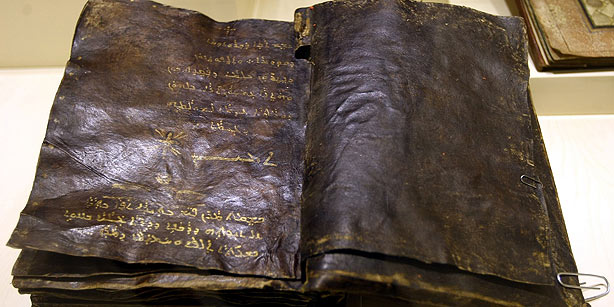 By Peter BetBasoo and Ashur Giwargis – “Much has been made of the recent discovery in Turkey of a Bible purported to be written in the Aramaic language, 1,500 years ago. The Muslim media, as well as Western media outlets, quickly pounced on this, claiming this Bible contains verses attributed to Jesus Christ, in which Christ predicts the coming of Muhammad. No media outlet has published a facsimile of these verses.
This ‘Bible’ is written on leather in gold letters. The picture of the front cover show inscriptions in Aramaic and a drawing of a cross.
For any native speaker of Modern Assyrian (also known as neo-Aramaic), and that would be your average Assyrian today, the inscription is easily read. The bottom inscription, which is the most clearly visible from the published photos, says the following:
Transliteration: b-shimmit maran paish kteewa aha ktawa al idateh d-rabbaneh d-dera illaya b-ninweh b’sheeta d-alpa w-khamshamma d-maran
Translation: In the name of our Lord, this book is written on the hands of the monks of the high monastery in Nineveh, in the 1,500th year of our Lord.
Nineveh is the ancient Assyrian capital and is located in present-day north Iraq, near Mosul.
There are spelling errors that are immediately noticeable.
The first word, b’shimmit maran (‘in the name of our Lord’), is erroneously spelled with a ‘t’ instead of a ‘d’. The ‘d’ in Assyrian is the genitive, and it prefixes the word that follows. It should read b-shimma d-maran, not b-shimmit maran (note, the last word of the sentence is correctly spelled d-maran (‘of our Lord’)).
The first word also contains another spelling error. The correct spelling for ‘name’ in Assyrian is ashma, with the initial ‘a’ being silent. Therefore, when correctly spelled, ‘in the name of our Lord’ should be written as b-ashma d-maran.
The word idateh is misspelled, it should end with an ‘a’, idata. Also the phrase al idateh (‘on the hands’) is incorrect, it should read b-idata (‘by the hands’).
The bottom sentence uses the word ktawa (‘book’) to refer to the book, but in Assyrian the Bible is never referred to as a ‘book.’ One says awreta (Old Testament), khdatta (New Testament), or ktawa qaddeesha (holy book). Given this, since no one has seen the inside of this ‘Bible,’ we cannot be sure if it is in fact a Bible.
Most significantly, this writing is Read more…
The Man of Lawlessness and the Burning of the Qur’an
By Jack Smith
 Behind my desk is a newly framed picture that has special meaning to me. It is a picture of the Dome of the Rock, the Muslim religious shrine that memorializes Muhammad’s “night journey” and his heavenly rendezvous with Allah. Superimposed on the picture are the words, “…only he who now restrains will do so until he is taken out of the way. And then that lawless one will be revealed whom the Lord will slay with the breath of His mouth…” 2 Thessalonians 2:7-8.
It was in my study of 2 Thessalonians 2 that God revealed the first “piece” of the “Islamic Paradigm” puzzle, that is, Islam is the fulfillment of Bible prophecy of an antichrist empire that will rise up in the last days to wage “holy war” against the world (Revelation 13:1-10). The spiritual meaning behind the Dome of the Rock was the first revelation of that Paradigm (see “Introduction, p XI, Islam the Cloak of Antichrist). The Dome of the Rock is not an Islamic worship center, i.e., a mosque. The Dome of the Rock is an octagonal, domed structure that “stands over” a massive rock (“Rock”) located on the Temple Mount in Jerusalem. There is nothing else located within the Dome of the Rock other than the Rock itself, and the marble, columned structure that foreshadows and encloses it.

Marble columns over the Rock
When I began my personal study of Islam in the Fall of 2001, one of the first books I purchased on Muslim Holy War (and, in fact, the only book I found on the specific topic) was entitled, “Jihad,” by Paul Fregosi, Prometheus Books, 1998. The opening Introduction (page 19) states:
The Jihad, the Islamic so-called Holy War, has been a fact of life in Europe, Asia, Africa, and the Near and Middle East for more than 1300 years, but this is the first history of the Muslim wars of Europe ever published. Hundreds of books, however, have appeared on its Christian counterpart, the Crusades, …. The Jihad has been the most unrecorded and disregarded major event of history. It has, in fact, been largely ignored. … In the New South Wales State Library, where I did part of my research while in Australia, there were 108 entries listed in their catalogue cards for the Crusades, but only two for the Jihad! The Jihad has been largely bypassed by Western historians, and this book is an attempt to right the situation, … (Emphasis in italics, mine).
Jihad was published in 1998, three years before 9/11. Fregosi states, “this is the first history of the Muslim wars ever to be published… The Jihad has been the most unrecorded and disregarded major event of history.” Why? Why have the Muslim holy wars not been reported in the same way that the Crusades have been reported? Why so meticulously report on the Crusades and use them as “fodder” to malign Christianity, and report virtually nothing on Muslim holy war? Why have the pens of historians, both American, European, and Muslim omitted the murderous actions of the mujahideen of Islam for almost 1400 years?
In fact, it is embarrassing for me to admit it, but when I first began my study of Islam after 9/11, I was somehow either unaware of it, or had forgotten, that the Middle East at the time of the Quranic revelation to Muhammad (610 A.D.) was predominantly Christian. The land that Christ once walked, the lands that the Apostle Paul planted churches, the entire Middle East, north Africa, Iran, Iraq, and Turkey, were predominantly Christian. Certainly, not a “unified” Christianity, but Christian all the same. In fact, the seven churches of Revelation 2 and 3 were all located in modern day Turkey. Then, jihad occurred. And, Christianity was Read more…
Israel – America – Isaiah & Judgement
By Ray Gano
 Over the past week or so I have been reading Isaiah.
To be honest I am blown away at the similarities mentioned about Israel and then looking at modern day America.
I am not promoting some replacement theology idea or anything like that; but I do believe that when people or nations turn their backs on God, the laws of nature, God’s Law, comes into play.
I am one who firmly believes that our nation was brought about by divine providence. King James, the very same king who put his name to the only Authorized version of the bible, also sent people to “the new world” to spread the Gospel and claim the land for God in the name of His Son, Jesus Christ. This is the basic tenants of the James Town Charter claiming America for His Glory.
We are not God’s chosen people and in no way replace Israel, but I believe we have a special place in God’s plan and because we have remained a Christian nation up until about 40 years ago, God has blessed us immensely.
Our nation has done more to further the gospel, protect the innocent, stood for what was right, and against what was wrong than any other nation. We have defended the weak, opposed tyranny and tyrants.
On July 4th 1776 we declared our freedom beginning with these words…
When in the Course of human events it becomes necessary for one people to dissolve the political bands which have connected them with another and to assume among the powers of the earth, the separate and equal station to which the Laws of Nature and of Nature’s God entitle them, a decent respect to the opinions of mankind requires that they should declare the causes which impel them to the separation.
We hold these truths to be self-evident, that all men are created equal, that they are endowed by their Creator with certain unalienable Rights, that among these are Life, Liberty and the pursuit of Happiness.
At the base of the Statue of Liberty it states,
“Give me your tired, your poor/Your huddled masses yearning to breathe free”
We are a nation built upon the principals of God and His Word.
But somewhere on this journey, our great republic strayed and instead of being good, we have chosen Read more…
Joel Rosenberg: The Handwriting is On the Wall, It’s Time to Prepare Churches for the Inevitable
 By JONI B. HANNIGAN – “JACKSONVILLE (FBW)—The handwriting is on the wall and war between Iran and Israel is imminent, Joel Rosenberg, an evangelical Christian and New York Times best-selling author, told the last session of the First Baptist Jacksonville Pastors’ Conference Jan. 29.
‘War is coming,’ Rosenberg said. ‘You and I are living in an extraordinary moment in one of the most dangerous moments in the history of our country; one of the most dangerous moments in the history of Israel and the Middle East; and one of the most dangerous moments in the history of the church.’
And the question is, ‘Are we ready for what could be coming?’
The popular writer, who grew up with a Jewish father and a gentile mother, shared lessons from Daniel 5 on the future of America and the coming war in the Middle East.
Rosenberg, whose newest book Implosion: Can American Recover from our Economic and Spiritual Challenges in Time is set for release in June, said many pastors are unwilling to speak about the future in terms of Bible prophesy.
For some it’s because prophecy has been ‘sensationalized’ in the past and they resist the ‘cheapening of God’s Word,’ he said. Others might feel unprepared. Some have simply forgotten its power.
‘Prophecy is an intercept from the mind of an all-knowing and all-seeing and all powerful God,’ he said. It is meant to inspire, motivate and encourage. It will lead to repentance, holiness, and prayer and fasting, Rosenberg said, adding that prophecy is about the ‘preaching of the Gospel, making of disciples, planting churches, reaching young people with the Gospel, [and] reaching all people with the Gospel.’
Speaking on ‘The pastor and his future,’ Rosenberg asked pastors, ‘What is it that God is calling you and your congregation to do?’
Sharing examples of escalating tensions in the Middle East and rejecting ‘replacement theology,’ Rosenberg said the physical state of Israel is the Israel about which the Bible refers. ‘God is not done with us, He loves us, He has a plan for us,’ Rosenberg said. ‘God so loves the world, the whole world, that He gave His only begotten Son.’
After a recent trip to the concentration camp at Auschwitz, Rosenberg said he was reminded ‘bombs can do in six minutes what it took Adolph Hitler about six years to do; to kill six million Jews.'” Read more.
Daniel B. Wallace: Seven Early New Testament Papyri Manuscripts Discovered
The more manuscripts we discover, the more the Islamic claim that the Bible we have today was corrupted is silenced. When these texts are analyzed in full they will again confirm what Christians have already known: All Biblical manuscripts and fragments dated even hundreds of years before Mohammed are virtually identical to the canonized Biblical texts we have today. As I pointed out in “A few Simple Questions for Muslim Visitors“, when Muhammad recited the Qur’an he clearly stated that he did not believe that the Bible was corrupt at that time and called upon Christians to adhere to the Scriptures that they possessed. But manuscript discoveries such as these beg the question: Since the Scriptures we have today are the same Scriptures that Christians had even well before the time of Mohammed, when do they believe the Bible became corrupted, who corrupted it, and how was it corrupted? The silence is deafening …
 By Daniel B. Wallace – “On 1 February 2012, I debated Bart Ehrman at UNC Chapel Hill on whether we have the wording of the original New Testament today. This was our third such debate, and it was before a crowd of more than 1000 people. I mentioned that seven New Testament papyri had recently been discovered—six of them probably from the second century and one of them probably from the first. These fragments will be published in about a year.
These manuscripts now increase our holdings as follows: we have as many as eighteen New Testament manuscripts (all fragmentary, more or less) from the second century and one from the first. Altogether, more than 40% of all New Testament verses are found in these manuscripts. But the most interesting thing is the first-century fragment.
It was dated by one of the world’s leading paleographers. He said he was ‘certain’ that it was from the first century. If this is true, it would be the oldest fragment of the New Testament known to exist. Up until now, no one has discovered any first-century manuscripts of the New Testament. The oldest manuscript of the New Testament has been P52, a small fragment from John’s Gospel, dated to the first half of the second century. It was discovered in 1934.
Not only this, but the first-century fragment is from Mark’s Gospel. Before the discovery of this fragment, the oldest manuscript that had Mark in it was P45, from the early third century (c. 200–250 CE). This new fragment would predate that by 100 to 150 years. Read more…
Walid Shoebat: Iran To Obtain Nuclear Weapons, Will Destroy Saudi Arabia
Many Christians, and even Jews, who are paying close attention to recent developments in the Middle East between Iran and Saudi Arabia are now beginning to piece together what the Prophets of old foresaw long ago …
Shoebat: “Israel is in great danger. But I’m not worried about Israel. Yes, it’s in a great danger, but we keep forgetting about the most important element in the Bible: God. God is on the side of Israel. Iran will gain its nuclear [weapons], no question …”
Host: “Wait, can you say that again, because that’s pretty — that’s a big statement. Are you telling me that Iran is going to succeed in developing nuclear weapons…”
Shoebat: “Absolutely.”
Host: “… and then do what. Launch them against Israel?”
Shoebat: “They could launch them against Israel. But remember, the Israelis have the Arrow missile. It could meet any missile coming from Iran mid-way over the top of Saudi Arabia. And if you look at the Bible, remember, the Harlot is destroyed by two entities. By … the hand of My people, Israel, and then you have in Isaiah 21, Arise O Elam to destroy what? Arabia. Elam is Iran. Persia will destroy Arabia. I believe Arabia is the Harlot of Babylon. If you look at the Bible — when you read Babylon in the Bible — all the names of the cities, entities, regions within those [areas of] Babylon in the Bible, you will never find any ancient name of any Babylonian city … Every single vicinity [mentioned in Isaiah 21] is in Arabia. The burden against Dumah. Dumah is in Arabia… Dedan, Kedar, those are all in Arabia. It’s born from Babylon. That’s why it’s called the daughter of Babylon. We need to focus on Saudi Arabia because it is mentioned heavily in the Bible.”
Jeremiah 50:9, “For behold, I will raise and cause to come up against Babylon An assembly of great nations from the north country, And they shall array themselves against her; From there she shall be captured. Their arrows shall be like those of an expert warrior; None shall return in vain.”
Baylor University Medical Center Surgeon Says Human Body Did Not Evolve
 By Brian Thomas, M.S. – “In a recent paper titled ‘Dissecting Darwinism,’ Baylor University Medical Center surgeon Joseph Kuhn described serious problems with Darwinian evolution.1 He first described how life could not possibly have come from chemicals alone, since the information residing in DNA required an input from outside of nature.2
He then addressed Darwinism’s inability to account for the all-or-nothing structure of cellular systems, including the human body. As a medical doctor, Kuhn not only knows the general arrangement of the human body’s visible parts, he also understands the interrelated biochemical systems that sustain and regulate all of those parts. He recognized that the human body contains an all-or-nothing system in which its core parts and biochemicals must exist all at once for the body to function.
Biochemist Michael Behe named these all-or-nothing systems ‘irreducibly complex.’3 Removing a single core part from one of these systems keeps the entire system from working, and this implies that the system was initially built with all of its parts intact.
This is exactly what researchers expect to see if God purposely created living systems, rather than if natural processes accidentally built living systems bit-by-bit—as Darwinian philosophy maintains.
Kuhn cited the work of another medical doctor, Geoffrey Simmons, who described 17 ‘all or nothing’ human body systems.4 These combine with many others to form the entire human body—a system of systems—that is irreducible at many levels, from gross anatomy to biochemistry. For example, just as a woman would die without her heart, she would also die without the vital blood biochemical hemoglobin.
But even an intact heart and hemoglobin need regulation. A heart that beats too fast or too slow can be just as Read more…
Does Psalm 83 Describe The Next Mideast War?
I have also believed for some time that any answer to the prayer of Psalm 83 could only be observed at the conclusion of Israel’s final battle, brought to a decisive and irrefutable end through Divine intervention at the Second Coming of Messiah. It is good to see some prominent pre-trib adherents reconsidering Psalm 83 and any prerequisites needed to satisfy its fulfillment, as pointed out by Richardson below. Now they just need to re-examine the details surrounding Gog-Magog …

By Joel Richardson – “Throughout the Christian church, an idea that has gained much traction in recent years holds that the next major Middle Eastern war is described in Psalm 83. According to this view, a contingent of Arab nations that immediately surround Israel will soon make an attempt to invade her, only to be utterly defeated by the Israeli Defense Forces. Many even believe that as a result of this great victory over her neighbors, Israel will literally come to occupy the nations of Syria, Lebanon, Jordan, Iraq, Saudi Arabia and Egypt. This growing view also holds that after this period of victory and peace, another massive war, this time described in Ezekiel 38 and 39, will follow. If one peruses several of the larger online Bible prophecy discussion forums, it will quickly become apparent just how widespread this view truly is among prophecy students.
But few of these students of prophecy are aware of the many problems with this view. For the past few years, I’ve been highlighting several of these problems, but recently, both Dr. Thomas Ice, the executive director of the Pre-Trib Research Center, and Pastor Mark Hitchcock, another very well-accomplished prophecy teacher and author, have also articulated several of the problems with the popular interpretation of Psalm 83.
The first problem is that most scholars reject the idea that Psalm 83 is even an actual prophecy, but is simply, ‘a national prayer of lament.’ Such a Psalm would not be considered a prophecy in the sense of that which was uttered by the biblical prophets.
Second, even if one does consider Psalm 83 to be a prophecy in the proper sense, the primary reason many have come to accept this two-war scenario is because of the differences between the nations listed in Psalm 83 and Ezekiel 38 and 39. While Psalm 83 lists what are often referred to as the ‘inner circle’ of nations that immediately border Israel, Ezekiel 38 and 39 lists a series of nations that form a larger ‘outer ring’ around Israel including Turkey, Iran, Sudan, Libya and, many argue, Russia. But a closer examination of both texts reveals that it is far more likely that these two passages speak of the same war.
If one examines the list of nations in Psalm 83, few analysts include the nation of Turkey. Yet Asaph, the writer of this Psalm, mentions that ‘Assyria’ (v.8) will join this coalition. When this Psalm was written during the reign of King David, the Kingdom of Assyria included portions of modern-day Iraq, Syria and Turkey. Analysts of Psalm 83 have included both Iraq and Syria in their coming invasion scenario, but never Turkey. Yet the reality is that the Assyrian Kingdom during the time the Psalm was written included quite a bit more of modern Turkey than Syria. This is significant, of course, because
Read more… Israel National News
- Live updates stopping in honor of Seventh Day of Passover in North America
- Chag Sameach!
- Trump agrees to two-week ceasefire in Iran
- UN probe: Israeli tank killed one Lebanon peacekeeper, Hezbollah IED killed two
- NYC teen arrested for threatening to murder Jewish children in Brooklyn
- Middle East official: 'Good news coming' in US-Iran talks
- Iran-backed militia in Iraq releases kidnapped US journalist
- Pakistan PM urges Trump to extend Iran deadline by two weeks
- IDF says there may be an increase in fire toward Israel in the coming hours
- Report: Iran calls off US talks hours before Trump deadline
FrontPage Magazine
- A Tale of Two Rescues
- Why California Budgets Rise Even as Populations Drop
- Jamie Glazov on The Josh Hammer Show: United in Hate
- France: Muslim is ‘Seized by a Momentary Fit of Madness’
- Soleimani’s Niece and Grand-Niece to Be Deported
- India: Muslim Tries Twice to Open the Emergency Door Mid-Flight
- A Soldier of Allah in the U.S. Army
- War on the Cartel Front Continues
- PBS Smears All Republicans as ‘White With Fear’
- The Tucker Carlson We Thought We Knew Never Existed
Gatestone Institute
- Trump and the End of Tehran's Illusion
- Germany's 'National Interest' and Fragile Support for Israel
- The 'New Syria': Same Old
- Same Regime, Different Face: The West's Recurring Mistake in Iran
- A War That Went Awry
- Trump Is Preventing the Nightmare of Nuclear-Armed Iran
- With Friends Like These: America and Its Fake Allies
- Islamic State Weaponising Social Media for Radicalisation: Exploding Threat in the Indo-Pacific
- Egypt's Dangerous Muslim Brotherhood Organization
- A Free World Opportunity
Middle East – The Jerusalem Post
- IDF confirms Lebanon strikes amid uncertainty over ceasefire scope
- Netanyahu refutes Pakistan PM's claims of Lebanese inclusion in ceasefire deal
- Iran violates ceasefire agreement hours after Trump announces truce
- Trump announces 'double-sided ceasefire' between US, Iran following Pakistani proposal
- Preliminary UN probe blames Israel and likely Hezbollah for peacekeeper deaths
- Kuwait, Bahrain push preemptive measures, close bridges as Iran threatens transport infrastructure
- Iraq's Kataib Hezbollah to release abducted American journalist Shelly Kittleson
- Two IDF officers, civilian face indictment in alleged Gaza aid-truck smuggling scheme
- Houthis hold Gulf states from joining US attacks with Bab el-Mandeb Strait trump card - interview
- Iran attacked Saudi Arabia's Jubail petrochemical complex, IRGC says
Earthquakes & Volcanic Activity
- World Earthquake Report for Wednesday, 8 April 2026
- Volcanoes Today, 8 Apr 2026: Fuego volcano, Semeru, Dukono, Reventador, Mayon, Sangay, Sabancaya, Whale Island
- Fuego Volcano Volcanic Ash Advisory: CONT VA EMS OBS to 14000 ft (4300 m)
- Dukono Volcano Volcanic Ash Advisory: VA TO FL100 OBS AT 08/0340Z, EXT E OBS VA DTG: 08/0350Z to 10000 ft (3000 m)
- Sangay Volcano Volcanic Ash Advisory: CONT VA EMS to 21000 ft (6400 m)
- White Island volcano (New Zealand): no eruptive activity over past period
- Sabancaya Volcano Volcanic Ash Advisory: SPORADIC PUFF to 22000 ft (6700 m)
- Reventador Volcano Volcanic Ash Advisory: CONT VA EMS to 14000 ft (4300 m)
- Mayon Volcano Volcanic Ash Advisory: ERUPTION AT 20260408/0115Z FL080 EXTD SW REPORTED OBS VA DTG: 08/0120Z
- Semeru Volcano Volcanic Ash Advisory: VA TO FL150 REPORTED FROM GROUND AT 08/0004Z to 15000 ft (4600 m)
Islamic Terrorist Network In America

Click For Larger Version

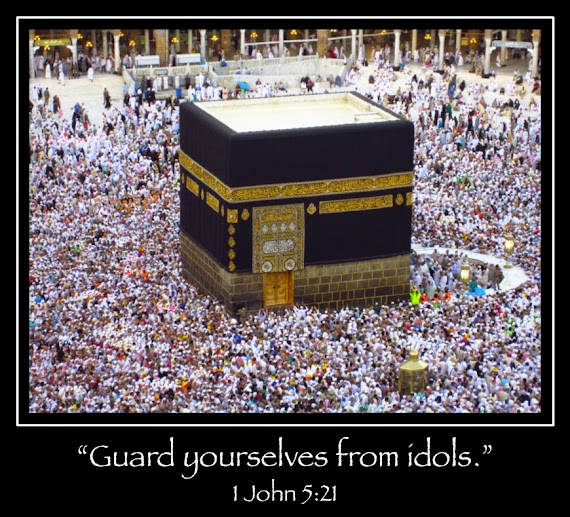
Click To Learn What Makes This An Idol

 MidnightWatcher - Prophecy in Motion
Recent Comments